Friday, August 8, 2014

Historical Food Fornightly

Historical Food Fortnightly Challenge #5

Pies


The Challenge: Pies

I knew exactly what I wanted to make for this challenge. I had two options and one I chose for this fortnight and the other I saved for the next fortnight. 


The Recipe: Great-Grandmother Anna's Shoo-Fly Pie
Shoo-Fly Pie is a molasses pie that is traditional among the Pennsylvania Dutch, German speaking immigrants from southern Germany to Southeastern and South Central Pennsylvania. (The name also refers to their descendants, such as my grandfather).  The pie gets its name from the sweet molasses that attracts flies that must be "shooed" away.  This recipe was passed down from my great-grandmother Anna (an American-born Russian Jew who married a Pennsylvania Dutch boy in 1922) to her daughter-in-law, my grandmother.  This pie is one of my favorites. My grandmother used to make it just for me whenever we visited and I always ate it for breakfast.

Pie crust recipe from my paternal grandmother with help from The Lily Wallace New American Cookbook c. 1947:

3 heaping cups full of flour
1 handful equal to one stick shortening
1 pinch salt
3/4 c. ice water

Mix flour, salt and shortening by hand. Slowly add ice water and combine by hand. Press into a ball and divide into two parts. Chill and roll out until 1/8" thick. Flour rolling pin and roll dough back onto rolling pin and into pie tin. Gently press dough into pie tin and prick all around with a fork. 


Great-Grandmother Anna's Shoo-Fly Pie

2 small pie pans line with aluminum foil
2 bottom pie crusts

Topping:
 1 1/2 c. flour
1 c. dark brown sugar
1/4 c.  shortening (originally lard)

Combine in a bowl and cut with a knife until crumbly.


Filling:

1 c. molasses
1 c. hot water 
1/2 tsp. baking soda

Add 1/2 tsp. of baking soda to water and stir until foams. Measure one cup liquid to each pan. Pour topping in each pan and gently mix it into the liquid to keep it from being too soupy on bottom. Bake at 350 degrees for half an hour.

I also found a traditional recipe that reads nearly the same (we omit the vinegar) in Mary at the Farm (p. 377)

The Date/Year and Region: Pennsylvania, 1915/1920s (dating back to the 1700s and forward to present day, the recipe hasn't changed much)
 
How Did You Make It: 
I followed the directions. I trust my grandmothers!


Time to Complete:  It took about an hour for the dough because I chilled it before rolling. Mixing the pie takes 10 minutes or less and baking took a good half hour or more.

Total Cost:
I had all the ingredients on hand at the time. This is a traditional Amish recipe and they live very simply so it can't be very expensive. 
Current prices:
molasses $3.99
butter $2.89/lb.
dark brown sugar $.99/oz/ 
flour $3.99
baking soda $1.19
shortening $.21/oz
water


How Successful Was It?: 
Moderately. For my first time making pie crust, my crust was a great success. I couldn't get two even balls of dough or even one big one. I ended up with two uneven balls and used the smaller ones for Shoo-Fly Pie. My pies were very full and took a long time to bake. One pie cooked too much and the other not enough. My crumb topping got absorbed into the liquid too much.

They taste good but I'm used to half molasses and half corn syrup so it doesn't taste quite the same as it does when my grandmother makes it. It's still tasty though.

How Accurate Is It?: The original recipes call for lard but I substituted shortening for lard. My grandmother adapted the recipe further and uses half dark corn syrup but I chose to use all molasses.


What I've Read This Week

What I Read in July . . .

Moonlight Masquerade (London Encounters #1)Moonlight Masquerade by Ruth Axtell -- Inspirational Regency Romance

This story of romance and intrigue is set against the backdrop of the Napoleonic Wars. Rees Phillips is on loan from his job as a lowly clerk in the Foreign Office to the Home Office. He has been sent to spy on the young widow, Lady Exham, nee Celine de Beaumont. If he can find proof she's a French Bonapartist spy, he'll achieve a promotion and finally be able to marry. The problem is, Lady Wexham is very very beautiful and very kind. Can he keep his mind on his job and fight his growing attraction to his employer? Lady Celine Wexham is enjoying life as a young widow. Her marriage to a much older man was a disaster and she has no intentions of marrying again. She's been bored with her society life, so when a friend asked her to pass along information, she jumped at the chance. She has a cause she believes in and is willing to risk all to help. She suspects her new butler is not all he appears to be and that they are engaged in a cat and mouse game. She comes to care for this mysterious and handsome. Is it possible to do one's duty to God and country but also love the enemy? Who will come out ahead?

The first and last few chapters of this book are intriguing, but as it took me three nights to finish this book, it just wasn't compelling enough to really grip me. The middle of the book stalls the action to turn into a preachy moral tale debating religion and philosophy. I'm not sure what that's about since I skipped those discussions. They just didn't interest me. Despite the modern language (no one said "hello" in 1813), the period details in this novel are incredible! The author has done an excellent job researching the Regency era and incorporating little ordinary details into her story. She never stops to explain history or objects, something I am very grateful for. A novice to the genre probably should start with another book that's less descriptive, but as a long-time Regency fanatic, I loved the descriptive details. The intrigue in the story kept me wondering what would happen, especially 2/3 of the way through when the plot really picks up. The story is both too long and too short. The middle section is too long and the romantic plot should have been wrapped up in less words and more actions without an epilogue. The epilogue is too slow.

The characters in this novel are hit and miss. I absolutely adored Celine. She's brave, kind, and democratic - everything I admire in a heroine. I loved her so much and I wanted her to be happy. I think her fear at the end was a little out of place. It doesn't take much logic, despite the prevailing beliefs of the day. (Celine's fear is the historically correct opinion). I would have liked an epilogue that tells the reader what happens a few years later. Gaspard, the French chef, is also a good character. He's more than the typical temperamental French chef who usually appears in these novels.

The miss characters are Valentine, the stereotypical ladies' maid and of course Rees, our hero. Rees is a stuffy bore. He's 31, which was middle aged at the time, and never even kissed a woman. That's extraordinarily unlikely given the time period. He spends too much time wondering what God wants, trying to please God and praying. He's just too stiff, boring and religious for me. It seems like the author went away too out of her way to create the anti-rake hero. He improves dramatically in the epilogue, enough to make the ending sweet, but I can't understand what Celine sees in him. He makes a nice change from the rakes but I love the Corinthians with rakish reputations. "I'd like it if he COULD be wicked, but wouldn't," to quote Anne Shirley.


Friday, July 25, 2014

Historical Food Fortnightly Challenge #4 (Part 2)

Historical Food Fortnightly Challenge #4 

Foreign Foods (Part 2)


The Challenge: Foreign Foods


The Recipe: German Pancakes No. 2
Note: makes 1 large pancake


The Date/Year and Region: The International Jewish Cookbook; 1919, New York

How Did You Make It: Exactly as the recipe says. I consulted a modern recipe to find out what a brisk oven meant. I heated the oven to 400 degrees initially and baked the pancake for a few minutes until the edges turned brown and pulled away from the pan. Then I reduced the heat to 350 and baked for about 20-25 more minutes until it didn't look wet. Just before removing from the oven, I stuck a plate in the stove to heat. When I took it out and removed from the pan, I sifted powdered sugar on top and added some sliced strawberries. 


Time to Complete: A few minutes to beat the eggs and mix the ingredients; 30 minutes baking time plus time to heat the skillet and oven.

Total Cost:
I had all the ingredients on hand at the time.


How Successful Was It?: 
Very! It tastes delicious, but a tiny bit salty so I would recommend reducing the amount of salt.  I've had Dutch pancakes at restaurants before and this one is similar but lighter. It was hard not to eat the whole thing myself. It got a thumbs up from the rest of the household but not rave reviews. I will definitely be making this one again, especially since I found the right pan later on.

How Accurate Is It?: Other than using a modern mixer and electric stove and oven, I substituted sweet strawberries for acidic lemons which I do not like at all! It made the pancake more of a dessert and that much more delicious. 


Historical Food Fortnightly Challenge #4

Historical Food Fortnightly Challenge #4 

Foreign Foods (Part 1)


The Challenge: Foreign Foods


By The First Presbyterian Church, Dayton, Ohio.
Dayton, Ohio: Oliver Crook, c1873


The Date/Year and Region: 1873, Ohio


How Did You Make It: 
I grated unsweetened chocolate and a bit of American Heritage Chocolate until I had about 2 T. While I was grating, I melted some sweet butter on the electric stove. Then added the flour, egg yolks, low fat milk (all I had on hand) and eggs. Then I realized I had added to many eggs to scrambled to add more of the other ingredients, which was probably a bigger mistake. Then I put it in the fridge to cool for half an hour. I beat the egg white until fluffy but couldn't get them stiff. I put the chocolate mixture back on the stove to warm it a bit and added the egg whites and sugar, buttered my mom's flan pan and poured it all in. The batter was lumpy and whisking didn't help. I didn't know what temperature to bake it at and a search for a modern recipe yielded nothing. I found a custard recipe that baked at 425 so I tried that. I baked for about an hour before removing from the oven. I refrigerated overnight and then tried to cook it again for about 40 more minutes the next day. The outside got crusty and the bottom stuck to the pan. The middle remained stubbornly wet but better than it was.


Time to Complete:
Forever


Total Cost:
I had all the ingredients on hand at the time.


How Successful Was It?: 
Not very successful. It didn't cook in the middle. After an hour, it finally puffed up but when I took it out of the oven it deflated. The middle was very soupy.  It tasted very eggy and not very sweet. I think my eggs cooked in the mixture on the stove. I should have used my heritage chocolate, but I don't have much left. My dad declared it was not the best thing I've made and no one has touched it since. It tastes much better with the raspberry sauce I made for challenge 2. 


How Accurate Is It?: (fess up to your modifications and make-dos here)
I used 1% milk and an electric oven. I also added more sugar and raspberry sauce.


Sunday, July 20, 2014

What I Read in June Part VII

What I Read in June Part VII . . .

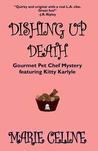
Dishing Up DeathDishing Up Death by Marie Celine -- Cozy Mystery

Kitty Karlyle is a celebrity chef, but not for humans, for their pets. She cooks and delivers gourmet meals to Los Angeles' most pampered pets. She thinks she's seen it all but when she discovers one of her clients, the former rock star Rich Evan, has been found face down in his puppy's food, she's shocked. She's even more shocked when she learns Rich has died and she's the chief suspect! She knows she didn't murder anyone on purpose, but what if she was accidentally responsible by cooking poisoned food? With her friend Velma as sidekick, she tries to find out what really happened. She tries to stay a step ahead of the annoying detective who keeps insisting he's going to marry her. Ironically, business is booming as Rich's best friend and ex-wife become clients and plan to recommend her. Can Kitty solve the mystery before she finds herself behind bars?

I really wanted to like this book. I loved the idea of a gourmet pet chef. I love animals just as much as Kitty and was excited to see her recipes, but she clearly doesn't love them as much as I do because she doesn't seem to know that many cats and dogs can't tolerate dairy and grapes and onions can cause liver damage. Kitty is the perky, perfect girl you love to hate. My feelings didn't go that far because she does love animals, but I found her a little too naive and a little too perky to be truly sympathetic. She wants to believe the best in everyone. The animals were much better characters, especially the puppy Benny. Her best friend Velma is an odd character. I couldn't quite like her either but I appreciated how she had her best friend's back. All of the secondary characters are stereotypes. All of the men are disgusting pigs, even the detective who I could not stand.

This book is a first novel and it reads like one. The writing is simplistic and not very good. The plot is downright dreadful. The story is full of dated 90s references. They're subtle but it's surprising how much technology has changed. (i.e. leaving a message on an answering machine). I liked the inclusion of a research librarian using microfilm instead of Google but that actually dates the story a bit too. The characters all seem to accept the sex, drugs and rock n' roll culture of LA. One character is a sexual predator who nearly rapes the heroine and it's glossed over! She didn't even think to tell the police and apparently it's OK for a male rock star to trick a girl into sleeping with him. He is a downright nasty character. The mystery is impossible to figure out. It goes somewhere random that I never expected. Plot points don't exactly come together and the end is very rushed. I filed this under clean romance because there's some weird random romantic plots tossed in at the end for no real reason.

I wouldn't recommend this book to anyone who likes good literature.

What I Read in June Part VI

What I Read in June Part VI . . .

Miss Quinn's QuandaryMiss Quinn's Quandary by Shirley Marks -- Regency Romance

Miss Larissa Quinn is traveling from the young ladies' seminary where she has spent most of her life to stay with her aunt in the wilds of Westmoreland. When she arrives at an over-booked inn, she declares she is married to ... a stranger, Lord Randall Trent, who was traveling up the Severn on the same boat. Lord Randall knows he's a gentleman and she's safe with him, but what if he wasn't? He can hardly resist the beautiful young woman as it is so when she seems eager for a kiss, he can hardly help himself. Larissa is afraid of living her life without experiences. She is unprepared for how the kiss makes her feel. She's determined to never forget it for it will likely be the only she she ever experiences. He travels on to his Uncle Cyrus, the Earl of Rushton, who decides to sweep Randall up into the world of the haut ton in order to find a new wife. He finds the woman of his dreams, but she needs someone to look out for her ward. Imagine Randall's shock when he discovers that the ward is none other than Miss Quinn! She's a forward little piece of baggage and Randall thinks someone should teach this chit how to go on but it won't be him. He's too busy trying to court the lovely Lady Dorothea Brookhurst. That's fine with Larissa because she is trying to win a kiss from Lord Fenton, who is very slow to come up to scratch. If only she could get the memory of that earth shattering kiss out of her mind. Then, some enemy seems determined to hurt Randall and he is sure to hang if Larissa can't come up with a scheme to save him and bring about a happily every after for all.

This story could have been a funny Heyeresque piece but it failed to meet expectations. The relationship is based purely on feelings and the narration doesn't dig deeply into the characters' heads. I don't really see anything honorable about the way Randall treats Larissa. Despite her forward behavior she is an innocent. The romance is slightly more sensual that I expected from Avalon. I didn't really get Randall and Larissa's relationship. Their story changes from hot to cold and back and forth. I didn't like them together. Larissa is an idiot who innocently breaks almost all the rules and Randall knowingly breaks some of them, yet no one seems to care. The older adults are silly and dim-witted. I figured out who one of the villains was but there were enough red herrings so that I couldn't be completely sure. I wasn't surprised but I was surprised that a certain minor character didn't play a larger role because so much was made about them. 

The Abandoned Rake (Signet Regency Romance, AE 8269)The Abandoned Rake by Emily Hendrickson -- Regency Romance

Joanna Winterton is in mourning for a fiance she didn't love. She feels the ton's sympathy is a little too stifling. The only one who isn't offering kindness and platitudes is the rakish Sir Lucas Montfort. He knows her fiance didn't deserve her. Joanna thinks he's one to talk, for he is engaged to a milk and water miss barely out of the schoolroom. She thinks he needs a bold wife who will stand up to him. Joanna decides to escape London until the gossip dies down. She rents a cottage in the Lakes District with her eccentric, spinster aunt Caroline. When Lucas is publicly humiliated, his pride is wounded and he can't stand the gossip. He decides to go rusticate in the Lakes District, where he hopes for a dalliance to take his mind off things. There he encounters the lovely Joanna. He can't help but tease her but he knows not to dally with a gently bred lady. Lucas's kisses are delicious and Joanna could easily become abandoned if she isn't careful. She knows he isn't serious so she must not refine too much on his actions. He just can't understand why she doesn't dote on him like every other woman he knows. He enjoys the cozy home Joanna and her aunt have made and are kind enough to include him. Then mysterious accidents begin to happen whenever Joanna and Lucas are together. Someone is out to kill one of them, but who would want to kill Joanna or Lucas and why? The pair work together to solve the mystery, coming closer by sharing an experience but Joanna may have to take matters into her own hands if this story is to have a happy ending.

I loved the unique setting for this story. The Lakes District is described so well that I really felt like I was there. It makes the typical plot into something different. The description makes me want to go there. I liked the way the hero and heroine get to know each other. It bothered me at first but as the plot goes on, the relationship develops nicely. The mystery was a bit obvious but kept me wondering why and how it would turn out. It was a little random though. The last third of the novel drags on too long and the ending is a little rushed.

What kept me from really enjoying this novel was the hero. He doesn't have a good opinion of women, which is understandable given his past experiences, but he continually thinks badly of Joanna and assumes things about her that are obviously untrue given what he knows of her. He can't bring himself to think anything different, yet he's constantly teasing her and kissing her and obviously falling in love. His negative thoughts are repetitive and last too long. I can see what Joanna sees in him but I think if she knew what he was thinking, she may not like him so much. 

I really liked Joanna. She's smart, witty, strong and brave. Though she's in constant need of rescuing, she doesn't have hysterics and she knows how to save herself if she needs to. I felt sympathy for her because of her father and she shows readers how difficult it was to be a woman at that time, even for a woman with a moderate fortune. Though I didn't really understand that part of the plot because it didn't seem plausible without some explanation like she's so desperate for attention and praise from her father or he'll withhold her fortune or something along those lines. 

The secondary characters are great. I especially loved Rex, the Border Terrier. Bonus points in my rating are due to him. He needed more scenes and more to do but I'm a sucker for an animal companion and I am obsessed with terriers, so I loved him. I also loved Aunt Caroline. She's a good influence on Joanna and a good role model. She has a disability but doesn't want or need sympathy or pity. I liked her subplot but I'm not sure that was the right direction to take her in. I could have done without Mary. She didn't serve much purpose unless Joanna was going to end up a copy of her aunt.

What I Listened to in June

What I Listened To In June . . .

One Came HomeOne Came Home by Amy Timberlake, read by Tara Sands -- Young Adult Historical Fiction

Thirteen-year-old Georgie Burkhart can shoot as straight as can be without missing, do anything else her grandfather taught her like tracking and hiding, and tend the family store account books. She wants nothing more than to run with family store with her older sister Agatha by her side. In 1871 Wisconsin, that's about all a woman can expect to do with her life if she doesn't marry, and Georgie is NEVER getting married. Agatha, however, has other ideas. She is passionate about natural and would love to go to college and study natural science. She's fascinated by the hoards of passenger pigeons who flock to Placid, Wisconsin to roost. So, when Agatha disappears with some pigeon hunters, everyone assumes she's run off to university. Then the sheriff returns home with bits of a body with auburn hair wearing a blue/green dress - a ball gown Agatha's Mama made. Everyone assumes Agatha is dead, except for Georgie. The one thing she can not do is accept her sister's fate. So she sets off on a journey to find her sister accompanied by the onerous Billy McCabe, Agatha's former beau. Georgie experiences many adventures along the way and lives an entire lifetime in only a few days. will the truth remain buried or will Georgie find out what happened to Agatha?

This is a gripping mystery novel that I had a hard time putting down. At first I kept falling asleep in the car while listening, but I was interested enough in the story to rewind and start again a few times. Once I got into the story, I had to know what happened to Agatha! I thought I knew but the clues kept pointing in so many other directions, I wasn't sure. The last third of the book, after the journey, drags on too long. It's all telling and not much action. It seems kind of tacked on. It takes too long to wrap up the loose ends. There is a lot of humor in the story to balance out the sadness. The violence is a little bit graphic but nothing that really bothered me too much.

The setting is interesting but Wisconsin wasn't exactly the wild west in 1871. I could picture Georgie and her journey easily from the descriptions. I thought there was a bit too much history tossed in randomly. The pigeons are fine but the author's note contains too much about the pigeons. The history tossed in at the end doesn't fit with the story. I know what the author was trying to do but it seemed forced and made the message heavy handed. I also found lengthy passages with metaphysical and philosophical pondering too long and too heavy for the novel. Otherwise, the plot was great.

Tara Sands does an excellent job reading this book. She uses a country twang sort of voice of Georgie, not quite Annie Get Your Gun but close. She sounds like a young teenager. She pitches her voice lower for Billy and uses different voices for the adults Georgie encounters. She's not as diverse as Jim dale but I really enjoyed the voices.

The characters are very memorable, especially the hoydenish Georgie. I can't help but love Georgie. She's so earnest and innocent in the beginning. I didn't understand why she didn't do what she did at the end in the first place but she needed the journey to grow as a character. I really liked her character development. She changes a lot as a result of all she's been through. I liked her best when she was acting stubborn and hoydenish. She was very mean to Billy but I can understand her feelings. She's still a child and thinks like a child at times. I don't know how I feel about Billy. He's a difficult character. In some ways, he's as childish as Georgie and not as smart, but in other ways, he's a responsible adult. Agatha is selfish. I can relate to her dreams and desires and the ambition to go after what she wants, but she didn't behave very well by running off without word to her family. They would have worried even without the body.

I really enjoyed this book that I downloaded from the library without even reading reviews. I definitely recommend this book for people 12+. I think young boys would like this as much as girls. Georgie is a tomboy and there's plenty of action to keep boys interested. Though there's a bit of secondary romance but Georgie isn't interested in boys yet. She does admire Billy's figure as he strips down to his union suit but it's very innocent.