Showing posts with label biography. Show all posts

Saturday, April 5, 2014

What I've Read Recently

What I've Read Recently . . .
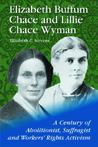
Elizabeth Buffum Chace and Lillie Chace Wyman: A Century of Abolitionist, Suffragist and Workers' Rights ActivismElizabeth Buffum Chace and Lillie Chace Wyman: A Century of Abolitionist, Suffragist and Workers' Rights Activism by Elizabeth C. Stevens -- Non-Fiction/Biography


This slim volume contains a wealth of information on two women who spent their lives fighting for social justice and equal rights. Elizabeth Buffum Chace was born into a Quaker family and came to the abolition movement naturally, as an extension of Quaker philosophy. She became a devoted disciple of William Lloyd Garrison and the radical faction of abolitionists who demanded immediate emancipation of the slaves and nothing less. Her newfound faith in abolitionism caused her to break with the Society of Friends. Her new religion became abolition and it dictated the way she ran her household and raised her children. Her children became budding abolitionists as well. Following the Civil War, Elizabeth took up the "woman suffrage" cause and championed women's right while Lillie struggled to come of age in a new world. Elizabeth continued to fight to woman suffrage and equality for the rest of her life. Lillie went on to right about the plight of factory workers and wrote about social equality, literary matters and the historical figures who shaped her childhood.

This book is packed with information primarily from primary sources. The author examines the Chace women in context of the social movement of their lifetimes. The book goes into great detail about the Garrisonian abolition movement and those who were a part of it. It is also a history of the women's rights movement of the nineteenth century, as anti-slavery and women's rights were combined. The parts about Elizabeth were excellent, drawing on her letters and recollections. Lillie's story is not as easy to uncover and Lillie seems to have struggled in her mother's shadow, wanting to champion social justice but not being able to be as strong or as brave as her mother had been.

The book suffers a little from containing too much information. It's very dense and I couldn't read every word. This book is not for the casual reader. It is an academic book and not a popular history.

This is an excellent academic book for those studying Nineteenth Century American women and reform. I learned a lot, despite studying a lot about the subject. It's also a great history of New England and the spirit of activism that sprang from the Protestant thinking tradition.

Sunday, December 1, 2013

What I Read This Weekend

What I Read This Weekend . . .

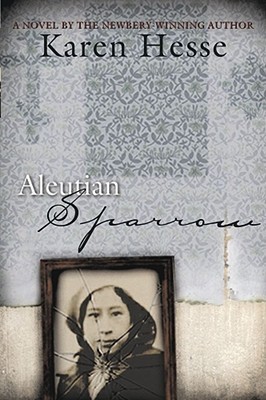
Aleutian Sparrow by Karen Hesse, read by Sarah Jones, and with Harriet Hope -- Young Adult Historical Fiction


Told in Karen Hesse's trademark blank verse, this story is the collective story of the Aleutian people who were "evacuated" from their homes in the Aleutian Islands during World War II "for their own good." In the beginning of the story Vera leaves her home in Unalaska village with Alexei and Fekla, the elderly couple she helps to visit her mother and friends in Kashega, a smaller village southwest of Unalaska. Vera's mother has forgotten the old ways but Vera loves spending time with her mother at Solmon's store. Vera runs with her friends Pari and Alfred as they enjoy the long summer nights. Then our government comes and informs them the Japanese have invaded the Aleutians and the Aleut people must be sent away. The Aleut people are taken away from everything they've ever known - away from the fish and the seals, away from their homes and into a damp, dark forest that breeds sickness along with mold. Vera is strong and determined to survive against all odds. This shocking story is one I've never heard before and it was quite surprising. I didn't know anything about the Aleut people so I really enjoyed the details of their daily lives and culture. I liked the contrast between the two villages and was a bit surprised to discover how modern their homes were (more than many lower 48 homes at that time and even some today). The story was difficult to get through but I had to know what happened to the characters. I had a hard time really connecting to the characters because of the poetic style. I think straight prose would have worked better. As it is, Vera tells the collective story and not much about herself. There isn't much character development except for what we're told is happening and what people are feeling. Though this story is heartbreaking, the will of the people to survive is incredible. I can't even imagine how horrific the situation was and how confused the Aleuts must have been. The mark of a good historical fiction novel for me is when I learn something new and this story accomplished that. I especially enjoyed the oral history interview with Harriet Hope at the end. Though she was only five years old at the time, her memories are sharp and clear. She has been told stories by her older siblings and her mother. Her father, being non-native, was allowed to remain. This makes the evacuation even more shocking. The interview was almost more interesting than the novel. I liked Sarah Jones, the narrator. She sounds like a young girl and when she quotes the elders, she puts on an elderly voice. She didn't have a lot to do except read the text but her voice is pleasing and makes the story flow smoothly. I  highly recommend this book to everyone in 7th grade up through adults. It's a story that needs to be told.


"When Did You See Her Last?" (All the Wrong Questions) by Lemony Snicket and Seth -- Middle Grades Fiction

Young Lemony Snicket is alone in trying to solve the mystery of the missing Ellington Feint, Hangfire and the Bombinating Beast. His chaperone S. Theodora Markson wants to solve the mystery of another missing girl, a Miss Cleo Knight who is a brilliant scientist. Lemony picks up on the fact that her parents seem oddly unconcerned and only the maids are worried about Cleo. Lemony reconnects with Moxie to attempt to solve the mystery of the missing Miss Knight when he stumbles across clues that lead him into a terrifying adventure. This books is much better than the first in the series. I couldn't put it down and I want more NOW! It astounds me how clever Mr. Snicket is. The plot had more twists that I'm sure I can pick up on. There may be references to other things that happened in his future during the ASOUE events. There's also references to his siblings Kit and Jacques. Kit has a subplot featured in this novel. Snicket's trademark vocabulary-building is amazing as usual. I'm very well educated and had no idea what half the words here meant. I also loved the literary references. As for characters I liked seeing Moxie again but she's only in it briefly. She's named Moxie for a reason and it shows in this book. Ellington's character is developed a bit more. She's very complex and I like that. What I don't like are the adults in the story. The kids don't have anyone they can trust because all the adults are really clueless. I know the story is written for kids and I guess kids who feel like they can't trust adults but the evil in this story is too great for children to fight alone. The action sequence at the end is terrifying. The art is different from Bret Helquist's style but it suits the book quite well. It's sort of a film noir throwback. I loved this entry in the series. Fans of ASOUE will too. 

Books identified in the text:
To the Lighthouse by Virginia Wolfe
Harriet the Spy, The Long Secret and Nobody's Family is Going to Change by Louise Fitzhugh
Pippi Longstocking by Astrid Lindgren
The Witch of Blackbird Pond by Elizabeth George Speare
Jane Eyre by Charlotte Bronte
The Iliad by Homer
others I'm not familiar with

Special bonus: photos of Lemony Snicket's associate Daniel Handler at a recent local appearance. He's quite a character and it was worth the two hour wait to meet him. 
Mr. Snicket was supposed to appear but ...

He sent his "associate" Daniel Handler instead

Mr. Handler is quite the character

Mr. Handler is authorized to sign his name to Mr. Snicket's books


Lady Catherine, the Earl, and the Real Downton Abbey by The Countess of Carnarvon -- Biography

Catherine Wendell grew up in New York and Maine as part of Gilded Age high society. Upon the sudden, tragic loss of their family finances, her father attempted a second career but tragically died before he could recover their fortune. Left on the fringes of respectable society, Catherine's mother took the family off to live with her sister in England. Catherine met Lord Porchester, son of the Earl of Carnarvon in London during her season. She found him charming and irresistible. He found her innocence and freshness delightful. They married and went off with Porchey's regiment to India. Before they had a chance to really be properly married, the Earl of Carnarvon died and the young couple had to return to England to take over Highclere. Catherine took delight in her two children that followed and enjoyed socializing with the Duke of Kent and other close friends. Her husband increasingly turned to the pleasures of London in the Roaring Twenties ignoring his young wife. Catherine, feeling lonely and isolated, because increasingly unhappy. The story that follows is not a happy one. It involved infidelity, divorce, depression, and the drama of war. Keep in mind this is NOT a novel and the story is supposed to share a bit of information about the beautiful American-born Countess as a parallel to the TV series. I liked the first few chapters that dealt with Catherine's childhood and early married years. As time went on, the narrative became bogged down with way too many historical figures, most of whom I didn't know and had nothing to do with Catherine's story. The narrative also got dragged down by way too much description of World War II. If I wanted to read about the war, I'd read a book about WWII. There really wasn't enough material on Catherine to fill a whole book. I cared about her and felt sorry about her but got the impression that she wasn't entirely a victim as she appears here. I was more interested in her personal life than the external drama that was happening around her. The Epilogue tells us what happened following World War II and briefly mentions Catherine's death. That should have been a larger part of the story.  My advice is to skim this book or read the beginning and the end. 

Monday, November 11, 2013

What I've Read Recently

What I've Read Recently . . .


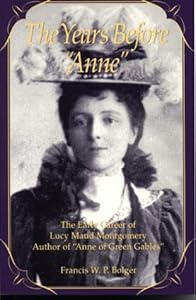
The Years Before Anne : The Early Career of Lucy Maud Montgomery Author of "Anne of Green Gables" by Francis W.P. Bolger -- Biography

This biography of the celebrated Lucy Maud Montgomery was originally published on Prince Edward Island in 1974. In 1991 it was issued in paperback by Nimbus Publishing. This book covers the early childhood and young adult years of the author of Anne of Green Gables up to the publishing of the first Anne book. It quotes heavily from Maud's autobiography The Alpine Path. It also contains previously unreleased material including essays, letters and family photographs. I picked up this book for the primary source material. I own The Alpine Path and have read extensively about Maud and her life including her journals. This book contained some new to me material. I was interested in the personal letters between Maud and her cousin Penzie. They're typical teenage girl letters from a lonely girl to her best friend back home. They give insight into the nature of Maud's mind at that time and how she developed her writing. Also of interest to me were the essays Maud wrote in her teens and early on in her career. It's interesting to see how her writing developed and how she drew on local sources for ideas and then took off with her imagination to create the stories we all know and love. I'm sure most, if not all, this material is included in other volumes about Maud's life. If you come across this book, it's worth a perusal.

Servants' Hall: A Real Life Upstairs, Downstairs Romance by Margaret Powell-- memoir

Margaret Powell relates more incidents from her time in service. When the son of one of her employers runs off with a maid it causes a big to-do both upstairs and down. The master and upper servants are furious at this breaching of class distinctions while Margaret and the younger servants think it's a fairy take come true. Margaret would have jumped at the chance to become a real lady but Rose stubbornly clings to her working class roots, parroting her mother's evangelical religious beliefs and her father's hatred of the ruling class. Margaret and another friend from service, Mary, continue to visit Rose and try to remain friends through the turbulent marriage though never fully feeling comfortable with the situation. Meanwhile Margaret and Mary go out in search of their princes. They kiss a lot of men who turn out to be frogs rather than princes but it doesn't stop them from hoping. Margaret sees service as a means to an end rather than a permanent situation.

I found this memoir more engaging than the first one because it had a central plot rather than a disjointed set of remembrances. I especially liked the upstairs/downstairs conflicts and learning about how people viewed those distinctions and the possibility of moving up in the world. Rose's story is heartbreaking and anything but a fairy tale. I felt sorry for her and I also had sympathy for her husband because Rose was just SO annoyingly stubborn.

For those who like Downton Abbey and Upstairs, Downstairs and wonder what life in service was really like, this book is for you. It's not necessary to have read any of Margaret Powell's other books to enjoy this one. 

Saturday, September 7, 2013

What I Read Recently

What I Read Recently  . . .


Marmee and Louisa : The Untold Story of Louisa May Alcott and Her Mother by Eve LaPlante -- Biography

Many people are familiar with Marmee, the comforting, understanding mother in the novel Little Women. Not many people are as familiar with Abigail May Alcott, the mother of Louisa May Alcott. Abigail came from several prominent Boston families and was born to a generation that didn't encourage women to take a public role. She chafed against the restrictions placed on her and longed to be educated. After marriage and death took her sisters and eldest brother away, she became close to her surviving brother Samuel Joseph May. Samuel Joseph was an educated, enlightened Unitarian minister who championed anti-slavery and women's rights throughout his long life. He influenced his sister to learn to think and write down her thoughts. When the handsome young peddler turned philosopher A. Bronson Alcott came to visit Samuel Joseph, Abigail became smitten. She thought at last (at 30 years of age) she had found a man who would be her true partner in all things. Together they would teach school, influence young children and change the world. That turned out not to be the case as Bronson was too traditional to allow Abigail a role outside the home, too noble to work at a job that would support his family and too radical for New England in the mid-19th century. While Bronson struggled to teach his philosophy, Abba was left home to care for her children and make a comfortable home the best she could with no resources and failing health. Her second daughter Louisa was her favorite child. Out of the four surviving children Louisa looked and acted the most like her mother. Louisa, energetic, proud and ambitious followed her mother's example of keeping a diary and longed for the day when she would be able to support her family and allow her mother a rest. Louisa and Abba championed anti-slavery and women's rights. They believed women could be equal to men in all things. Success came eventually, but it took a toll on Louisa's physical and emotional health. Both of these amazing women died before they could fully see the results of their efforts to gain women equal rights.

This new biography, by a relative of Abigail May Alcott's pieces together a story largely from forgotten primary sources. After Abigail died, the family burned her diaries and many of her letters. Bronson edited and copied over other papers and so scholars believed there was nothing from Abigail herself. As a librarian and historian, I appreciated all the hard work Eve LaPlante did to locate personal papers of the Mays and Alcotts. She did an amazing job compiling information and adding to the body of knowledge that already exists. The book is easy to read and well-written. The story of Abigail's early years is fascinating. I knew a lot of the rest from reading books about Louisa and visits to Orchard House, but I still learned a lot from reading Abigail's own words. I have always admired Louisa and now I know how she came by passions for writing and social justice. Abigail must have been a saint and I admire her greatly now. The book made me hate Bronson. I think he must have been a narcissist. The story of Abigail and Bronson's marriage is heartbreaking. (Yet I'm glad because it gave Louisa the drive to succeed and gave us Little Women, etc.). There's an extensive bibliography in the back containing lists of primary and secondary sources. I've read many of the secondary sources in my own research and some are a bit outdated but important scholarly works. I highly recommend this book to Louisa May Alcott fans and scholars of nineteenth century women's history. 


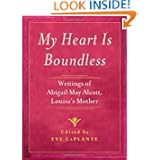
My Heart is Boundless: Writings of Louisa May Alcott's Mother edited by Eve LaPlante 

This collection of journal entries, letters and recollections from previously undiscovered and unpublished collections reveals the true character of the real life Marmee. Abigail was a headstrong, intelligent, warmhearted woman who had lofty ideals and big dreams but suffered terribly through her husband's inability to support her family. She seems to be the prototype for Jo March. She was a loving mother and devoted sister and wife. Her letters are poignant and beautifully written. Abigail had radical ideas even for today. She was passionate and dedicated to her causes and her personal educational philosophies. Her devotion to Bronson was a bit irritating. She believed in him and his "genius" and was sympathetic to his unwillingness to work at a position that went against his philosophies. She realized too late that he wouldn't support their family and did all she could to work for money. Yet, she was torn between working outside the home and staying with her children, which is something I think many modern mothers can relate to. This collection is short but captures the essence of Abigail's life. I really appreciate the research that went into this collection. I wish there were facsimiles of the original letters though. This book is well worth a read for mothers, Louisa May Alcott fans, those interested in Transcendentalism and women's rights. I loved getting to know the woman who raised one of my favorite authors. It's easy to see how much Louisa loved and admired her mother and this collection will show you why. 

Thursday, January 5, 2012

Georgette Heyer: Biography of a Best Seller

Georgette Heyer: Biography of a Best Seller
by Jennifer Kloester

I received this lengthy biography for Christmas. I believe it was purchased through an Amazon reseller.

Miss Heyer was born in 1902 to an upper middle-class British family. She loved to watch the stage coaches come rolling down the street, an image which stayed with her for the rest of her days and helped her Regency world come to life. A bright and imaginative child, her parents allowed her imagination to run free and her father encouraged and influenced her story telling. At the age of 19 she published her first book, written to amuse her invalid brother Boris. She published one or two novels a year almost every year for the rest of her life. Her early marriage to George Ronald Rougier and the birth of her son Richard did not hamper her career. Her husband was supportive and even helped shape the plots of her early mystery novels. Miss Heyer's early novels were contemporary and dealt with the issues of a woman's place, marriage and other topics of the day. Her fun mystery novels paid the bills and allowed her the freedom to research for her historical novels. History was her true passion and by the 1930s, she was writing nearly exclusively Regency novels. Miss Heyer was notoriously reserved and very private. She almost never gave interviews and was very demanding in regards the the publication of her books. She was conservative, snobby and prejudiced by modern standards though she was very much a product of her upbringing in that time and place. She admired and idealized the Regency era and drew her world from her own memories of the Edwardian era and extensive research. Her attention to detail and ability to bring characters to life made her books instant best sellers. Her death from lung cancer in 1974 was a great tragedy in the world of literature.

Ms. Kloestner built on a previous work by Joan Aiken Hodge to create a complete picture of the life of one of the 20th century's most prolific and beloved authors. Ms. Kloestner interviewed Miss Heyer's son, friends and others who knew Miss Heyer well. The biography is also drawn from archival sources (my favorite!) such as private correspondence and publishing records. The biography is well-written and the writing style is accessible to anyone. Though it is long, it moves along quickly, at least if one doesn't ready every word! The book goes into great depth, almost too much at times, about the life of Georgette Heyer and those who were close to her. Ms. Kloestner quotes extensively from Miss Heyer's correspondence and the back of the book includes lists of Heyer's novels, short stories and Ms. Kloestner's sources and acknowledgments. There is even a section of photographs, many never before seen from private family archives. I am very impressed by Miss Kloestner's research and think this is a wonderful biography. Short of any new information that comes to light in the future, there can never be another book about Georgette Heyer equal to this one. I highly recommend it to those who want to know more about their favorite author.