Showing posts with label Regency. Show all posts

Friday, March 17, 2017

What I Read in March 2016 Part IV . . .

What I Read in March 2016 Part IV . . .


Jane and the Waterloo Map (Jane Austen Mysteries, #13)Jane and the Waterloo Map (Jane Austen Mysteries #13) by Stephanie Barron--Historical Mystery/Austenesque

While Jane is in London attending to the proofs of Emma and nursing her brother Henry, she is brought to the notice of Mr. Baillie, a Court Physician, who in turn brings her to the notice of such a person as the Prince Regent himself! Prince George and his daughter Princess Charlotte are big fans of Miss Austen's novels and Jane is invited to view the Regent's library with James Stanier Clarke, a clergyman and historiographer. While there, she discovers a man lying paralyzed and ill. While Mr. Clarke runs for help, Jane is left to clean up after the sick man and attend to him. Later, after the man has died, she is shocked to discover yew leaves in the handkerchief. If the man, Col. MacFarland, a war hero, vomited yew leaves, then surely someone must have poisoned him. Jane wonders whether the mysterious death has to do with his final words to her "Waterloo map." Indeed, Jane discovers the presence of such a map hidden in the library. It's a watercolor of the Russian front with a cypher on the back. Jane knows of only one man who can help solve the mystery, Mr. Raphael West. Mr. West is busy attending his ill and aged father, the famous painter Mr. Benjamin West, but not too busy to assist Jane. Together with the help of Col. MacFarland's former batman Spence and Jane's niece Fanny, they endeavor to solve the mystery.

This story starts off a little slow even after Jane discovers Col. MacFarland. It didn't get really good until about halfway through the book and then I couldn't put it down. I had an early guess as to who the villain was but played along and followed the clues as Jane uncovered them to another person. It seemed I was wrong and Jane was right. Then it seemed I was sort of right, but I was proven wrong again. I never guessed who the villain actually was. The reader can not guess the motivation without knowing the cypher so that made it extra difficult. There are so many twists and turns in this story that make it a fun adventure. Then there's also a mild romance between Fanny and the surgeon and of course Jane and Mr. West. Jane is wary, given her broken heart and Mr. West's time is not his own. Sadly, we know dear Jane only has a year and a half left to live but I hope Ms. Barron can squeeze in another adventure or find some way to continue the series. I have enjoyed Jane's adventures in detecting.

There are a couple of real life figures who appear in this novel and several made up. Among the real people are Mr. Clarke, a Mr. Collins-like clergyman who presumed to tell Jane how to write. He's very amusing and her letters to him are full of patience but you can tell she was laughing at him. There's also Mr. Baillie, the physician who brought her to the notice of the Regent. He seems like a good doctor. We don't know much of his personality. Jane, of course, is the central character. The character Jane seems in keeping with what we know about the real Jane Austen and the author had letters from this period to draw on and quote from. I'd like to think that the author captured Jane's feelings correctly but we will never know. She's certainly a sympathetic character and with the events that transpired to cause her worry at the end of the novel, I feel more in sympathy with her. Being a nearly 40-year-old spinster is not easy in any time, but was especially difficult in the 19th century.

Raphael West is an in-between character. He existed in real life but not much is known about him. Stephanie Barron portrays him as kind, caring and intelligent man. He's not as brooding as The Gentleman Rogue but he does have burdens to bear and as such, the relationship can not be. I like how this introduces a romance but as we know, Jane never married, so the complications work out with real life history. They're also incredibly realistic complications that could have prevented someone like Jane from marrying someone like Raphael. The characters here feel like real people because of their real life concerns.

As for fictional characters, we have Spence, the old batman. He's a hardened campaigner and loyal to his master. He is frustrated by the lack of understand his master's sister and her betrothed have for him, despite Lieutenant Dunross also being a veteran. Dunross is not a likable character. He's brusque and mysterious. We don't know why he was forbidden to marry MacFarland's sister and it is suspected that he has a shady past. Miss MacFarland is also not a likable character. At first she seems admirable, standing up for herself when callers are refused, but then she turns off Spence without a character and makes plans to marry Dunross. However, Barron's skill is in writing a good mystery and these characters are mixed up in the mystery somehow, some way and we only see the characters from Jane's point-of-view and what she's been told by others. We are never in their heads so we don't actually know what they're up to.

I wouldn't recommend starting at the end of the series. I would start at the beginning or start with the previous mystery and then read this one.

Wednesday, November 9, 2016

A Trip to JASNA AGM 2016 : Pre-Conference Part II

JASNA AGM 2016


Satisfy Your Sweet Tooth: A History of Sugar and Dessert


I was lucky enough to get a spot in this talk by food historian and historic foodways consultant Joyce White. Sugar and sweet desserts evolved over time from Medieval England to the Victorian era when desserts became closer to the modern sweets we enjoy today. In Medieval times, sweets were incorporated into the meal. Sugar came from sugar cane and was expensive so honey was more widely used. In the 14th and 15th century sugar-coated seeds and flowers, known as dragĂ©es or comfits, were common eaten. We had the opportunity to try candied violets, which taste very floral. Too much for me. 

Sugar was also used for medicinal purposes. It balanced the humors, especially when combined with vinegar. Sugar and spices were blended with sugar and eaten at the end of a meal to aid digestion. Crystallized ginger was also eaten as a digestive aid. I tried a nibble and it wasn't bad. A larger bite packed a real punch. Eater beware! Sugar coated fennel seeds were eaten 
We also tried sugar coated fennel seeds. Those were actually good. They taste just like crunchy Good and Plenty candies. They must be the forerunners of that type of candy.

Gingerbread was another popular sweet beginning in the medieval period. It was literally ginger bread-made with boiled honey, breadcrumbs and sometimes ground sandalwood chips added for color. This is not the rich molasses gingerbread we know today and it doesn't taste like it. Joyce White's recipe is a transliteration of a medieval recipe. By the 16th century, the honey was replaced by molasses and breadcrumbs with flour. In the 18th century, chemical leavening agents were used in baking.

Before marmalade became common in the 19th century, quince paste was the equivalent in the 16th century. Read more on A Taste of History. I did not like this at all. It smelled strange and tasted as bad as it smelled. It wiggles like Jell-O. I don't eat wiggly foods so after a tiny bite, I passed this one on to my relatives.

Starting in the medieval period, no banquet or dinner party was complete without a fashionable sugar sculpture, known as sotiltees (or subtleties).. Like ice sculptures today, but significantly more ornate, these served as centerpieces on the table. They were 3D objects or scenes made to be admired while food was served around them. Food historian Ivan Day has some magnificent photos of his creations on his blog. These remained popular into the Victorian period.

In Jane Austen's time, small cookies made with currents and flavored with wine, rosewater and/or orange water were popular. Joyce White chose to make Barnet cakes. 

Ices and creams of all kinds were popular with Georgian and Victorian diners. Ice cream was a rare and expensive treat until the Georgian era. 

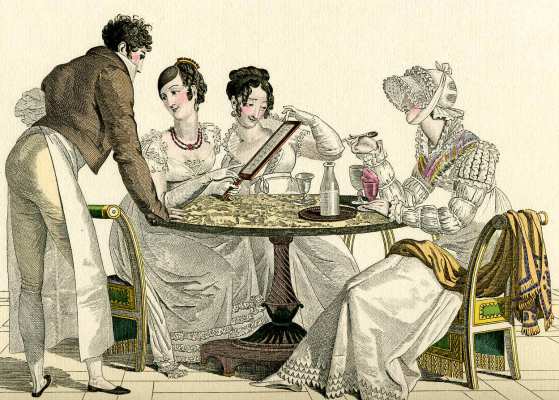
Regency era people enjoyed eating ice at a confectionery shop. 

You wouldn't find ice cream like in a modern ice cream parlor but something more like Italian ice or gelato in flavors that seem unusual and exotic to us, like parmasean cheese, alongside normal flavors like lemon. Ice could be molded into fancy shapes for a dinner or ball. The ice cream making device, known as a sabotiere, differed from a Victorian ice cream maker in that it lacked a crank. The sabotiere was placed in a bucket surrounded by ice and salt and then the cream was hand-turned. 


The ice cream was flavored with natural flavors like berries, spices and rosewater.
Creams could be fancy molded confections or flavored whipped creams.
As technology advanced and sugar refining become easier, desserts evolved into the modern sweets we know today.

This was a great presentation with some unusual historic sweets to try. 

Sunday, October 2, 2016

Play Review: Arcadia

Arcadia

by Tom Stoppard


all images c. Sandra Feinstein Gamm Theatre

I recently had the pleasure of seeing a local theater company's production of "Arcadia" by Tom Stoppard. This tragi-comedy set at Sidley Park in Derbyshire, England, has a dual narrative. In 1809, thirteen-and-ten-month old Thomasina Coverly questions her tutor about "carnal embrace." It seems the servants have been gossipping about Thomasina's tutor, Septimus Hodge, and his relations with a guest in the home, Mrs. Chater. Septimus distracts Thomasina by setting her complicated mathematics problems I can't even begin to understand or explain. This leads the precocious young scholar to ask even more complicated questions I can't explain, but you can read the play or look it up. Suffice to say, she understands advanced math and science and works on a theory that wasn't proven for almost 200 years after her time. Meanwhile, Septimus must dodge the wrath of Mr. Chater, a poet and guest in the home and somehow Lord Byron is also involved. Lady Croom is engrossed in redesigning the estate in the picturesque style in the manner of Capability Brown (my comments on this follow).

In the late 20th century at Sidley Park, scholar Hannah Jarvis, who wrote a bestselling but critically panned book on Lady Caroline Lamb, is currently studying the elusive hermit of Sidley Park. Byron scholar Bernard Nightingale gate-crashes to investigate a little-known gap in Lord Byron's life and discover the reasons Byron left England in 1809. What they think happened and what actually happened are slowly revealed as the scenes shift back and forth through time. Lord Croom's heir, Valentine Coverly is a mathematical genius, on the verge of an important breakthrough while not-so-secretly pining for Hannah, who is too dedicated to scholarship to have time for romance.

The play is cute and funny in parts. My companion, mini Jane Austen, found it quite witty.
                                                     

She especially enjoyed the references to gothic novels (Maria Radcliffe, Horace Walpole), the picturesque, Capability Brown and the ha-ha. She is certain the author of this play must have read her novels, especially the one she titled Susan but is known as Northanger Abbey. She also liked some of the Byron references but thought no one really cared about the scandalous relationship between Byron and Lady Caroline Lamb. I think I was the only one who actually understood what the characters were talking about! This is a play for Janeites and Regency devotees.

My human companion and I thought the play went on a little too long and some of the references were way too obscure. I thought the landscape design planning went on too long and was too obscure for most people. It was played for laughs and people found it funny because of the characters' actions and words but I'm not sure they really knew who Capability Brown was or what the picturesque was. 


The mathematical theories and whatever it was were way way way too complicated and it went on too long. I understand Valentine's study of grouse. That makes perfect sense. Thomasina's questions about jam stirred into rice pudding and heat make some sense and it all came together in the end, but went on too long. It could have been trimmed a bit.

The characters are quirky and fun. Young Thomasina Coverly is cute and charming. She has a brilliant mind but like every teenager, is curious about love and relationships.


She is loosely based on Ada Lovelace, the only legitimate daughter of Lord Byron, who is considered the first computer programmer. I can imagine Ada heard gossip about her Papa and had a lot of questions, like Thomasina. She is closer to her tutor, Septimus, than her own family. Her parents are taken up with shooting, landscape design, love triangles, and of course, how long until they can marry Thomasina off. They are worried she will be an unmarriageable bluestocking. Septimus tutors Thomasina with patience (most of the time) and humor. He answers her questions and understands her brilliant mind needs to be exercised. In the end, she outdistanced even his own brilliance. Thomasina is quite the main character in this show. At first I didn't think Septimus was going to be a likable character because he seemed to be a rake, constantly being caught in "carnal embrace" with one lady or another. He, like his pupil, has a brilliant mind and as the story goes on and Thomasina gets older, I grew to like him a lot. He may be schoolmates and friendly with Lord Byron and have learned a thing or two about "carnal embrace" but he is not Lord Byron.

The secondary characters in 1809 are not very likeable and hard to keep track of. Mr. Chater is a (bad) poet and apparently as good a husband as he is a poet. He seems a bit pompous and a toned down version of the type of character Jane Austen liked to skewer (Mr. Elton, Mr. Collins). His wife is always unseen but her other paramor, Captain Brice, RN, appears once in awhile to cause trouble. He is the villain of the piece in a sense.

The modern day characters are not all that likable either. I did relate to Hannah Jarvis, a scholar who deals in facts and has no time for frivolity and no patience for the pompous Bernard Nightingale. Something about him reminded me a bit of Mr. Wickham, as played by Aidan Lucas in the 1995 adaptation. He was also the type of character Jane Austen would enjoy writing.


The Coverly family consists of Valentine, the mathematical genius; Chloe, a young lady, older than Thomasina, but also interested in romance and "carnal embrace." Finally, there's Gus, the silent younger son, who appears to have autism. The young actor seemed to have the mannerisms of a child with autism anyway. I also think Valentine also had autism. He is a mathematical genius singularly focused on his study of grouse. He is socially awkward and jokes about Hannah being his "fiance."

The acting was excellent. There were some veteran actors in the show, but I felt that the younger actors did a better job. The stand out was Grace Viverios as Thomasina. A senior in high school and veteran of youth theater, she portrayed all the innocence and sweetness of the younger girl on the cusp of womanhood. She made Thomasina funny and charming. Though Thomasina's brother only appears in the end, the two interacted like siblings and played off each other well. The weak link was Deb Martin as Lady Croom. She overacted the character. Her gestures and movements were too over the top, especially for a Regency lady, and I was in the last row of the small theater. That style probably works best in a larger theater but in a tiny, almost black box, it was too much- almost like she was acting the part of a Regency era actress. Their faux English accents were pretty decent but they spoke much faster than BBC actors.

Now for my critique of the history... Being a Janeite and a Regency history amateur scholar, I nitpicked the history behind the story. I don't understand what on earth Thomasina was studying but I can critique the rest of it; aide from the anachronism of a young lady studying with a tutor, I'll let that pass since she is loosely based on Ada Lovelace.

The story revolved partly around the "Picturesque" movement, giving the play the name "Arcadia."


However, the story takes place in 1809 and Lady Croom wanted her park done in the manner of Capability Brown but also in the style of a gothic novel. It's my understanding that Capability Brown was the anti-gothic novel designer. The "beautiful grounds at Pemberley" that so attracted Elizabeth Bennet were done in a more natural style, probably by Capability Brown. I think the playwright confused Humphrey Repton and Capability Brown's styles. Also, the story, taking place in 1809, relied on styles popularized in the previous century. I thought by 1809 the fad for hermits and grottos and follies was over. I think I was the only one who was confused by the contradiction!


I was also the only one who laughed at the references to the popular Gothic novels of the 18th century. I LOLd at the Maria Radcliffe reference-I think I was the only one who understood exactly who the authors were and what the novels were about, though I've never made it all the way through. (I did try Mysteries of Udolpho but couldn't get into it). The play is about the end of the Enlightenment vs. the Romantic period. I didn't quite get the connection to the gothic novels and the romantic period. That's nitpicking.

The 19th century costumes were gorgeous! Lady Croom especially had an amazing wardrobe. Thomasina's dresses were beautiful and simple - just right for a young lady. My only quibble is that she wore her hair up the whole time. It would have made it easier to tell the passage of time if her hair was down and then later up. The gentlemen looked pretty good. The costume designer must make allowances for the theater and the ease of dressing so ignore the zippers down the backs of the boots and the looser fit than was fashionable. They weren't dressed in the finest fashions but Lord Croom is not seen and prefers country life to town anyway. 

It was a good play despite being too long in parts and not fully comprehensible. I will have to read the play so I can go slowly and digest it. 

Monday, January 25, 2016

What I Read in May 2015 Part VI

What I Read in May 2015 Part VI ...

For Freedom by Kimberly Brubaker Bradley--Young Adult Historical Fiction

For Freedom: The Story of a French SpyThirteen-year old Suzanne David of Cherbourg, France is concerned mainly with her music studies. She wants to be an opera singer as soon as she is old enough. Her best friend Yvette may tease her about music but Yvette understands Suzanne like no one else. They're only vaguely aware that France and England are at war with Germany. Then one terrible day, Suzanne's life changes forever. Suzanne must have the courage to deal with what comes and stay strong through the long years that follow. She then finds a way to use her gifts for a good cause.

The dedication is kind of a spoiler but even so, I couldn't put the book down. I could have sworn I had read this before, but nothing seemed familiar. The plot is a little slow at first but then moves into heart-stopping territory. The author doesn't hold back from the gritty details of what war was actually like. This book made me realize what a friend's grandfather must have gone through living in Nazi occupied France. The story made me mad and sad at the same time. I felt every emotion with Suzanne. This is a good book for anyone 13+ to learn about WWII and some of the terrible atrocities committed and some of the heroes that turned tragedy into triumph.


Of Noble Family (Glamourist Histories, #5)Of Noble Family by Mary Robinette Kowal--Historical Fantasy

Jane and Vincent have spent a happy winter in Vienna with Jane's family. The arrival of Melody's baby, Tom, has brought joy to all their hearts. Then Vincent receives some surprising news which leads Jane and Vincent to the West Indian island of Antigua. Upon their arrival, the learn a shocking secret which will upend their whole lives if they don't stay alert. With a growing sense of foreboding and Vincent not behaving like himself, Jane knows that only she can intervene and manipulate and master manipulator into letting them have their way.

Where do I even start with this review? I don't even know how many stars to give the book because I experienced so many emotions through it. At first everything was going well and it was so nice to see Vincent relaxed and happy. It was a refreshing change from his depression in the previous book. Then once they arrive in Antigua everything changes. The book takes a serious look at slavery and race and issues. Obviously, property in the West Indies means slavery and slavery means encountering gruesome facts and learning to navigate the bizarre world where one's half sibling can be a slave. Jane and Vincent's attitudes reflect our modern values more than the typical opinions of the time. The neighboring planters are more in line with the status quo. Vincent's past, of course, makes him more empathetic to the slaves but as he readily admits, he can't really know what they're going through. I took a graduate seminar on slavery and the discussion about low birth rates sounded familiar and the author acknowledges in her note on history than she fictionalized the reasons for that statistic. Other than one fictionalized element, the rest sounds pretty accurate and it's not for the squeamish. The story isn't all that violent, comparatively speaking, at least reading it. If it was a movie, it would probably be rough to watch. Jane and Vincent's modern attitudes left me conflicted. While I agree with them, I'm not certain they're behaving entirely 19th century.

The second most discussed subject in this novel, also not for the squeamish, is childbirth. I learned way more than I never wanted to know about childbirth practices in the early 19th century. 

Thursday, July 3, 2014

What I Read in May Part V

What I Read in May Part V . . .

Quiet Meg (Regency Trilogy, #1)Quiet Meg by Sherry Lynn Ferguson -- Regency Romance

Charles Cabot is a landscape architect. He has more commissions than he has time for, but he couldn't help but accept one from his old school friend Bertram Lawrence. The Lawrence's estate is going to be a bit of a challenge because everyone wants something different. Sir Eustance, Bertram's father, is confined to a wheeled chair and Charles has grand plans to make the grounds more accessible, which pleases the old man. He manages to convince Bertram to accept the changes and Bertram's little sister Lucy, about to have her come-out, appears to be infatuated with him. Charles wants nothing to do with the spoiled beauty. He is, however, intrigued by the one member of the family he has never met: Miss Margaret Lawrence. She seems to share his passion for landscape design for the kitchen garden she designed for Cook is incredible. When he learns that Meg has been the victim of harassment by the wealthy and powerful Earl of Sutcliffe, her plight brings out his protective instincts. Then he finally sees Margaret and tumbles head first into love. He knows he shouldn't, for the last man who dared to love Meg paid dearly for it. At last Meg returns home from living in seclusion with her elderly aunt. She's disconcerted by having a stranger in the house, especially one so handsome and clever. She can't help being attracted to him, though she's terrified of what will happen if Mr. Cabot returns her feelings. She can only hope that Lord Sutcliffe has forgotten her. Alas, it seems that he has not and is still determined to possess her at any cost.

This story is vastly different from any other Regency I've ever read. It more closely resembles Phantom of the Opera. (Yes, girls, the Phantom is a psycho maniac murderer determined to have Christine). The plot takes many different turns which differ from Phantom. Phantom is of course a crime novel with a Gothic plot but the basic idea is the same. I stayed up long past my usual cut off time finishing this book. This story is also unique because the story opens with the hero's point-of-view and the heroine is discussed, but doesn't appear, for a couple chapters. The story is truly unpredictable. The plot moves in a different direction than the one I thought it should go in but I think my way would not have solved the problem. I didn't like the romance so much. It begins with love at first sight, which I don't like. The love between the hero and heroine grows as they get to know each other, but they spend a lot of time misunderstanding each other and arguing for no reason. I didn't really feel that they shared enough of a connection but of course I rooted for them because of the wicked villain determined to destroy their lives.

I wasn't crazy about Meg. She's a regular Helen of Troy. Men fall in love with her as soon as they see her. She's a little meek but that's due to her circumstances. She's terrified and wants to keep a low profile. I certainly empathized with her and felt she deserved happiness, but I didn't exactly relate to her or love her. Charles is actually similar to Meg. He's handsome and a bit quiet. He's passionate about what he does and seems to enjoy it. He's also not so secretly related to half the nobility in Europe. I don't really get why he has to protect someone he doesn't know. He's a little too noble for my liking.

The secondary characters are wonderful. I liked the Lawrence family, with the exception of Lucy. Lucy's fault is being young and silly. She talks too much too. Sir Lawrence is a doting father. He adores his children and wants to protect his eldest daughter. He doesn't wallow in pity for being an invalid. He doesn't have a tyrannical temper because of his condition either. He cares about his estate and is a moral man. I'd want him for my father! Louisa is a realistic big sister. Instead of being social climbing and snobby like most older sisters, she married for love and she has a good relationship with her siblings. Bertram is a bit of an idiot but he cares about his sister very much. They tease each other as siblings often do but it's never mean or malicious. Charles' Grandmere is delightful! She's very wise and knows what her grandsons are thinking before they do. She's a bit spirited and not a haughty grande dame. Charles' cousins, Hayden and David, add some humor to the story. Hayden is an atypical dandy and I liked that about him. David is very clever and must have been an excellent soldier. I'd like to know how the Marquis became such an expert on women and David needs a bit more backstory too. The villain is particularly nasty. He's well beyond the typical villain who wishes to possess the heroine as an object. Unlike Erik in Phantom of the Opera, he doesn't have a backstory. We don't know why he's the way he is. He just likes toying with Meg and doesn't like to be thwarted. he enjoys the hunt and playing with his prey. He must not be right in the head to be so cruel. He's truly a maniac who doesn't deserve any sympathy.

An Elegant Madness: High Society in Regency EnglandAn Elegant Madness: High Society in Regency England by Venetia Murray -- Non-Fiction

This book provides a look into the lives of the haunt ton (upper ten thousand) in the Regency era. There are chapters on "An Impolite Society," "Bucks, Beaux and 'Pinks of the Ton'", "'The Seventh Heaven of the Fashionable World'," "Relative Values: The Cost of Living," "London: The Most Prosperous City in Europe," "From the Seaside Resorts to the Northern Meeting," "'The Mistress Had a Better Deal Than a Wife'," "Clubs and Taverns: Gambling and Gluttony," "The Age of Indulgence," "The Pursuit of Pleasure," "Charades and Epigrams: The Country House," "Fashion, Manners and Mores: The New Liberalism," and "On the Eve of Reform." The author quotes extensively from primary sources of the period which is great. I always want to know the source and if something is accurate. Ever wondered where Georgette Heyer found all that slang? In a book called The True History of Tom and Jerry; or the Day and Night Scenes of Life in London first published in 1820. The author also differentiates between the late Georgian, the Regency and the late Regency periods. Each one had their own set of rules or lack thereof. Some of the entertainments in London in the Georgian era sound like fun but the Regency society was too hedonistic for me. There was a whole lot of shocking behavior going on until middle class religious morality caught up with everyone.

Georgette Heyer could have and should have written this book. It's a source book for many Regency romance authors. I would caution against making it the only source, however, because the focus is on the ton. You will find a bit about the Corn Laws, the recession following the end of the Napoleonic wars and a mention of the Peterloo Massacre. There's also not much in the way of critical thinking about the primary sources. The author does acknowledge that a source is biased once in awhile and she does state that the mistresses she talks about weren't ordinary prostitutes but middle and upper class women who chose that life. She also never mentions Beau Brummel's syphilis and how it affected his life in exile. She writes about his life as if he were perfectly normal, which was not the case. (No mention of disease in general). If you're looking for a light read to understanding the history behind the novels, then definitely read it. I learned a few things and I've been reading Regency novels and blogs for several years now. I would also read What Jane Austen Ate and Charles Dickens Knew From Fox Hunting to Whist the Facts of Daily Life in 19th-Century England by Daniel Pool, Jane Austen's England by Lesley Adkins and (if you are an adult and not squeamish about disease) Beau Brummell The Ultimate Man of Style by Ian Kelly


Friday, November 1, 2013

What I've Read This Week Part II

What I've Read This Week Part II . . .


Belle Epoque by Elizabeth Ross -- Young Adult Historical Fiction

Based on a short story by Emile Zola, this novel set in 1880s Paris is about Maude Pichon, a country girl who dreams of a better life. She has run away from her country village in Brittany to escape her narrow life and domineering father. In Paris, she hopes all her dreams will come true. She discovers that real life in Paris is not so easy. She must live in the grimy Left Bank area and work as a laundress. She discovers an ad for girls needed for undemanding work. Curious, she goes to the agency in question to inquire. There she discovers that ugly girls are needed for rich ladies to hire as their companions in order to enhance their own beauty. Maude is horrified and can't bring herself to accept the job. Soon, she has no choice and becomes a repoussoir, a repellent, an ugly one. Her first client is a countess who desires Maude to be a companion for her daughter Isabelle. There's a catch, Isabelle doesn't know Maude is a hired spy for her mother. Soon Maude finds herself flying high with the aristocrats. Maude lives a double life, moving through bohemian Paris with a young musician named Paul and identifying with the other repoussoirs by day and socializing with aristos at night. Isabelle is difficult to get along with at first, but soon she discovers what Isabelle values most is honesty and intelligence. How can Maude bring herself to tell Isabelle the truth? If Maude is honest with Isabelle, she'll be out of a job. If she's honest with the Countess, she'll be without a friend. At first I identified with Maude and her yearning for life beyond a small town. Then Maude becomes someone entirely unlikeable by the middle of the book. She has to in order to go on her journey of self-discovery. I found this part of the plot heavy-handed and cliched. A lot of the story was typical of young adult novels. Isabelle is another example. Like Maude, she dreams of a different life beyond the narrow confines of her society. Unlike Maude, I really admired Isabelle and her determination to break free from her mother's determined plans. She's a wonderful character and I wish there had been more about her. In addition to the cliched and predictable plot, there's also a lot of symbolism and a strong message. This is a typical young adult novel for young teens but it's made better by the amazing period details. I especially loved the descriptions of Paris: the building of the Eiffel Tower, the bohemian society, the artistic, scientific and cultural advances are all interwoven into the story. The author did an amazing amount of research and skillfully worked her information into the story. I enjoyed the period details more than the actual plot. I liked the idea, but I think it might work better as a story for older teens or adults. I'll have to look for the original Zola story. 


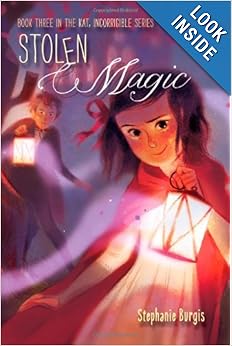
Stolen Magic (Book Three in the Kat, Incorrigible Series) by Stephanie Burgis -- Middle Grades Historical Fantasy

Kat and her family are back in this third and final volume. It's nine months after the events in Bath and change is in the air for the Stephensons. Angeline's wedding day approaches and no one must do anything to offend the Carlyles. Kat is looking forward to her Guardian initiation, which keeps getting delayed as they struggle to find a new Head. Kat tries her hardest to practice her powers but finds a stumbling block in the form of her brother Charles! Newly sober, Charles has decided to take up his role as the head of the family and this means trying to curb Kat's behavior. Well, we'll see about that! When the Stephensons arrive in Devon for the wedding, disaster upon disaster occurs. The Guardians have a secret task for Kat and she must work with her dreaded nemesis to save England.  Angeline faces an uphill battle with her fiance's family. A mysterious Marquise arrives for the wedding and Kat suspects the woman has big secrets that could tie her to the Stephensons in a most shocking way. A distraction for dear Charles arrives in the form of Frederick's beautiful cousin Jane. However, as soon as Kat escapes her brother she encounters a dangerous enemy whose power is greater than her own. When he threatens to kill Kat and hurt the ones she loves, she's ready to attack, but how can she when she isn't fully trained? Can she protect her family and save England without being killed or stripped of her powers?  I had been dying to read this book since the end of Book 2. I stayed up WAY too late reading it. The magical mystery plot kept me turning the pages. I also wondered about the mysterious Marquise though I guessed who she was right away. There's also a non-magical mystery plot that absolutely confounded me and shocked me. It was somewhat predictable in a way but in the context of the story it wasn't so easy to figure out. I found the ending really rushed and the best part was rather skimmed over which disappointed me a LOT. I also found the new secondary characters really two-dimensional. The mysterious villain's plot was interesting but too quickly resolved and a bit too predictable and juvenile. There's also a big moral spelled out at the end. These factors made me love the book a lot less than the previous two. I still loved Kat and her family. I especially liked Angeline in this one. I wished the ending had been fleshed out more. I was really interested in what was about to happen and then... a brief summary. This book, out of the three reads the most like a typical middle grades novel. I liked the first two because they were different and fun. I'm sad to see the series end and I hope Stephanie Burgis has more Regency magic stories planned. I'd love to see Kat as an older teen or maybe Angeline's daughter romping through late Regency Society! It would be fun to see how Angeline handles her new responsibilities.

Wednesday, October 16, 2013

What I've Read Recently part I

What I've Read Recently Part I . . .


Jane Austen's England by Roy and Lesley Atkins -- Non-Fiction

Jane Austen's England covers life in the Georgian era from birth to death. The authors use letters, diaries and other period sources to describe how the common people REALLY lived. Far from the genteel world of the drawing rooms of Jane Austen's novels, the England portrayed in this novel is dark, dirty, diseased and at times crude. The authors nicely balance "period drama" world that we love to romanticize with the world of the common people. They cover the lives of the gentry and the aristocrats but also explain the difficulties of trying to survive as a common working man or woman. The chapters cover everything from etiquette, advice and fashion to disease and death. I especially liked the extensive quotes from period sources to show that the authors did their own original research. At times this book was really slow and relied on quotes that were far too long. I knew a lot of this information already from reading other books about Jane Austen's life and times and also from blogs. I do feel I learned a lot though. The language is fairly accessible to non-scholars but the use of primary sources may be daunting to some. I would recommend this book to those who have a serious interest in learning more about Georgian England.

The Annotated Pride and Prejudice: A Revised and Expanded Edition by Jane Austen, edited by David M. Shapard

 The Annotated Pride and Prejudice: A Revised and Expanded Edition
by Jane Austen,edited by David M. Shapard contains the original text of the novel and on the facing page, explanations on the text. Included throughout are period illustrations, many of which have nothing to do with the story. There is also a chronology, maps, and a bibliography. Clocking in at over 700 pages, it's a difficult task to read all the annotations. I felt like many of the annotations were unnecessary. The reader can figure out the meaning from the context. I also skipped a lot of the annotations explaining different types of carriages, clothing, etc. and things I already knew. What I really liked was the explanation of etiquette. Because there's so much to keep track of I have a hard time remembering everything, but here it's in context so it's easier to remember. I also liked that the annotations forced me to reevaluate my thoughts on the novel. I had to look more carefully at the characters and their words and motivations. I didn't interpret everything the same way as the editor but it was interesting to read his take on it and review my own thoughts. I found myself not liking the Bennets very much - not even Lizzy. In contrast, I liked Darcy more than ever before. I don't really know why except that the interpretation made me see the characters in a new light. Mr. Bennet is a terrible father when previously I thought he was funny and not so bad as Mr. Darcy makes him out to be. I loved Lizzy before and thought she was witty and now I think she's a bit more rude than I had realized and she tends to always make light of situations like her father. I admire her for her outspokenness and willingness to stick to what she feels is right.

The illustrations are nice to have but some don't have any relevance to the story. This paperback edition only has black and white illustrations. The maps are not very detailed but help provide a frame of reference.

If you are reading this novel for the first time, especially for a class, I would recommend this edition. If you're an experienced scholar who has studied Jane Austen's life and times, you won't really need this much explanation.

Friday, August 16, 2013

Museum Exhibit: Artist, Rebel, Dandy: Men of Fashion

Artist, Rebel, Dandy: Men of Fashion

I recently had the pleasure of visiting the Rhode Island School of Design’s exhibit Artist, Rebel, Dandy: Men of Fashion . This exhibit celebrates men (and some women) who love clothes, love to dress well and have forged their own path to create new, avant garde styles; from the notorious Bea Brummell of Georgian England to late Twentieth Century men and women, this exhibit has it all.
Being a lover of the Regency era, I especially enjoyed seeing the Prince Regent’s banyan from his younger days.


and a great coat made by Weston, tailor to the aristocrats. 


There were also cutaway coats and silk knee breeches belonging to prominent Rhode Islanders of the period. I’ve seen photographs, movies, reenactor costumes and women’s clothes but for some reason, the museums I’ve been to lacked men’s clothes. It was amazing to put an actual 3D image in my mind of the clothes I’ve only read about. 


I’m vastly impressed with how much Georgette Heyer got right in her novels. She was the best at setting the scene and creating memorable characters. Many of her admirers have used her settings and introduced real people into the plot. A scroll featuring the noted dandies of the day helped put faces to the names I’ve read about. I only wish Mr. Darcy and Henry Tilney had been featured.

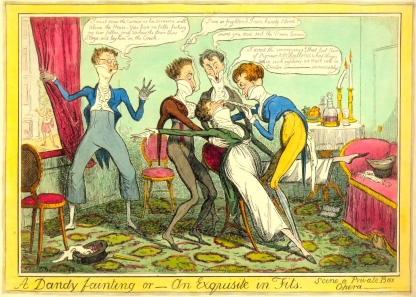
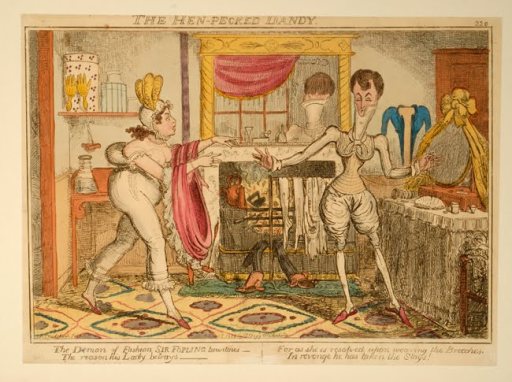
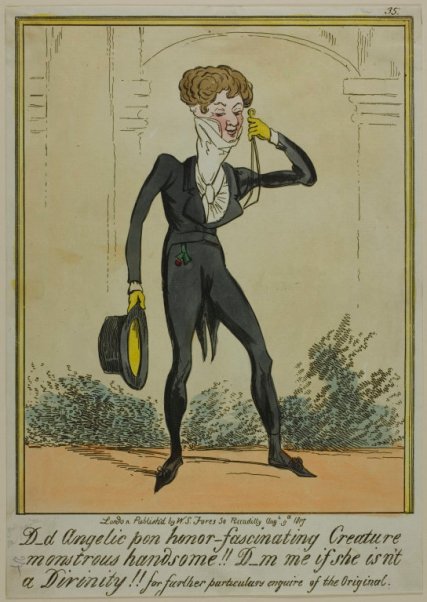
Also from the Regency era, the exhibit features many Cruikshank cartoons. For those who may not know, Robert and George Cruikshank were printmakers in late eighteenth and early nineteenth century London. Their colorful, witty cartoons lampooned the excesses of society. These cartoons were similar to today’s political cartoons and celebrity gossip blogs. I’ve seen a few cartoons online and some at the Morgan Library’s Jane Austen exhibit. The RISD exhibit had many on loan from the Lewis Walpole Library at Yale University.

There was:
Young Gentlemen: Dress of the Year 1798

Lacing in Style

A Dandy Fainting
A Dandy Fainting
George Cruikshank
A Dandy Fainting or An Exquisite in Fits


The Commercial Dandy and his Sleeping Partners

A New Irish Jaunting Car (lampooning the dandy fad for riding early bicycles)

And my personal favorites
A Hen Pecked Dandy

A Hen Pecked Dandy
Dandies were known for their tightly laced corsets, just as women had been. Here, the woman in the cartoon declares that she will be be adopting a more masculine style since the gentleman has co-opted a feminine style of dressing.

Many of the cartoons displayed a fear of reversal of sex roles with effeminate young men wearing corsets and fainting just as women were expected to do.


D___d Angelic
A dandy (the Beau himself perhaps?) looking through his quizzing glass at a beautiful woman.

See more and read about Regency dandies at Jane Austen's World and at BookTryst

At first dandies were a figure of fun until Oscar Wilde and his set made dandyism a a way of life and a culture of it’s own.

For Downton Abbey fans, there were several early 1900s shirts laid out with collars just as Lord Grantham’s valet would have done. There was also a Brooks Brothers coat c. 1917 that I can see Matthew Crawley buying on a trip to New York to visit Mary’s family.

These great men have influenced styles of dress into the 20th century and present day. The exhibit featured movie costumes as well: Fred Astaire’s suit from the movie Top Hat

Fred Astaire and Ginger Rogers
Photo copyright: SNAP / Rex Features


Diane Keaton’s suit from Annie Hall

Diane Keaton Annie Hall
Diane Keaton in Annie Hall

There was so much to see in this exhibit that I didn’t have time to look at everything in detail.

You can read about it in the Boston Globe 
See photos at Vogue.com  at Radio Boston and Art Tattler

Read more about Dandyism at Dandyism.net

Monday, July 8, 2013

Professor Amanda Vickery

Professor Amanda Vickery


I finally had a chance to browse YouTube to see some wonderful documentaries hosted by Professor Amanda Vickery.

At Home With the Georgians

This documentary supplements Professor Vickery's book. She takes the viewer on a trip through Georgian era homes and explains the importance of home and the meaning of home in the Georgian era. She uses diaries, prints, artifacts and other period objects to delve into the period. I was only able to find Part 3 Safe as Houses in full and clips of other parts. 

She starts by setting the scene: nighttime in London today is an exciting, energetic place but not so in the Georgian era. Nighttime was dark and threatening. A house breaker could enter over the gate or down the chimney armed and dangerous ready to attack anyone who stood in his (or her) way. Georgians went through great lengths to protect their homes. 

Dr. Vickery examines the seamier side of Georgian life. A diary of a well-respected widowed clergyman reveals a secret affair with a maid which deeply troubled his conscience.

She also discusses the plight of women without an independent income. She looks at the diary of a married woman who felt captive in her own home. Due to her husband's increasing jealously, he placed serious restrictions on her movement. She stayed for the sake of her children. Another sad story involved a spinster dependent on her brother for a home. She had no rights at all and was constantly made fun of and was deeply unhappy and lonely. Finally, an inheritance from an aunt allowed her to become independent in her 40s. This story hit home for me, being a single woman without a fortune. It also showed a bit of what Jane Austen's life must have been like before she published her first novel. How liberating it must have been for her to finally have some money all of her own.


This documentary was a bit dull at times, especially when Dr. Vickery was examining locks and anti-burglar devices. History really came alive when she read from diaries. Actors portraying the real people make the stories come to life. I loved seeing both the diaries and the representations of the people who wrote them. I would have enjoyed the first two parts of the series more but they were unavailable. Dr. Vickery is personable and truly seems to love researching the period. Her joy shines through on her face as she shares her research with her viewers. This series makes history more tangible and accessible for the amateur historian.


The Many Lovers of Jane Austen

Despite what the title may sound like, this documentary is about the people who love Jane Austen. It examines her enduring legacy and the reasons why nearly 200 years after her death her books remain so popular. She discusses Jane Austen's fame with noted scholars and public figures such as the Earl of Spencer, whose ancestor Lady Bessbourough was among one of Jane Austen's first fans. Each person interviewed reads an excerpt from one of the novels and scenes of modern readers reading all over the place are shown. 


Dr. Vickery tours Chawton cottage and debunks the myth of the shy spinster. She concludes that publishing anonymously was merely a polite convention and that witty Miss Austen enjoyed playing games with people who didn't know she was the author. By the 1820s, the romantic movement ushered in the age of sweeping landscapes as a character which made Jane Austen passe. At the end of the 19th century, Jane Austen came back into print thanks to the invention of train travel. Train stations sold and continue to sell cheap paperback copies of her novels.  Jane Austen's nephew also wrote a memoir of his famous aunt that brought her back into public notice. It wasn't until around 100 years after her death that Jane Austen achieved immortal fame. She became the subject of study by a group of intellectuals and professors, the first Janeites, who examined Mansfield Park and the social commentary within. Rudyard Kipling read Jane Austen to his wife and daughter to ease the pain of his only son Jack in World War I. He even wrote a story about soldiers in the trenches enjoying the light escapism of Jane Austen's novels. 

Dr. Vickery also looks at the movie versions of Pride and Prejudice, the first being the famous Olivier movie people either love or hate. The scholar explains that this movie was a hit Broadway comedy and it wasn't intended to be a faithful production of the novel. The next movie aired in the 1960s in Britain and was aimed at a juvenile audience. In the 1980s, Jane Austen finally arrived on the BBC (BBC2) in an expensive production, but it wasn't until 1995 when Jane finally catapulted into super stardom. Andrew Davies' sexed up script and Colin Firth in a wet shirt made Jane Austen a household name and created legions of new fans. Since then, Jane Austen has become a brand. 

Dr. Vickery traveled to Bath to the Jane Austen festival and to Texas to the annual JASNA meeting where she met ladies in costume; learned Mr. Wickham sends panties to ladies along with his phone number; and shopped for Jane Austen themed tea and souvenirs. Finally, it is concluded that Jane Austen mania has peaked in the West but it just getting started in Asia.


This documentary is fabulous and a must watch for any Janeite. I knew some of the history but this documentary delves much deeper than any biography or blog post I've read so far. I especially liked the visuals - seeing clips of the movies I haven't seen (OK and seeing Colin Firth in a wet shirt again) and seeing the fans dressed in costume.I was a little taken aback at the commercialism of Jane Austen. I don't mind sexed up Jane Austen as long as it's tasteful and within the realm of possibility because I think it introduced new fans to her lovely novels. I enjoy the movies and I adore the novels. I like buying themed gifts and I cherish rare books and academic discussion. I think Jane Austen can be accessible to everyone if they try and if it takes commercialism to do it, then so be it. I think Miss Austen would get a kick out of all the fuss.


Pride and Prejudice: Having a Ball With Jane Austen


Professor Amanda Vickery and art critic Alastair Sooke hosted this 90 minute special which recreated the Netherfield Ball from Pride and Prejudice. The purpose was to uncover the deeper meaning behind the ball and everything that would have gone into it. This was something that Jane Austen's readers would have been aware of but has gotten lost over time. The Netherfield Ball was a private invitation only event to which only the best families in the county would be invited. The hosts take the viewer on a detailed journey to look at period customs, music and food. 


To recreate the ball, a troop of ballet students was recruited to learn several complicated dances. They found it far more difficult and energetic than they expected. The music was chosen from Jane Austen's own music books. Alastair took a look at a manuscript music book that could have been written in Jane Austen's handwriting and even contained a doodle in the margin! 

The food was painstakingly recreated from Georgian era recipes, some by Martha Lloyd. The food is quite different from what we're used to. May jellies and ices and alcoholic drinks were served alongside meat and vegetable dishes all at the same time. People could reach across the table and grab whatever they wanted.This type of meal was haute cuisine and would have been very luxurious for the Bennets. One of the dancers said that it was possible, if you were attuned to someone and they were speaking loudly, to hear what was being said across the table, despite the noise. This verifies what Jane Austen wrote in Pride and Prejudice about Mr. Darcy hearing Mrs. Bennet's conversation. 


 Clothing and makeup is also examined. The costume designer chose silk taffetas for the wealthy Bingley sisters who would have had their gowns made in London. The more provincial Bennets would make do with a local dressmaker. Elizabeth may have made her own dress, remade from an older one. The costume designer chose a sheer white muslin with embroidery. She gave lie to the myth that some ladies dampened their petticoats for muslin becomes see through when wet. If it happened at all, it was for a very private party. Not even Lydia would be so bold! 


Modern electric lights were removed and beeswax candles were made to adorn the small room in Chawton House where the ball was held. As the evening went on, the dancers took on more and more characteristics of the period. They became flirty and high spirited, especially once a new young man was introduced into the mix. They also became very hot under all the candlelight! Amanda Vickery remarked that she found herself watching the men more than the ladies because their calves were easier to see. Dancing well must have been more important for the gentlemen than the ladies because it was a chance for the ladies to check out the gentlemen. I know from my visit to Colonial Williamsburg that this was indeed true. The expression "put your best foot forward" actually comes from dancing. Some gentlemen padded their calves to make them look more muscular and thus more attractive to the ladies. In short, a ball was an elaborate courtship ritual.  
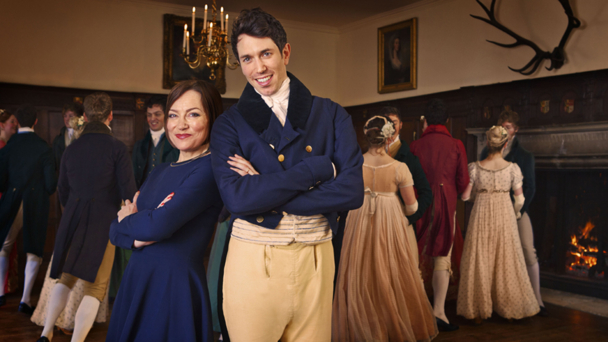

In between ball preparations, an actress portraying Jane Austen wrote her novel with her quill pen. 

This program is absolutely spectacular! What a labor of love! As a social historian, I thoroughly enjoyed all the historical details revealed through the creation of this ball. I especially liked learning about the food and the music which I have not studied much. I appreciated all the attention to detail and seeing how the food, costumes and lights made the dancers act. Their comments were very interesting and informative. I loved this behind-the-scenes look. It would have been nice to actually see more of the dancing after all that rehearsal. This documentary will appeal to casual Austen fans, amateur historians, social historians and the general public. I highly recommend trying to watch it or read the article from BBC news.