
What I Read in August 2016 Part II . . .
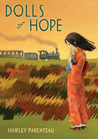 Dolls Of Hope by Shirley Parenteau--Middle Grades Historical Fiction
Chiyo Tamura is a farmer's daughter from the hills of Japan. She's incensed that an old man wants to marry her beloved older sister and her parents won't do anything to stop it. When Chiyo meets her potential future brother-in-law, she is surprised by his kindness. She is ashamed of her feelings and vows to bring honor to her family. That's not so easy to do when her brother-in-law sends her far away to school in Tsuchiura, where wealthy girls who are daughters of important men go. She's told to model herself after Hoshi Miyamoto, a famous general's daughter, but after only a few minutes at the school, Chiyo knows that won't be easy. When Chiyo learns about the friendship dolls being sent from American school children to Japanese schools, she is eager to see them and welcome them. A trip to Tokyo to welcome the dolls brings unexpected surprises- and consequences. Chiyo longs to be the traditional, humble Japanese girl her family wants her to be but how can she stand by and watch something she loves be destroyed? Japan is changing and maybe Chiyo has to change too.
I really enjoyed this story. While I know a lot about Japan and Japanese culture, this time period is new to me. I was surprised at how behind the rest of the world Japan was and how they were already mobilizing for war- to expand their territory and conquer weaker nations. The central theme of the story is change. The 1920s represent a period of change for women and for Japan. Women were entering public roles and becoming more independent and free, just as Japan was becoming more modern. I liked the juxtaposition of the American vs. Japanese cultures and how both Lexie and Chiyo represent a new generation of women struggling to find their role in a changing society, perhaps rebelling against traditional gender roles.
Sweet little Chiyo captured my heart just as she captures the nation in the story. Her devotion to Emily Grace and her love for the doll really resonated with me. As a doll collector, I understood her fierce need to protect her beloved Emily Grace. I liked following Emily Grace's journey after she left Lexie but it isn't necessary to have read Ship of Dolls first. I also really liked Chiyo's friend Hana and how she helps Chiyo. The one character I could have done without is Hoshi. Her plot is the typical mean girl story. She turns out to be complete psycho which was a surprise, instead of the two girls becoming friends in the end, which saves the book from being too overly cloying for an adult reader.
I think this story would be best enjoyed by girls 8-12 and doll lovers around the world.
 Sweet Home Alaska by Carole Estby Dagg--Middle Grades Historical Fiction
Terpsichore (Terp-sick-oh-ree) Johnson is devastated to learn her best friend's family is going to settle in Matanuska Colony Alaska- part of a New Deal plan where families will learn to become self-reliant farmers. Terpsichore vows to do anything she can to make sure her family goes too. When her plans go awry, she finds herself stuck in the middle of nowhere living in a tent with her parents, precocious twin sisters and baby brother. The only kid she knows is an annoying boy with a cat-scaring dog and an obsession with bugs. She thought it would be a fun adventure like Little House in the Big Woods and Farmer Boy, her two favorite books. The first day of school brings torment but also a new friend and a plan to get herself recognized for a special talent. As she falls in love with Alaska, she fears her mother will vote to return to Madison, Wisconsin and civilization (and a strict grandmother). Terpsichore plans a special surprise that will be sure to win over her mother. As the only unmusical Johnson, she has to find a way to use her gifts and make a new home for herself and become known as a kid who did something special.
This story is a cute homage to Laura Ingalls Wilder's novels. I think Terpsicore will really appreciate The Long Winter once it's published! Living in the Alaskan wilderness and learning to manage the land is very similar to what the Ingalls family experienced living on the prairie in South Dakota. However, the Johnsons and fellow colonists do have some resources the Ingalls family didn't have but that only makes the story more exciting, not less. I had a hard time putting down the book. I couldn't wait to find out what Terpsichore would do next and of course if they would stay. The story is chock full of period details including how to use a wood stove, how to cook strange foods in tasty ways, how to wash diapers (no disposable diapers yet in 1934-35), pop culture (the school puts on a Wizard of Oz musical play several years before the Judy Garland classic) and of course, farming. I expected the farming details to be boring but I liked what Terpsichore figured out how to do. Her special project was very sweet and I found it fascinating. I think the real life Laura Ingalls Wilder and Almanzo Wilder would be proud.
Terpsichore is a great character. She's a normal kid who believes in her ability to do anything she puts her mind to and works at. She feels overshadowed by her precocious and talented twin sisters (eight year old Shirley Temple wannabes) and feels undervalued by most adults. I like how she comes up with practical solutions and how she learned the value of true friendship. Her struggles her very real and what happens isn't too much of a fantasy. It felt plausible but maybe not all for one kid. I also liked her friends Gloria, the girly girl drama queen and Mendel, the nerdy scientist. Gloria reminded me a lot of Ruthie in the Kit stories (American Girl).
I found Terpsichore's sisters a little annoying. Their double Shirley Temple twin act was way over the top cutesy. I did like their character development though and how the sisters came to rely on one another and help each other out. The only character I didn't really like was Mrs. Johnson. At first her calling her husband Mr. Johnson creeped me out, thinking she would be a subservient housewife but that turned out not to be the case. She actually plays a large role in the family and has the final say in whether they stay or go. She comes across as really snobby at first, looking at the fellow colonists as backwoods bumpkins and even dismissing her husband's farming background as primitive and uncivilized. Like Ma Ingalls, she feels a church and a school make for a civilized town. I felt like her husband should say to her "Would you rather starve to death in civilization or have food and fresh air for your family here in the wilderness?" Her character development is a bit abrupt and I felt needed a little more slow growth.
I really enjoyed this novel and I think readers old enough to read without pictures on up to adult will enjoy this book. It would make a good read aloud for younger kids as well. The only thing sensitive readers might have a problem with is the brief mention of the deaths of two children. Other than that, there's no violence (except for mentions of hunting), no bad language, no bratty children- just good fun.
 Remarkable Women of Rhode Island by Frank L. Grzyb--Non-Fiction
This book contains brief biographies of notable women with Rhode Island ties, from Weetamoo, Anne Hutchinson and Mary Dyer all the way to Viola Davis, an Emmy winning actress; and Elizabeth Beisel, three-time Olympian and silver medal-winning swimmer. Being the archivist for the Rhode Island Heritage Hall of Fame and a women's historian, I was aware of nearly every single one of these women. There weren't any surprises, just some obscure omissions and some notable ones too. What about Lucy Truman Aldrich and Abby Aldrich Rockefeller for the most notable? There are several others I can think of. The biographical profiles are concise and easy to read, however they sometimes contain superfluous information. I don't care about Doris Duke's relationships; tell me more about her achievements.
The book An ornament and honor to their sex: New England women from Valley Forge to Fenway Park by Jane Lancaster goes more in depth.


