Showing posts with label slavery. Show all posts

Monday, October 4, 2021

Banned Books Week 2021

 Banned Books Week 2021


Jump Ship to FreedomJump Ship to Freedom by James Lincoln Collier--Older Middle Grades Historical Fiction

Daniel Arabus and his Mum are enslaved by Captain and Mrs. Ivers of Stratford, Connecticut colony and wishing to be free. They SHOULD be free as Daniel's Daddy served in the Revolutionary War and earned the money to buy his freedom. Instead of being grateful Daniel's dad served in his place, Captain Ivers seizes the soldiers' promissory notes given to those who served to be exchanged for paper money soon... eventually... maybe once the Congress in Philadelphia gets around to deciding what they're going to do now they're free from British rule. Daniel and his mother can't wait for the white men to decide. They want to be free, deserve to be free, ARE free but Mrs. Ivers is hiding the money and carrying on as usual. When Daniel steals back the notes, he puts into action a sequence of events that could end with him being dead at the bottom of the ocean or sold into slavery in the West Indies to be worked into an early grave. He's determined not to let that happen for the sake of his mother. She deserves her freedom after the heartache of losing her man to war and finally death. Daniel vows to escape to New York where his family has friends but what will happen once he arrives? What if his journey is all for naught?

This book is one of the top banned books of the 1990s. Published in 1981, written by history scholars, it must have been one of the earliest children's historical fiction novels to honestly portray slavery and racism in the years following the Revolutionary War. The fact this book is set so early and set in New England makes it unusual even today. As a result of much scholarship and debate, the authors modernized most of the language with the exception of the word used to describe Daniel and other people of African descent. They actually DO go there and use THAT word- the mother of all banned words - "n____." Daniel even uses it to describe himself because that's all he's ever heard. Daniel also continually thinks and says White people are smarter than he is. Therefore, lazy parents who don't bother to read the whole book, want this one banned. I didn't like Daniel's lack of self-esteem and the way he kept putting himself down. I do agree that it could be damaging to the self-esteem of young Black students, but it's not a reason not to read the book. We can't know if that's the way enslaved people in the 1770s thought of themselves. Given that many like Daniel's father, fought and died for the new Republic, some probably didn't but Daniel is just out of childhood at 14. He's been told and retold his whole life how White people know more, know better than him. Not even his friendship with the nephew of his enslaver shows Daniel the value of his own thoughts.

Other parents might object to the way Daniel continually lies and breaks the law but if they bother to read the book, Daniel lies to save his life! Slavery in the Caribbean was an automatic death sentence. Work in the sugarcane fields was grueling and hot. The life expectancy of an enslaved person was extremely short. Plus Daniel has his mother to worry about.

This is a coming of age story about a young enslaved boy. As he goes on his journey towards freedom he learns a lot. He learns valuable life skills involved in being a sailor when he had assumed it was mostly standing around singing sea shanties. He learns about the new government forming and what that means for him. He discovers while some Whites are not as horrendous as his enslaver, most really don't care enough to end slavery right now. The Constitution was a COMPROMISE -and a bad one- favoring the southern states. Without them, we would be a loose collection of states, like Europe but tiny, each with their own laws. That would be problematic for many reasons and not to mention the fact the northerners really didn't care about ending slavery any more than the southerners did. It was mainly only Quakers and other fringe religious fanatics like Mr. Fatherscreft.

Some Black readers may object to the character of Tom, a Black man who is nasty and vindictive towards his own race. He wants to be important to Captain Ivers and the White crew so he capitulates and does what they want in order to be respected. I think it's implied he also goes behind their back and helps himself to cargo to sell but is smart enough not to get caught because they trust him.

As the story goes on, Daniel grows in confidence. He learns not to denigrate himself and his race. He STOPS using the very bad n_ word and switches to "negro" which is not so acceptable nowadays either but is more respectful. Daniel learns how to be a man, how to think for himself and make concessions in order to get what he wants in the long run.

I thought the plot started off a little slow and I had a hard time getting past Daniel's constant thoughts about "What do I know? I'm just a ___?" and "White peoples is smarter than us. Once Daniel is on board the ship, the story picks up and it becomes difficult to put down. The writing style is a little stilted and boring. It's not the BEST book about slavery at this time I've ever read and I'd say The Seeds of America Trilogy: Chains / Forge / Ashes is much better written but for the time, this book must have been groundbreaking and shocking. I actually can't think of any other books besides Seeds of America and Hang a Thousand Trees with Ribbons that even tackle the subject of slavery. I have a feeling this one is going to end up on the banned anti-Critical Race Theory book list if it's still in schools. It's not there yet.Central York (Pa.) Banned Book Club

No, the book offers no redemption for Captain Ivers. He was arrogant and greedy and nearly lost everything but he still will stop at nothing to get his "PROPERTY" back. That's all Daniel is to him. That's the way it was folks. Even the most ardent supporters of the Revolution were ardent supporters of slavery and considered enslaved people property. The authors' note at the end is very good.

A word of caution to devoted fans of the musical Hamilton. Our beloved hero makes a cameo at the end of the novel and let me warn you that he is in no way an admirable or nice man. It was quite a shock but probably more realistic than Lin Manuel Miranda portrays him. He comes across as one of the villains.

Friday, March 17, 2017

What I Read in February 2016 Part III

What I Read in February 2016 Part III . . .


Good FortuneGood Fortune by Noni Carter--Young Adult historical fiction

When Anyanna Bahati was four years old, she was cruelly ripped away from her mother and the only life she ever knew in Africa. Despite the Atlantic slave trade being made illegal several years earlier, Ayanna endured the Middle Passage to end up a slave in Tennessee. For ten years Ayanna, now known as Sarah, has worked in the fields of the Williams plantation. She loves her foster mother Mary and her brother Daniel, but is haunted by dreams and memories of the past. Sarah longs for something more out of life. When the young master and mistress go to school, Sarah discovers her passion for learning. She teaches herself to read and write a bit on the sly but it's not enough. She yearns for freedom. When she meets a young slave preacher, John, she finds in him a kindred spirit. His soul is free just like hers and together they can fly away from reality without leaving earth. Then the Master's eldest son comes to bother Sarah and warns John away. Without John, without freedom, Sarah's life is meaningless. She knows she can't stand to bear Master's child. When she discovers John, her brother Daniel and some friends plan to run on Christmas, she knows she must go with them or she'll surely die. Complications ensue and Sarah must have the courage to not only take her freedom, but define what freedom means for her and figure out how to get it.

This story takes place in the 1820s after the Atlantic slave trade had been abolished. Many people ignored the law (some from my own northern state) and officials looked the other way. After the abolition of the slave trade, trade between states became more common and also "breeding" plantations where slave owners took advantage of enslaved women to force them to bear slave children against their will. Despite the Master not taking advantage of his slaves that way, his eldest son is a young man under the influence of some unsavory friends who think nothing of having a little "fun" at the expense of someone they consider less human. This is the reality the main character faces in this novel. As such, the first half of the story is pretty tough to read. The plot gets a little better later on, but most of the story is very slow. It wasn't until the last third of the book that I couldn't put it down. This book is very long for a Young Adult novel and I thought perhaps the story could have been split into two books or even a family saga - a sort of Roots for young adults. The story seemed very antebellum but the author did her research so I guess it's accurate. There is a LOT going on here and it seems like too much for one novel. Yes those things happened and all that could have happened to one person but for the sake of a story and keeping track of characters and what's going on, it's too much. The way the story is intertwined with Sarah's dreams is a bit confusing at first. There is a romance between Sarah and her friend John but being slaves, they are not allowed to be together. There's another romance later in the book.

This story is largely character driven. The struggles Sarah faces are both universal to enslaved people and also to African-Americans even today. She also faces an internal struggle- What does freedom mean to her? Does she accept what is or does she fight for more? Should she fight and how? I liked her character development as she grew older and discovered more about herself and what she wanted. I felt she was a bit reckless at times but not stupidly so. She's a strong female character to inspire all girls. Sarah fights for what she believes in and what she wants. She feels things deeply and loves and is loved in return, yet I never fully felt like she was a much-loved, memorable character. I admired her strength but just didn't connect with her, which I should have because education is a big part of my life. It took her way too long to realize how she cold make a difference. I thought of it right away. I liked her solution to injustice but in that place and time, it was dangerous.

Daniel's character growth was excellent. At first I thought he was too full of anger, that he was going to get killed for doing something reckless. I didn't necessarily agree with everything he believed would make his life better. He grows a lot and learns to fight in a way that will make a difference at this time, much like Sarah.

Mary, Daniel's mother and Sarah's foster mother, is a complicated character. She loves her children and wants what's best for them but she also accepts her situation. She knows how to keep safe. She doesn't want to rock the boat.

John is my favorite character. I liked the way he could be free in his mind. I liked his hopes and dreams and how he made Sarah feel. I teared up in parts of his story.

My favorite character was Miss Rosa. She's strong, smart and brave. I love how she helped Sarah on her journey of personal growth. She's an inspiring character.

I liked this book a lot but it's not the best book about an enslaved girl I remember reading but I think it's very timely and young readers can learn a lot. They can learn to think about the issues in the stories and how those issues are still relevant today. The author is a young adult and she's a girl after my own heart. She was fascinated by family stories about her 4 xs great-grandmother and researched all she could before writing her novel.

Friday, August 3, 2012

What I've Read This Week

What I've Read This Week . . .

The Lost Quilter (an Elm Creek Quilts novel) by Jennifer Chiaverini --Historical Fiction

When we last saw Joanna in The Runaway Quilt, she was being dragged away by slave traders just days away from her flight to Canada. Now in present time, Sylvia uncovers some evidence that sheds light on what happened to Joanna. What follows is Joanna's story from early childhood until adulthood. Fiercely independent and proud, Joanna refuses to be completely servile. She goes from job to job in the Big House and the fields until she's chosen to be the family seamstress. The cook, Ruth, tried her hardest to protect Joanna but trouble caught up to her and forced her to run. After her stay with the Bergstroms, Joanna's desire to be free burned even brighter despite being sold back into slavery and sent to South Carolina. Through the turmoil of the antebellum years and Civil War, Joanna never stops longing for freedom or thinking of the son who is lost to her. She experiences loss, love and all the heartbreak of slavery while stitching her secret map North into her quilt. This is an incredibly well-researched book. I took a graduate seminar on slavery and I can track some of the source material the author must have used for research. The story is light on plot aside from the utter misery of being a slave and when the plot does come, it seems a bit far fetched and the ending is a bit rushed. Sylvia never really does get the answers to her questions which really bothers me. I don't know why the author chose to frame the historical story with the present. The epilogue would have been fine on it's own. The epilogue is fascinating and I have to find out if it's based on something real. Even without a traditional plot, I found this book very engrossing. I wanted to know what happened to Joanna but yet I had to keep putting the book down because it was just so sad. That being said, I greatly admire Joanna. So she so strong and so brave. I can not even imagine what it must have been like to be a slave and I can't say how I'd deal with it but I know there were many real life Joannas who were strong and survive. The book satisfied my curiosity about what happened to Joanna after the Runaway Quilt. I recommend this book to readers who read The Runaway Quilt and want to know what happened to Joanna and also to those who like to read novels about slavery. It stands alone without having read The Runaway Quilt though it helps if you have read it. This is another great entry to the Elm Creek Quilts series.

Wednesday, June 15, 2011

What I've Read This Week

What I've Read This Week . . .

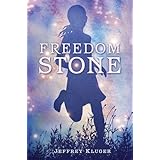
The Freedom Stone by Jeffrey Kluger -- Middle Grades Historical Fiction

Thirteen-year-old Lillie and her family are unfairly being held in slavery during the Civil War. Lillie's father joined the Confederate Army when the Army promised freedom to those who served and their families. Lillie's father was killed in Vicksburg and when he died, he was found to be in the possession of $500 in Yankee gold coins. Master assumed the money was stolen and refused the free Lillie's family. Now the slave appraiser is taking an interest in Lillie's little brother, Plato and her friend Cal. She's convinced her father wasn't a thief and is determined to find out the truth.

Cal is a proud, headstrong teenage boy chafing under the restrictions of slavery. He's eager to be free and willing to risk his life to gain freedom. 

Miss Sarabeth is the pampered daughter of the Master. She and Lillie used to be close but now Lillie has drifted away and become close to the old baker woman Bett. Miss Sarabeth knows she shouldn't be jealous but she can't help feeling left out. When she thinks she has uncovered a big secret, she has to decide where her loyalty lies. 

Time is running out for Plato and Lillie becomes even more determined to uncover the truth about her Papa's money. To finally discover the truth, she needs some help from Bett. Bett has baked a magic rock from Africa into her baking oven and figured out how to make bread that shifts time. Lillie needs Bett's help before it's too late to save her family

This is an interesting book that blends fact and fantasy. The details about life in slavery are excellent. The author doesn't spare the harsh realities but handles slavery in an age-appropriate manner. The characters are a bit stereotypical, especially the white ones. Even so, I liked Lillie a lot and identified with her stubbornness. I admired Lillie's willingness to do whatever she could to become free and Mama's pride. The only thing I didn't like was the third person narration. I think it should have been first-person from Lillie's point-of-view or alternate between Lillie and Cal. I felt too detached from the story with the third-person narration. I usually don't like fantasy/supernatural/time travel stories but I really liked this one. The magic made the story stand out from all the other stories about slavery. It was believable because the author set parameters about what it could do and how. I liked that the magic is African, a good reminder of the heritage that was taken away from those who were enslaved. This is a great book for anyone ages 10+.