 Forget Me Not by Sarah M. Eden-- Georgian Romance
Thank you to NetGalley and Covenant Communications for a free advanced copy of this book. Opinions stated in this review are entirely my own.
Katie Jackson's review on AustenProse is pretty much perfect, but I promised to review this book so here it goes:
After losing his siblings and childhood playmates, Lord Lucas Jonquil decides it's time to live his own life. He heads off to Brier Hill, his estate, to get settled and then he's off on adventures living life to the fullest. His little playmate, Julia Cummings, is heartbroken - again- at yet another loss. Her mother, twin sister and two childhood friends are already gone and her older brother is fighting against the rebels in America. When her best friend decides to up and leave without telling her, the loss seems unendurable. He promises he'll be back to visit soon but eight years go by without Julia ever seeing Lucas again. Now she's a young lady who prefers the quiet solitude of home, reading and studying to the childish romps and games they used to play. It's safer that way. Lucas has been off mountain climbing and having adventures, living life to the fullest. He can't wait to be off on his next trip. Lucas and Julia are both stunned when their parents publicly announce the old friends are to be wed in a week's time. This is news to the not-so-happy couple! Julia resents being forced into an unwanted marriage and Lucas feels trapped. Can these two make it work? It doesn't seem like it and they may need some divine intervention to help. Enter Lucas's best friends, known as "The Gents," a lively band of brothers who are determined to help fix their friend's broken relationship.
Normally I'm not a huge fan of marriage of convenience novels. They go on too long with too many misunderstandings and the couples never talk. This one is no exception and even after they work things out, it goes on too long. However, I was eager to read this after binge reading the Jonquils series all spring and summer. I adore this family and I really wanted to get to know Father. I really enjoyed that aspect of the book. The little "Easter Eggs" (nods) to the Jonquils series are wonderful.
Philip is the son who most takes after Lucas. Lucas, known as "Jester" to his friends, hides behind a mask of comedy. He jokes and pretends everything is OK even when it's not. He's cruel to Julia at times but also sweet, tender, loving and romantic. To be fair to Lucas, what teenage boy/young man tells his plans to a little girl? NONE! Not even if they're childhood friends. Maybe he assumed her father had told her or maybe he was waiting until the last minute to make parting less painful. We never really learn why he didn't tell her he was leaving except that he was thoughtless. Later on, he is thoughtless and doesn't talk to her about his plans. He never asks what her hopes and dreams are and doesn't try to figure out how their differences can be reconciled. He still cares about Julia but he doesn't consider her thoughts and feelings much.
Like the brothers, I assumed Mater and Father fell in love at first sight and were inseparable until death did them part. However, Mater hints that the Jonquil men, including their father, make idiots of themselves in front of the women they love. Lucas is no exception. .
Julia, too, bears some of the blame for their early marital problems. She behaved rather immaturely when she heard the news of their impending nuptials. Julia sounded younger than 2o but I attribute that to the fact she hasn't had a Season or been anywhere outside the village other than to visit cousins in Berkshire. Julia is grieving the loss of so many people she loves and putting up walls to protect herself is easier than dealing with the pain. I don't really blame her for that but she needs to tell Lucas. Julia doesn't have any empathy for Lucas's grief either. He lost his siblings and hers and most recently, her elder brother STANLEY, one of his best friends. She doesn't consider that his jetting off on adventures is a way to keep from being alone with his feelings.
I liked little Julia, the feisty hoyden, game for any adventure. She sounds like a lot of fun but like her twin, I prefer reading and playing with my dolls to crazy, dangerous stunts. Lucas's goal is to recapture that magic childhood and bring back HIS Julia. He should be getting to know her as an adult and find some common ground. He makes a bit of a beginning, which is very sweet, but it's not enough to make up for his casual dismissal of her. I have a soft spot for him though because even though he's a dunderhead when it comes to love and romance, he is fundamentally a nice young man. (Yet, after bearing him 7 sons I'd be like GO AWAY on one of your mountain climbing adventures PLEASE! Don't come back until after I'm too old to have babies or birth control is invented).
I really appreciate how smart Julia is. She is vastly intelligent and all self-taught. Her governess sounded narrow-minded and stupid. I love how Julia has a thirst for knowledge and isn't afraid to go after it. She's opinionated and makes her thoughts known at a time when women were supposed to be ornaments to Society. (Elizabeth Poldark, that vapid doll is an excellent example of a Georgian woman). It's easy to see why Philip is attracted to Sorrel because young Julia is very much like Sorrel, intelligent and prickly.
Lucas's friends are a lot of fun. I enjoyed meeting them and seeing Lucas from their points-of-view. First we meet Kester Barrington, aka "Grumpy Uncle." I don't think Kes is grumpy at all. He's an introvert by nature and cautious. Just because he's the voice of reason, doesn't mean he's grumpy. He's just not crazy! I like him a lot and can relate to him best of all. No mountain climbing for me, thanks! "The King" turns up next. Digby LAYTON is silly but he's used to getting his own way and what he wants is for his best friend to stop being a dunderhead. His rule is gentle and benevolent. He surely must be Philip's godfather and sartorial advisor because he acts like a fop. I suspect he isn't and I find that affectation annoying but Digby is fun and makes people smike. Lord Aldick Benick, younger son of the Duke of Hartley, is the strong, silent type. He seems imposing. "The General" has a keen mind and likes to use his brain to strategically plan things, in this case, how his best friend is going to win over his wife. Henri Fortier aka "The Archbishop" is the peacemaker of the group. He also seems a little bit silly. I think he must be the namesake and godfather of "Holy Harry" Jonquil. (Henry is also Lucas's middle name). Finally, Niles Greenberry doesn't say much but he's up for anything and I expect his loyalty has earned him the nickname "The Puppy." They love Lucas like a brother and accept Julia as a sister and want to help but sometimes their plans interfere with the romance and Lucas (and the reader) is frustrated!
It was also fun to meet the Jonquil boys' grandparents. "Flip" gets his wit from his Jonquil grandparents. They're very much in love and share a wacky sense of humor. They can make the weather sound funny and interesting. I really like them, arranged marriage notwithstanding. Not as charming is Julia's father, Lord Farland. He means well and probably wants to make sure Julia is taken care of before he dies like his wife and son but he did her a disservice. Julia has never been anywhere or met anyone. Her only childhood friends are dead or married and moved away. It's heartbreaking to see her withdraw into herself. First, he should have at least sent her to a Little Season or a season in Bath, mourning or not. She could have attended informal gatherings, made friends with other girls on the verge of coming out and met gentlemen. No dancing, of course, but at least she could go for a drive or a walk with a gentleman, provided she was suitably escorted. Then the arranged marriage wouldn't have been such a shock and so confining.
We also meet the Duke of Kielder as a little boy of 6 or 7 and his parents, the Duke and Duchess. This is a deeply unhappy family. The Duke is a homebody and his wife is always itching to travel with her gal pals. He could, legally, forbid her from leaving home, but I think he cares about her and doesn't want to do that. He's unhappy she doesn't like to stay home. Little Lord Folkstone is lonely. He's so serious for such a young lad. Julia's heart goes out to him.
There's also a brief cameo by Robert Finley, a rotter. He's the awful, annoying boy in the neighborhood. He apparently takes after his father. I assume the Mr. Finley in The Kiss of a Stranger and As You Are is his son. Robert isn't as bad as the present Mr. Finley.
I really want to see more of Lucas and Julia as parents to 7 mischievous young boys but at the same time, it will be heartbreaking! Knowing what happens made this one a little tough to read. Poor Julia! How she endured so much loss, I don't know.
My only real complaint other than the length is that other than the fashions and dances, the time period doesn't really stand out. I would have liked to see more specifics about Georgian etiquette. For example: what were the Georgian mourning customs? Were ladies allowed to show emotion? I would have also liked seeing Julia learning how to be a wife from an advice book. She does acknowledge the law of the day makes her belong to Lucas and that, to her, is a misery. I'm not sure he can dictate the terms of her title in her marriage settlement though. Wouldn't Parliament have to redo the patent formally? Is she only the Baroness of Farland because she's the only surviving child or does the title normally pass through the female line? That makes a big difference for the grandchildren. (The Heart of a Vicar)
I also want to comment on the book design. It's so beautiful! The blank pages between chapters are covered in a forget-me-not design which carries over to the margins of the first page in the chapter. It's pretty even in black and white. I really like that.
One last comment: My rating for Adobe Digital Editions 4.5.11? half a star! It kept freezing on me and I had to borrow an android tablet and download the NetGalley app just to read this book.

Showing posts with label Georgian Era. Show all posts
Showing posts with label Georgian Era. Show all posts
Monday, September 7, 2020
What to Read While Social Distancing? : A Special Post 2


Monday, March 20, 2017
What I Read in November 2016 Part II. . .
What I Read in November 2016 Part II. . .
 The Assassin's Masque by Sarah Zettel-- Young Adult Historical Mystery
Peggy Fitzroy is supposed to be mourning her uncle, but there was no love lost between them so she is focused on protecting her aunt and keeping her cousin's temper under control. When a mysterious veiled woman shows up at the funeral, announces she knew Peggy's mother and they were "Birds of a feather", Peggy's curiosity is piqued. Her family members aren't providing any answers and there are more questions and more intrigue at court. Her Royal Highness believes that the Jacobite plot Peggy's uncle was involved in was only one strand of the web but with enemies at court, Mr. Tinderflint not answering questions and her father conspicuously missing (again), Peggy doesn't know what to think. She can't be sure she can trust her allies anymore either. She can rely only her beloved cousin Olivia and true love Matthew for help. Can they ferret out the plot without getting anyone killed?
This is a fabulous ending for Peggy's story. It kept me turning the pages and I couldn't put it down until I had finished the whole thing (past 2 am). There's lots of intrigue and adventure in this novel, plus romance and some humor. In parts it reminded me of the later Harry Potter books when Harry learns certain things about his trusted allies and himself that make him question his role in the plot to overthrow evil. Peggy finds herself in a similar situation. Like Peggy, I couldn't figure out who was telling the truth, or at least who wasn't telling the whole truth. Unlike Peggy, I knew when someone wasn't sincere but it was doubtful which of her adult allies she could trust. Even Sophy becomes an unknown factor. There is some violence and darker parts to the story but there's plenty of humor to balance it out. The Prince's masque is an especially funny section of the book, in the beginning anyway. The questions surrounding Peggy's aunt and Uncle Pierpont's mother are not fully resolved and that's the only thing I found to complain about in this review.
I love how all the characters have so much depth, even Sophy avoids becoming a cliche in this novel. I just love Peggy. She's sassy, intelligent, witty and loyal but she's not perfect. Peggy has a temper, she is unsure of herself at times, she makes mistakes and dare I say it - has nerves! I like her as she is. It makes her a fun heroine and someone readers can relate to. Her true blue cousin Olivia is a little silly, with an overactive imagination, but she's lived and sheltered and pampered life so she knows little of real life the way Peggy does. She provides a lot of the humor. I can't help but love her though. She's so much fun and her energy and enthusiasm for schemes are infectious. Sophy goes through the most character development in this novel alone. She's complicated. She actually has a lot in common with Peggy so naturally they don't get along. I was surprised at some of the things she did in this book but then not surprised by her motivation. I think she is a victim of gender roles in Georgian England and just wants to get ahead the only way she knows how, while Peggy accepts her fate as a poor orphan and anything else is a bonus. She's more tough than Sophy. The Princess of Wales is awesome. She's more shrewd and a better judge of character than her husband, she directs the spying action within the court, manages her young family, spends alone time with her husband all while ready to give birth! I must look her up and find out if she really was an amazing, strong woman.
Matthew is a swoony hero. He's too good to be true outside the pages of a book. I just loved him. He's a great boyfriend for Peggy. He loves her but understands her need to direct the action and will willingly follow her into danger and fight for her. What a guy! Peggy's father is a little mysterious. I'm not sure I really like him. He's a roguish sort of character and not much of a father. It's easy to see where Peggy gets her brains the more we learn about her parents. Mr. Tinderflint is a more complicated man than he appears at first. He is a lot like a certain character in Harry Potter. Still, I liked him a lot and didn't want to see him lose his head if things went wrong. The Prince of Wales is a simple man. He redeems himself late in the story and makes up for his bad judge of character.
The villains are pretty much the only standard characters in the book and only just barely avoid being cardboard. Julius, Lord Lynnfield, is by far the most cunning of the villains. He is ruthless and cruel. Sebastian has a very nasty temper and can't be forgiven for what he tried to do to Peggy in the first book, but I almost feel bad for him. Almost. He has a tough time as a younger son and is less hard than his brother. Mrs. [name omitted to avoid spoilers] is a crafty woman. I can not justify her actions the way Peggy seems to. Her daughter is completely mad!
This is a fun trilogy with a great heroine for anyone ages 13+. There's plenty of action for boys and romance and strong female characters for girls.
Friday, March 17, 2017
What I Read in March 2016 Part VI. . .
What I Read in March 2016 Part VI . . .
 The Talisman Ring by Georgette Heyer--Georgian Era Romantic Comedy
Sir Tristram Shield, attending his dying great-uncle Sylvester, learns of his uncle's rescue of Tristram's young French cousin, Eustacie, and Sylvester's plans for Tristram to marry the girl. It should be Tristram's cousin Ludovic Lavenham who marries the girl, but Ludiovic is a fugitive from the law and no one has seen or heard from him in years. He could be married or dead for all the family knows. Eustacie accepts the idea of a marriage of convenience until she learns that Tristram is not at all romantic and plans to keep her in dull Berkshire. She decides this is unacceptable and makes plans to run away. She gets no farther than the woods when she encounters a band of smugglers being chased by excise men. When one is shot, Eustacie finally gets the adventure she's been waiting for. With help from Sarah Thane, an independent spinster; Sarah's brother Sir Hugo, a justice of the peace; an innkeeper with a cellar full of fine French wine (duty free, of course), Eustacie endeavors to help the young man, who happens to be her cousin, and discover the mystery of the missing Talisman ring which will clear Ludovic's name.
I read this book once before. It was my second ever Heyer novel and I enjoyed it enough to keep reading her novels, but not enough to count it among my favorites. I feel the same way upon a second read. I think I would have liked this book more when I was younger and more silly and romantic like Eustacie. I figured out who the villain was pretty much from his introduction but that doesn't really matter because the characters figure it out pretty quickly too. What matters is the adventure of the plot. I found myself engaged enough to want to keep reading but not enough to feel breathless at the adventure and stay up all night reading. The plot moves along quickly enough and ends predictably. There are two romances in the making throughout the story. One I believed, but not sure it will last and the other I didn't quite buy. Near the end are some very funny scenes that nearly made me laugh out loud. I'm also not enamored with the Georgian setting. I just don't care for the fashions. This one is a little less descriptive than her Regencies. The story is typical of a Heyer mystery/romance which she wrote before she found Regency romances to be her big money maker.
I liked Tristram, for all he is unromantic. He's a sensible, mature man but he's also a sporting gentleman and can be heroic when the situation calls for it. He does have a sense of humor, but it's more ironic and subtle than Eustacie would like in a hero. Ludovic, on the other hand, is immature, rash and headstrong. He does something really stupid after he was told not to and walked right into a trap. He's so hot headed that he's eager to shoot off his pistol and enjoys showing off his prowess with a pistol. I do not think he is husband material just yet. He does want to clear his name, now his uncle is dead, and he has enough sense to know his days of adventure are probably over. He needs to grow up a bit or marry someone less silly than he is. I didn't like Basil very much. I'm not enamored with dandies and he doesn't even care enough about the architecture of his house to know anything about it. He is a very good actor though and I kind of admire him for his cool demeanor for most of the novel.Sir Hugo provides the comic relief. He's absent-minded and focused mainly on enjoying the excellent contents of the inn's cellar. Nye, the innkeeper and Clem, the groom also provide some lightness to the story, along with some bumbling Bow Street Runners.
The ladies are the stars of this novel. Eustacie is very young, volatile and silly. She's very much like Leonie in These Old Shades but a little more silly. She wants romance and adventure in her life and would have preferred to go to the guillotine and become a martyr or flee to Holland with her uncle than be in safe, boring England married to Tristram. Her biggest dream is to have a man ride "ventre a terre" to her deathbed. She's a quick thinker, I'll give her that, and she doesn't bat an eyelash when faced with danger or mayhem, but her schemes are rather silly. She needs parents to keep her from doing something stupid like running away to become a governess. She doesn't need a husband and especially not one as silly as she is. I liked Sarah Thane but I found her to be almost as silly as Eustacie. Sarah is romantic too and longs for adventure but she is more practical and thinks things through a little better than Eustacie. Her sense of humor is a little more fine tuned than Eustacie's and Sarah is mature enough to know the difference between romance in real life and romance in novels. Near the end of the book she does something stupid that could have led to serious injury or even death. I stopped admiring her after that but I liked the way she kept her cool and didn't lose her head, despite numerous adventures.
While I still prefer her Regencies, this one ranks as my top favorite of the Georgian novels.
 Cordelia Underwood: Or, The Marvelous Beginnings of the Moosepath League by Van Reid
In July 1896, 23 year-old Cordelia Underwood is bored. Most ladies her age are married or have a suitable position, but Cordelia is content to remain at home in Portland, Maine, except when there's nothing to do. Then a messenger comes, bringing a report of her Uncle Basil's death and the shocking news that Basil left Cordelia a parcel of land! She can barely remember her uncle, he was at sea all of her life and rarely came to visit. Why leave the land to Cordelia and not her brothers? She's pleased though, with the news. While visiting the wharf to pick up Basil's sea chest, Cordelia comes to the rescue of a portly, middle-aged man who nearly falls in the water trying to recover his hat. For all her effort, Cordelia nearly falls off the wharf herself until a handsome stranger pulls her to safety. Cordelia invites Mr. Watson to join her family on their 4th of July picnic outing at the fairgrounds; there is to be a balloon accession and other activities. Mr. Watson agrees and spends an enjoyable day despite dueling politicians and a mishap with the balloon. He makes the acquaintance of three gentlemen: Messers Ephram, Eagleton and Thump, who are quite taken with Mr. Watson. The characters separate and go on their own eventful journeys before being reunited for the exciting conclusion.
This story is very charming at times, reminiscent of Mark Twain at times, but it's very LONG. The book features three different plot lines that converge at the end and make it difficult to follow the plot. Actually there isn't a cohesive plot until the final third of the novel, then I stayed up too late reading and woke up too early to finish. I liked the stories individually as separate short stories but as a whole, this novel doesn't really work for me. I really liked the old yarns told by some of the characters; one of which is a ghost story, which doesn't have much bearing on the rest of the story. I also loved the animal scenes that were worthy of a writer like P.G. Wodehouse. The final third of the novel is an engaging mystery. I knew who "the boss" was but then it didn't seem possible. I didn't like how that plot came out at the end. It was a bit confusing as to "the boss'" involvement in the plot, what exactly were they hoping for from Cordelia and then the story wasn't really resolved. I was disappointed by the lack of resolution. There is also a bit of romance in the second half of the book. I wasn't thrilled by it and wasn't entirely surprised by how it turned out.
The characters are well drawn and interesting. I loved Ephram, Eagleton and Thump. They're not too bright but they mean well and they're funny and their journey is quite fun. I also really liked Mr. Watson and his sidekick, Sundry Moss. They're both intelligent, shrewd, brave and caring men. Cordelia is interesting but she disappears from large chunks of the story and her romantic plot is somewhat trite. I feel like the author didn't quite do her justice. She's witty and intelligent. A 23 year old unmarried woman with red hair and green eyes is very intriguing and I'd like to know more about her. Her parents are loving, kind people and I really enjoyed the family scenes. Aunt Delia is awesome and I admire her. Aunt Grace is a bit stern and stiff but she's a caring mother and aunt and she knows how to keep everyone from going crazy.
The villains are really cartoonish at times. Some are not very bright but that makes them funny. "The boss" is very intelligent and knows his game well. I was surprised at all the intrigue. He's an interesting villain. There are many many other characters in this story and they are quirky, original and fun.
I liked the story but didn't love it. It was way too long and disjointed for me. I wish it could have been a little trimmer.
The Talisman Ring by Georgette Heyer--Georgian Era Romantic ComedySir Tristram Shield, attending his dying great-uncle Sylvester, learns of his uncle's rescue of Tristram's young French cousin, Eustacie, and Sylvester's plans for Tristram to marry the girl. It should be Tristram's cousin Ludovic Lavenham who marries the girl, but Ludiovic is a fugitive from the law and no one has seen or heard from him in years. He could be married or dead for all the family knows. Eustacie accepts the idea of a marriage of convenience until she learns that Tristram is not at all romantic and plans to keep her in dull Berkshire. She decides this is unacceptable and makes plans to run away. She gets no farther than the woods when she encounters a band of smugglers being chased by excise men. When one is shot, Eustacie finally gets the adventure she's been waiting for. With help from Sarah Thane, an independent spinster; Sarah's brother Sir Hugo, a justice of the peace; an innkeeper with a cellar full of fine French wine (duty free, of course), Eustacie endeavors to help the young man, who happens to be her cousin, and discover the mystery of the missing Talisman ring which will clear Ludovic's name.
I read this book once before. It was my second ever Heyer novel and I enjoyed it enough to keep reading her novels, but not enough to count it among my favorites. I feel the same way upon a second read. I think I would have liked this book more when I was younger and more silly and romantic like Eustacie. I figured out who the villain was pretty much from his introduction but that doesn't really matter because the characters figure it out pretty quickly too. What matters is the adventure of the plot. I found myself engaged enough to want to keep reading but not enough to feel breathless at the adventure and stay up all night reading. The plot moves along quickly enough and ends predictably. There are two romances in the making throughout the story. One I believed, but not sure it will last and the other I didn't quite buy. Near the end are some very funny scenes that nearly made me laugh out loud. I'm also not enamored with the Georgian setting. I just don't care for the fashions. This one is a little less descriptive than her Regencies. The story is typical of a Heyer mystery/romance which she wrote before she found Regency romances to be her big money maker.
I liked Tristram, for all he is unromantic. He's a sensible, mature man but he's also a sporting gentleman and can be heroic when the situation calls for it. He does have a sense of humor, but it's more ironic and subtle than Eustacie would like in a hero. Ludovic, on the other hand, is immature, rash and headstrong. He does something really stupid after he was told not to and walked right into a trap. He's so hot headed that he's eager to shoot off his pistol and enjoys showing off his prowess with a pistol. I do not think he is husband material just yet. He does want to clear his name, now his uncle is dead, and he has enough sense to know his days of adventure are probably over. He needs to grow up a bit or marry someone less silly than he is. I didn't like Basil very much. I'm not enamored with dandies and he doesn't even care enough about the architecture of his house to know anything about it. He is a very good actor though and I kind of admire him for his cool demeanor for most of the novel.Sir Hugo provides the comic relief. He's absent-minded and focused mainly on enjoying the excellent contents of the inn's cellar. Nye, the innkeeper and Clem, the groom also provide some lightness to the story, along with some bumbling Bow Street Runners.
The ladies are the stars of this novel. Eustacie is very young, volatile and silly. She's very much like Leonie in These Old Shades but a little more silly. She wants romance and adventure in her life and would have preferred to go to the guillotine and become a martyr or flee to Holland with her uncle than be in safe, boring England married to Tristram. Her biggest dream is to have a man ride "ventre a terre" to her deathbed. She's a quick thinker, I'll give her that, and she doesn't bat an eyelash when faced with danger or mayhem, but her schemes are rather silly. She needs parents to keep her from doing something stupid like running away to become a governess. She doesn't need a husband and especially not one as silly as she is. I liked Sarah Thane but I found her to be almost as silly as Eustacie. Sarah is romantic too and longs for adventure but she is more practical and thinks things through a little better than Eustacie. Her sense of humor is a little more fine tuned than Eustacie's and Sarah is mature enough to know the difference between romance in real life and romance in novels. Near the end of the book she does something stupid that could have led to serious injury or even death. I stopped admiring her after that but I liked the way she kept her cool and didn't lose her head, despite numerous adventures.
While I still prefer her Regencies, this one ranks as my top favorite of the Georgian novels.
Cordelia Underwood: Or, The Marvelous Beginnings of the Moosepath League by Van ReidIn July 1896, 23 year-old Cordelia Underwood is bored. Most ladies her age are married or have a suitable position, but Cordelia is content to remain at home in Portland, Maine, except when there's nothing to do. Then a messenger comes, bringing a report of her Uncle Basil's death and the shocking news that Basil left Cordelia a parcel of land! She can barely remember her uncle, he was at sea all of her life and rarely came to visit. Why leave the land to Cordelia and not her brothers? She's pleased though, with the news. While visiting the wharf to pick up Basil's sea chest, Cordelia comes to the rescue of a portly, middle-aged man who nearly falls in the water trying to recover his hat. For all her effort, Cordelia nearly falls off the wharf herself until a handsome stranger pulls her to safety. Cordelia invites Mr. Watson to join her family on their 4th of July picnic outing at the fairgrounds; there is to be a balloon accession and other activities. Mr. Watson agrees and spends an enjoyable day despite dueling politicians and a mishap with the balloon. He makes the acquaintance of three gentlemen: Messers Ephram, Eagleton and Thump, who are quite taken with Mr. Watson. The characters separate and go on their own eventful journeys before being reunited for the exciting conclusion.
This story is very charming at times, reminiscent of Mark Twain at times, but it's very LONG. The book features three different plot lines that converge at the end and make it difficult to follow the plot. Actually there isn't a cohesive plot until the final third of the novel, then I stayed up too late reading and woke up too early to finish. I liked the stories individually as separate short stories but as a whole, this novel doesn't really work for me. I really liked the old yarns told by some of the characters; one of which is a ghost story, which doesn't have much bearing on the rest of the story. I also loved the animal scenes that were worthy of a writer like P.G. Wodehouse. The final third of the novel is an engaging mystery. I knew who "the boss" was but then it didn't seem possible. I didn't like how that plot came out at the end. It was a bit confusing as to "the boss'" involvement in the plot, what exactly were they hoping for from Cordelia and then the story wasn't really resolved. I was disappointed by the lack of resolution. There is also a bit of romance in the second half of the book. I wasn't thrilled by it and wasn't entirely surprised by how it turned out.
The characters are well drawn and interesting. I loved Ephram, Eagleton and Thump. They're not too bright but they mean well and they're funny and their journey is quite fun. I also really liked Mr. Watson and his sidekick, Sundry Moss. They're both intelligent, shrewd, brave and caring men. Cordelia is interesting but she disappears from large chunks of the story and her romantic plot is somewhat trite. I feel like the author didn't quite do her justice. She's witty and intelligent. A 23 year old unmarried woman with red hair and green eyes is very intriguing and I'd like to know more about her. Her parents are loving, kind people and I really enjoyed the family scenes. Aunt Delia is awesome and I admire her. Aunt Grace is a bit stern and stiff but she's a caring mother and aunt and she knows how to keep everyone from going crazy.
The villains are really cartoonish at times. Some are not very bright but that makes them funny. "The boss" is very intelligent and knows his game well. I was surprised at all the intrigue. He's an interesting villain. There are many many other characters in this story and they are quirky, original and fun.
I liked the story but didn't love it. It was way too long and disjointed for me. I wish it could have been a little trimmer.
Wednesday, November 9, 2016
A Trip to JASNA AGM 2016 : Pre-Conference Part II
JASNA AGM 2016

Satisfy Your Sweet Tooth: A History of Sugar and Dessert
I was lucky enough to get a spot in this talk by food historian and historic foodways consultant Joyce White. Sugar and sweet desserts evolved over time from Medieval England to the Victorian era when desserts became closer to the modern sweets we enjoy today. In Medieval times, sweets were incorporated into the meal. Sugar came from sugar cane and was expensive so honey was more widely used. In the 14th and 15th century sugar-coated seeds and flowers, known as dragées or comfits, were common eaten. We had the opportunity to try candied violets, which taste very floral. Too much for me.
Sugar was also used for medicinal purposes. It balanced the humors, especially when combined with vinegar. Sugar and spices were blended with sugar and eaten at the end of a meal to aid digestion. Crystallized ginger was also eaten as a digestive aid. I tried a nibble and it wasn't bad. A larger bite packed a real punch. Eater beware! Sugar coated fennel seeds were eaten We also tried sugar coated fennel seeds. Those were actually good. They taste just like crunchy Good and Plenty candies. They must be the forerunners of that type of candy.
Gingerbread was another popular sweet beginning in the medieval period. It was literally ginger bread-made with boiled honey, breadcrumbs and sometimes ground sandalwood chips added for color. This is not the rich molasses gingerbread we know today and it doesn't taste like it. Joyce White's recipe is a transliteration of a medieval recipe. By the 16th century, the honey was replaced by molasses and breadcrumbs with flour. In the 18th century, chemical leavening agents were used in baking.
Before marmalade became common in the 19th century, quince paste was the equivalent in the 16th century. Read more on A Taste of History. I did not like this at all. It smelled strange and tasted as bad as it smelled. It wiggles like Jell-O. I don't eat wiggly foods so after a tiny bite, I passed this one on to my relatives.
Starting in the medieval period, no banquet or dinner party was complete without a fashionable sugar sculpture, known as sotiltees (or subtleties).. Like ice sculptures today, but significantly more ornate, these served as centerpieces on the table. They were 3D objects or scenes made to be admired while food was served around them. Food historian Ivan Day has some magnificent photos of his creations on his blog. These remained popular into the Victorian period.
In Jane Austen's time, small cookies made with currents and flavored with wine, rosewater and/or orange water were popular. Joyce White chose to make Barnet cakes.
Ices and creams of all kinds were popular with Georgian and Victorian diners. Ice cream was a rare and expensive treat until the Georgian era.
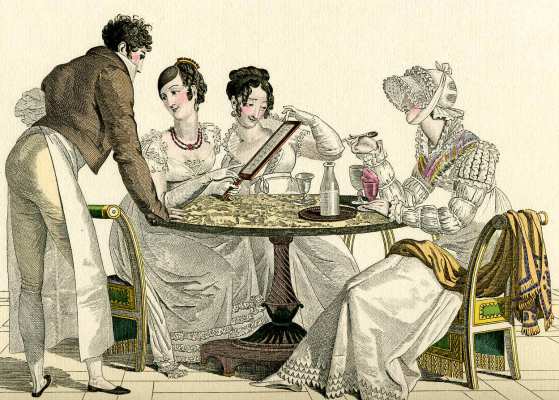
Regency era people enjoyed eating ice at a confectionery shop.
You wouldn't find ice cream like in a modern ice cream parlor but something more like Italian ice or gelato in flavors that seem unusual and exotic to us, like parmasean cheese, alongside normal flavors like lemon. Ice could be molded into fancy shapes for a dinner or ball. The ice cream making device, known as a sabotiere, differed from a Victorian ice cream maker in that it lacked a crank. The sabotiere was placed in a bucket surrounded by ice and salt and then the cream was hand-turned.

The ice cream was flavored with natural flavors like berries, spices and rosewater.
Creams could be fancy molded confections or flavored whipped creams.
As technology advanced and sugar refining become easier, desserts evolved into the modern sweets we know today.
This was a great presentation with some unusual historic sweets to try.
Sunday, June 26, 2016
Love and Friendship: Take Two
Love and Friendship: Take Two
I recently wrote a review of the Wilt Stillman adaptation of Jane Austen's Lady Susan. Herein I attempt a review of the novelization of the film.
 Love & Friendship: In Which Jane Austen's Lady Susan Vernon Is Entirely Vindicated by Whit Stillman
Ostensibly written by Lady Susan Vernon's nephew by marriage in 1858, this is an attempt to vindicate Lady Susan, who, in the original novella, is the most awful mother and an accomplished flirt. The nephew claims that anonymous spinster maligned his aunt by making up certain situations and dialogues. He attempts to remedy that with his own memories - and fails. The dialogue is terrible. It's stilted and unnatural but in the movie, it's funny! The actors can pull it off and make it seem funny. The narrator is a dreadful, pompous, bore who inserts his very Victorian ideas into the story. While I do feel bad for Lady Susan, being around the same age, it would have been hard for her as a poor widow, to find another husband or some other way to live. In the original novella, she's scheming and callous but according to her nephew, Lady Susan and Alicia had their own language and often shared inside jokes any listener would misunderstand. Riiigghttt...
The story is a bit funny in parts but mostly because I saw the movie so I can picture the actors' facial expressions. I don't think Jane Austen would have written a character so stupid as Sir James Martin. She poked fun at people but not people who are truly intellectually challenged, as Sir James seems to be. Lady Susan still isn't very likable despite her nephews assertions to the contrary and Frederica comes across as kind of Fanny Price-ish.
This is a so-so attempt at fan-fiction and I applaud his attempt to go with a lesser known work. I didn't have high hopes coming into the movie but expected better of the novelization.
Sunday, June 12, 2016
Movie Review: Love & Friendship
Movie Review
Love & Friendship

All photos copyrighted and taken from imdb.com. No copyright infringement intended. For illustration purposes only.
Love and Friendship is a take on Jane Austen's epistolary novella Lady Susan. The film, by Whit Stillman, stars Kate Beckinsale as Lady Susan Vernon, a recent widow mooching off the kindness of her relatives and friends and gobbling up any eligible man she can find. All this while trying to figure out what to do with her teenage daughter who simply refuses to behave.
I enjoyed this movie once I got into it. I didn't quite remember the beginning but I did remember most of the rest. They added a new ending after Austen's story ends. I didn't think the ending sounded true for the character. Lady Susan is anything but stupid so I don't think she would have revealed what she did when she did. The other big change was to Sir James Martin who is turned into a complete simpleton, much more the fool than Jane Austen intended him to be. The rest of the plot is largely what I can remember from the novella.

The acting was mostly good. Kate Beckinsale, an Austen veteran, plays Lady Susan with just enough humor to make her seem sort of likable... sort of... Lady Susan is an anti-heroine, one people will not want to root for. I feel some degree of sympathy for her because she is a widow with no money and the only way to get money if you were a Georgian woman was to marry it. Her conduct toward Frederica, on the other hand, will not win her any "Mother of the Year" awards.

Morfydd Clark plays Frederica to perfection. She's a bit more plain than I pictured Frederica. I don't think Lady Susan would have a plain daughter. Her acting was great. She played Frederica as sweet, shy and a bit timid but when surrounded by people who love her, she comes out of her shell.

Tom Bennett was a hoot as Sir James Martin, the dim witted suitor of Frederica Vernon.

On the bad side of acting was Xavier Samuel as Reginald DeCourcy. He was dull to the extreme. His delivery was flat and dispassionate.

On the female side, Chloë Sevigny, as Alicia Johnson, Lady Susan's American friend, is pretty bland. Honorable mention goes to Sophie Radermacher was way over the top as Maria Manwaring. She portrayed Maria as a woman a bit unhinged and on the verge of madness. I don't remember that from the book.
The real stand out are the costumes! They are so gorgeous! The styles look pretty accurate for the Georgian period. The costumes tell a story about the characters. I noticed Frederica stayed in mourning the longest. Lady Susan's colors go from deep mourning, to half mourning, to WOW! I especially liked Frederica's pale yellow chemise dress.

Also amazing are the historic homes in Ireland that serve as the sets. I tried to spot anachronisms and the only one I think I saw was a framed Ackerman's fashion print but it was hard to tell.
I'd like to think Jane Austen would be pleased with this adaptation of her novella.
Friday, May 22, 2015
What I Read in December Part IV . . .
What I Read in December Part IV . . .
 Dangerous Deceptions by Sarah Zettel--Young Adult Historical Fiction/Romance
This sequel to Palace of Spies has Peggy still at court, as herself this time, as a maid of honor to the Princess of Wales. She's shocked when her betrothed, Sebastian, turns up like a bad penny wanting to continue the engagement. After his attempted rape, Peggy wants nothing to do with him. She's also stuck making nice to her uncle, for the sake of her freedom and friendship with Olivia. Little Princess Anne's dog is about to have puppies and she wants Olivia to be Guinevere's midwife. Peggy is not enthusiastic about the project for she has enough to deal with court gossip and trying to figure out the game Sebastian is playing and what her uncle wants from her. Her mentor, Mr. Tinderflint is in Paris hoping to locate Peggy's father so she can finally be free from her uncle. When Uncle Pierpont refuses to give up her betrothal contract, Peggy and Olivia plot to discover the truth even if it means breaking a few laws. Peggy's beloved Matthew is along for the adventure to keep Peggy safe, but he can't be there all the time. Not even the Princess of Wales can save Peggy from an unwanted marriage or an another attack from Sebastian. If she uncovers nefarious secrets, her life may even be in danger. She must use all her wits and money to stay one step ahead or everything she's worked for and dreamed of will crumble to dust.
This book didn't move as quickly as the first one did.l I didn't reach the couldn't put it down stage until very late in the novel. The plot is filled with intricate details of life in court. The historical detail is amazing and I really got a sense of what it was like to be a courtier in early Georgian Britain. However, all that detail gets in the way of the plot. There's also a subplot about Peggy's friend that bears no real relevance to the main plot and is not fully resolved. I was able to figure out what Peggy's uncle was up to before she did. The ending is very abrupt and could use an epilogue. The book could also use an historical note to explain what was real and what happened after the events of the novel. The adventure part of the novel moves along quickly and is heart-in-your-throat exciting. I expected more of a heist plot though.
I love the characters in this novel. Peggy and Olivia are very modern women. Olivia especially is unrealistic for an 18th century woman, but there were some eccentric ladies and the restrictions on women were less than what they would become by the end of the Georgian period. Olivia provides the comic relief as does little Princess Anne. I liked Peggy too. For all she's supposed to be a spy, she isn't a very good one. I picked up on things she should have noticed much sooner. However, I like her because she's not perfect. She's not a super intelligent spy; she's just a girl caught up in circumstances beyond her control. She doesn't have all the answers and makes a lot of mistakes. I think this makes her a character teen girls can relate to and it makes her vastly appealing. I like how she uses her wit to battle her way through the court gossips. Matthew is a swoony sort of hero only found in storybooks. Their relationship made a nice change from the usual bickering couples.
The romance is sweet: kisses only. There is talk of rape, "tumbling" and mistresses. The few swear words don't fully appear in print. There is one scene of violence against animals which I did not care for. This book is geared for ages 14+. I think adults will like it too.
Dangerous Deceptions by Sarah Zettel--Young Adult Historical Fiction/RomanceThis sequel to Palace of Spies has Peggy still at court, as herself this time, as a maid of honor to the Princess of Wales. She's shocked when her betrothed, Sebastian, turns up like a bad penny wanting to continue the engagement. After his attempted rape, Peggy wants nothing to do with him. She's also stuck making nice to her uncle, for the sake of her freedom and friendship with Olivia. Little Princess Anne's dog is about to have puppies and she wants Olivia to be Guinevere's midwife. Peggy is not enthusiastic about the project for she has enough to deal with court gossip and trying to figure out the game Sebastian is playing and what her uncle wants from her. Her mentor, Mr. Tinderflint is in Paris hoping to locate Peggy's father so she can finally be free from her uncle. When Uncle Pierpont refuses to give up her betrothal contract, Peggy and Olivia plot to discover the truth even if it means breaking a few laws. Peggy's beloved Matthew is along for the adventure to keep Peggy safe, but he can't be there all the time. Not even the Princess of Wales can save Peggy from an unwanted marriage or an another attack from Sebastian. If she uncovers nefarious secrets, her life may even be in danger. She must use all her wits and money to stay one step ahead or everything she's worked for and dreamed of will crumble to dust.
This book didn't move as quickly as the first one did.l I didn't reach the couldn't put it down stage until very late in the novel. The plot is filled with intricate details of life in court. The historical detail is amazing and I really got a sense of what it was like to be a courtier in early Georgian Britain. However, all that detail gets in the way of the plot. There's also a subplot about Peggy's friend that bears no real relevance to the main plot and is not fully resolved. I was able to figure out what Peggy's uncle was up to before she did. The ending is very abrupt and could use an epilogue. The book could also use an historical note to explain what was real and what happened after the events of the novel. The adventure part of the novel moves along quickly and is heart-in-your-throat exciting. I expected more of a heist plot though.
I love the characters in this novel. Peggy and Olivia are very modern women. Olivia especially is unrealistic for an 18th century woman, but there were some eccentric ladies and the restrictions on women were less than what they would become by the end of the Georgian period. Olivia provides the comic relief as does little Princess Anne. I liked Peggy too. For all she's supposed to be a spy, she isn't a very good one. I picked up on things she should have noticed much sooner. However, I like her because she's not perfect. She's not a super intelligent spy; she's just a girl caught up in circumstances beyond her control. She doesn't have all the answers and makes a lot of mistakes. I think this makes her a character teen girls can relate to and it makes her vastly appealing. I like how she uses her wit to battle her way through the court gossips. Matthew is a swoony sort of hero only found in storybooks. Their relationship made a nice change from the usual bickering couples.
The romance is sweet: kisses only. There is talk of rape, "tumbling" and mistresses. The few swear words don't fully appear in print. There is one scene of violence against animals which I did not care for. This book is geared for ages 14+. I think adults will like it too.
Saturday, May 31, 2014
Movie Review: Belle
Movie Review
Belle

Starring: Gugu Mbatha-Raw, Tom Wilkinson, Emily Watson, Sarah Gadon, Tom Felton, James Norton, Miranda Richardson, Penelope Wilton
Dido Elizabeth Belle Lindsay, the illegitimate daughter of Royal Navy Captain Sir John Lindsay and a slave, is brought to England after the death of her mother. Her father deposits her in the care of his uncle, Lord Mansfield, Chief Justice of England. Lord Mansfield insists Dido is raised under his protection because she shares his name and blood. Young Dido is reared alongside Lord Mansfield's other niece, Elizabeth, who is Caucasian. The two girls quickly become friends and sisters, but as they grow to be of marriageable age, the differences become apparent. Hovering the background is the Zong case. A slave ship master is seeking insurance money for "cargo" he was forced to dump overboard in order to save his ship and his crew; or so he claims.

This is an incredible story that shows the difficulties of being a woman in the 18th century. Dido has money but as a woman of color, what opportunities are available to her? Elizabeth is white, but she's not acknowledged by her father and doesn't even have a dowry. What opportunities are available to her? The answer is marriage, but should they marry for love or social position? What happens if the two are not compatible? This questions complicates the story and turns it into a love triangle. This part of the plot is certain to please fans of period drama movies, literature and old-fashioned romantics. The love story is tied into the questions of race and slavery as Dido begins to question her identity and her social standing while her Papa must make an important decision. The history behind the story is not known on this side of the Atlantic, though I have heard of similar slave ship stories. The plot raises some interesting questions. It's very emotional and moving. I believe the plot would also appeal to lawyers and politicians and those who are interested in debating social issues. Though the Zong incident was horrific, I was glad to learn about it to understand more about slavery through the eyes of Georgian era Britons.
The acting was largely top-notch in this nearly all-star cast. Gugu Mbatha-Raw is not only gorgeous, she is an incredible actress. She has an express face which conveys everything Dido is feeling. There are several key moments when no words are spoken but her actions easily show the meaning of her complicated feelings. Gugu Mbatha-Raw truly makes the story. She sucked me right in with her amazing acting. I don't think the story would have been as appealing if not for her. My only quibble is that as fine an actress as she is, why is she so much lighter than the real Dido Belle?

The supporting actors are also great. Sarah Gadon, as Elizabeth Murray, reminded me a lot of Romola Garai. She's bubbly and expressive. Elizabeth is very innocent and at times, naive. Sarah Gadon displays Elizabeth's emotional journey very well. Tom Wilkinson is fabulous as Lord Mansfield, a man wrestling with his conscience versus his position in Society. Emily Watson as Lady Mansfield has a small role but when she's on screen, I got a sense that Lady Mansfield could end up a Grand Dame worthy of any of Maggie Smith's characters. Miranda Richardson is cast as another waspish lady but she does a fine job portraying the ambitious Lady Ashford. Tom Felton plays her son and I fear the young man has been typecast and will never escape the spectre of Draco Malfoy. Picture Malfoy in a wig and you have James Ashford. The only actor I thought wasn't great was Sam Reid as John Davinier. He picked up speed as he went along but he was fairly wooden in his delivery in the beginning and lacked chemistry with his love interest.
The costumes are exquisite! The colors are rich and the clothing is all so detailed. I love the hats most of all. The men are very handsome but understated in their dark clothing. The women are the peacocks in this version of Georgian England.

The sets are also amazing! The sumptuous houses, the beautiful gardens and the gritty dockside tavern all bring to life different aspects of Georgian life. It was incredible to get a glimpse of Vauxhall in it's heyday. Fans of Georgian and Regency novels will die to see this world brought to life.

The music is beautiful and fits perfectly with the tone of the movie. The soundtrack plays quietly in the background at the right moments and never intrudes on the action of the film.
I highly recommend this movie to anyone who has the opportunity to see it. It's Hollywoodized but a fine film. Pair it with Amazing Grace and then jump across the Atlantic and watch Amistad, 12 Years a Slave and finally, Lincoln.
Sunday, April 27, 2014
What I've Read This Week Part II
What I've Read This Week Part II . . .
 Palace of Spies by Sarah Zettel -- Young Adult Historical Fiction
London, 1716: Margaret "Peggy" Fitzroy is a sixteen-year-old orphan living with her parsimonious Uncle Pierpont and family as a poor relation. Fortunately for Peggy, her cousin Olivia sees Peggy as a close friend and ally in whatever scheme they can come up with. Peggy's uncle has decided to marry her off to a young man she's never seen. While Olivia thinks of marriage in terms of freedom, Peggy is worried because she's never even laid eyes on the man. When she discovers his true nature, she refuses to marry him and is rewarded with a swift kick out the door with nothing but the clothes on her back. Enter Mr. Tinderflint, a foppish fellow who claims to have been a friend of Peggy's mother. Tinderflint and his confederates, the grim faced Mr. Peele and puritanical Mrs. Abbott, have an adventure in mind for Peggy. Her mission, should she choose to accept it, to pose as Lady Francesca Wallingham, maid of honor to Caroline, the new Princess of Wales. Pose as a Lady in a Hanoverian court just while the Jacobites plot to put the Pretender on the throne? Are they mad? Peggy really has no choice, at least until Olivia can find a way to rescue her. Peggy finds life at Court full in intrigue and danger. There's Francesca's secret beloved to fend off and the company of Tinderflint, Poole and Abbott. Not to mention Sophy, her fellow maid who, for some reason, can't stand Francesca/Peggy. There's also the kind painter's apprentice, Matthew Reade, who wants to be Fran/Peggy's friend. Then Peggy begins to realize not all is what it seems at Court and her very life may be in danger. Has she gotten herself too deep into a game she can't win? Is there anyone she can trust?
This book in non-stop adventure. I couldn't put it down and stayed up far too late into the night reading. I didn't even finish it before I fell asleep. Just when I was going to put it down, something happened that made me need to read one more chapter, and then in the next chapter after that there were answers to the questions and before I knew it, it was past 2:00 a.m.! Needless to say I enjoyed the plot very much. I had a hard time figuring out what was going on and who could be trusted. I had no doubt how it would all turn out because there is a sequel, but getting there was thrilling. I did sort of guess at what Francesca had been up to before her death. I never really figured out how deep she was playing and why until Peggy figured it out. The book is chock full of period details, especially lengthy descriptions of fashion and getting dressed. The plot revolves around politics and I liked learning about the Hanovers in the time of George I. It seems that people at Court were more frivolous and earthy than their descendants at the time of George III and IV. I'm taking off points for lack of author's note. I was hoping an author's note would explain the politics a bit better and tell the reader the history behind the plot. I'm also taking off points for a near ravishment scene that goes a bit too far and also a depiction of a young woman and young man "rutting." Both bits were necessary to advance the plot but I didn't like either scene.
I love the characters. Peggy is a plucky, intrepid young woman. She has a deep understanding of the way the world works but she's no Fanny Price like poor relation. Her cousin treats her as an equal so she feels capable of acting as an equal. Her talent for drama comes in handy quite often. She's very brave even when she hits rock bottom. She's a little naive at times but she doesn't have a choice but to trust people when she needs help. She's similar to other teen heroines of the later Georgian era like Cat Royall and Jacky Faber but I like her better than Jacky because she's not too over-the-top exaggerated. She's a teenage girl with real feelings. Also delightful is Peggy's cousin Olivia. She's very naive but not in a stupid way. Though her father is cheap, she's spoiled because she's lived a comfortable life. She goes through life treating each day like a stage drama and dreaming up adventures and schemes for she and Peggy. She does not have her head in the clouds though and she's able to think on her feet and come through when it counts.
Mr. Tinderflint, Mr. Peele and Mrs. Abbott are also well-rounded characters. They're very mysterious and Peggy doesn't know really what they're up to or whether each has his or her own agenda. One of the three comes across as a bit two-dimensional once it's figured out what they're all about. The other two remain fully developed characters. I wish there was more Mr. Tinderflint in the story because I like him, especially the way he talks. The other characters are largely flat. Sophy is a typical mean girl. I kept hoping for more about her and why she hated Francesca/Peggy so much and how much she had figured out. Another character I loved to hate experiences a personality change and isn't quite developed on page enough.
This exciting adventure novel will appeal to readers 13+, especially those who like Julia Golding's Cat Royall adventures and L.A. Meyer's Bloody Jack adventures.
 The Bishop's Daughter by Susan Carroll --Regency Romance
3 1/2 stars
Harcourt Arundel, Earl of Lytton was wounded at Waterloo and now he's on his way home to his estate for the first time in a year. He knows no one will be waiting for him because his stepmother is always "ill," his vicar cousin thinks harry is consigned to hell and his one true love, Kathryn Towers coldly refused his offer of marriage. Harry arrives home just in time to discover he's late for his own funeral - literally. The entire neighborhood has come out to Harry's favorite spot for a memorial service. Harry's momentary shock at everyone's believing he is dead, gives way to mirth. When Kate Towers hears that laugh, she thinks she's hearing a ghost and promptly swoons into Harry's arms. When she realizes he's alive, she throws herself into his arms for a passionate kiss and then, realizing what she had done, slaps Harry. Harry understands that Kate truly loves him or she wouldn't be so angry. He also understands that a Bishop's daughter would never marry a hell born babe like Harry was. He's reformed now; if he hadn't already been bored with his dissipated life, Waterloo would have cured him of it quickly. How can he convince the very proper Bishop's daughter they belong together? Kate is stubborn and clings to her father's notions of proper behavior. It will take some help to bring these two lovebirds to the alter, where they belong.
This is a straight up romance. There's no adventure or a true villain causing problems. There's are some minor villains who cause problems along the way, but not a central mystery or villain. The story involves courtship and romance. At first I feared it might be a reworking of The Taming of the Shrew/Kiss Me Kate, but it wasn't, fortunately. It moves a little slowly. I could have used more courtship and less of the middle. It would make a cute novella if it was tightened up a bit. It's not a long novel but it felt like it at times. The emotions of the story stay largely on the surface. The author keeps it very light and I wanted a bit more of an emotional connection. The hero and heroine share a moment at the end that I would have liked to have seen sooner and developed better. The romance is very clean. The sensuality is implied rather than spelled out. We know what Kate is feeling from her actions rather than thoughts. I especially liked this technique.
Kate is a very proper young lady. She cares for her invalidish mother all by herself, brings aid to the parishioners who need it and behaves just as a Bishop's daughter ought. That makes her really annoying, in my opinion. She's always claiming to be so proper and not wanting to do anything her father wouldn't have liked, but she possesses an inner rebellious spirit. I liked her better when she allowed her passion to show through. She supposedly loves Harry but she's quick to make assumptions, listen to gossip and pass judgement. I kept wishing for her to talk to Harry. They're supposedly very close and she's supposedly in love with him but she doesn't act much like it. I found her difficult to like.
I loved Harry! I usually do like rakes but Harry is done with all that before we meet him. He's handsome, charming, an excellent sportsman, good with people of all ages and social classes and trying really hard to do the right thing. He's a great hero who doesn't deserve such an annoying heroine.
The secondary characters are all mostly two-dimensional stock characters. One reminds me of a character in Pride and Prejudice. This person got very interesting at the end and I wanted to know more of their inner thoughts and feelings. I especially liked Lady Deane, Kate's formidable Grandmama. She adds some humor to the story.
I liked this novel but it was largely forgettable.
Palace of Spies by Sarah Zettel -- Young Adult Historical FictionLondon, 1716: Margaret "Peggy" Fitzroy is a sixteen-year-old orphan living with her parsimonious Uncle Pierpont and family as a poor relation. Fortunately for Peggy, her cousin Olivia sees Peggy as a close friend and ally in whatever scheme they can come up with. Peggy's uncle has decided to marry her off to a young man she's never seen. While Olivia thinks of marriage in terms of freedom, Peggy is worried because she's never even laid eyes on the man. When she discovers his true nature, she refuses to marry him and is rewarded with a swift kick out the door with nothing but the clothes on her back. Enter Mr. Tinderflint, a foppish fellow who claims to have been a friend of Peggy's mother. Tinderflint and his confederates, the grim faced Mr. Peele and puritanical Mrs. Abbott, have an adventure in mind for Peggy. Her mission, should she choose to accept it, to pose as Lady Francesca Wallingham, maid of honor to Caroline, the new Princess of Wales. Pose as a Lady in a Hanoverian court just while the Jacobites plot to put the Pretender on the throne? Are they mad? Peggy really has no choice, at least until Olivia can find a way to rescue her. Peggy finds life at Court full in intrigue and danger. There's Francesca's secret beloved to fend off and the company of Tinderflint, Poole and Abbott. Not to mention Sophy, her fellow maid who, for some reason, can't stand Francesca/Peggy. There's also the kind painter's apprentice, Matthew Reade, who wants to be Fran/Peggy's friend. Then Peggy begins to realize not all is what it seems at Court and her very life may be in danger. Has she gotten herself too deep into a game she can't win? Is there anyone she can trust?
This book in non-stop adventure. I couldn't put it down and stayed up far too late into the night reading. I didn't even finish it before I fell asleep. Just when I was going to put it down, something happened that made me need to read one more chapter, and then in the next chapter after that there were answers to the questions and before I knew it, it was past 2:00 a.m.! Needless to say I enjoyed the plot very much. I had a hard time figuring out what was going on and who could be trusted. I had no doubt how it would all turn out because there is a sequel, but getting there was thrilling. I did sort of guess at what Francesca had been up to before her death. I never really figured out how deep she was playing and why until Peggy figured it out. The book is chock full of period details, especially lengthy descriptions of fashion and getting dressed. The plot revolves around politics and I liked learning about the Hanovers in the time of George I. It seems that people at Court were more frivolous and earthy than their descendants at the time of George III and IV. I'm taking off points for lack of author's note. I was hoping an author's note would explain the politics a bit better and tell the reader the history behind the plot. I'm also taking off points for a near ravishment scene that goes a bit too far and also a depiction of a young woman and young man "rutting." Both bits were necessary to advance the plot but I didn't like either scene.
I love the characters. Peggy is a plucky, intrepid young woman. She has a deep understanding of the way the world works but she's no Fanny Price like poor relation. Her cousin treats her as an equal so she feels capable of acting as an equal. Her talent for drama comes in handy quite often. She's very brave even when she hits rock bottom. She's a little naive at times but she doesn't have a choice but to trust people when she needs help. She's similar to other teen heroines of the later Georgian era like Cat Royall and Jacky Faber but I like her better than Jacky because she's not too over-the-top exaggerated. She's a teenage girl with real feelings. Also delightful is Peggy's cousin Olivia. She's very naive but not in a stupid way. Though her father is cheap, she's spoiled because she's lived a comfortable life. She goes through life treating each day like a stage drama and dreaming up adventures and schemes for she and Peggy. She does not have her head in the clouds though and she's able to think on her feet and come through when it counts.
Mr. Tinderflint, Mr. Peele and Mrs. Abbott are also well-rounded characters. They're very mysterious and Peggy doesn't know really what they're up to or whether each has his or her own agenda. One of the three comes across as a bit two-dimensional once it's figured out what they're all about. The other two remain fully developed characters. I wish there was more Mr. Tinderflint in the story because I like him, especially the way he talks. The other characters are largely flat. Sophy is a typical mean girl. I kept hoping for more about her and why she hated Francesca/Peggy so much and how much she had figured out. Another character I loved to hate experiences a personality change and isn't quite developed on page enough.
This exciting adventure novel will appeal to readers 13+, especially those who like Julia Golding's Cat Royall adventures and L.A. Meyer's Bloody Jack adventures.
The Bishop's Daughter by Susan Carroll --Regency Romance3 1/2 stars
Harcourt Arundel, Earl of Lytton was wounded at Waterloo and now he's on his way home to his estate for the first time in a year. He knows no one will be waiting for him because his stepmother is always "ill," his vicar cousin thinks harry is consigned to hell and his one true love, Kathryn Towers coldly refused his offer of marriage. Harry arrives home just in time to discover he's late for his own funeral - literally. The entire neighborhood has come out to Harry's favorite spot for a memorial service. Harry's momentary shock at everyone's believing he is dead, gives way to mirth. When Kate Towers hears that laugh, she thinks she's hearing a ghost and promptly swoons into Harry's arms. When she realizes he's alive, she throws herself into his arms for a passionate kiss and then, realizing what she had done, slaps Harry. Harry understands that Kate truly loves him or she wouldn't be so angry. He also understands that a Bishop's daughter would never marry a hell born babe like Harry was. He's reformed now; if he hadn't already been bored with his dissipated life, Waterloo would have cured him of it quickly. How can he convince the very proper Bishop's daughter they belong together? Kate is stubborn and clings to her father's notions of proper behavior. It will take some help to bring these two lovebirds to the alter, where they belong.
This is a straight up romance. There's no adventure or a true villain causing problems. There's are some minor villains who cause problems along the way, but not a central mystery or villain. The story involves courtship and romance. At first I feared it might be a reworking of The Taming of the Shrew/Kiss Me Kate, but it wasn't, fortunately. It moves a little slowly. I could have used more courtship and less of the middle. It would make a cute novella if it was tightened up a bit. It's not a long novel but it felt like it at times. The emotions of the story stay largely on the surface. The author keeps it very light and I wanted a bit more of an emotional connection. The hero and heroine share a moment at the end that I would have liked to have seen sooner and developed better. The romance is very clean. The sensuality is implied rather than spelled out. We know what Kate is feeling from her actions rather than thoughts. I especially liked this technique.
Kate is a very proper young lady. She cares for her invalidish mother all by herself, brings aid to the parishioners who need it and behaves just as a Bishop's daughter ought. That makes her really annoying, in my opinion. She's always claiming to be so proper and not wanting to do anything her father wouldn't have liked, but she possesses an inner rebellious spirit. I liked her better when she allowed her passion to show through. She supposedly loves Harry but she's quick to make assumptions, listen to gossip and pass judgement. I kept wishing for her to talk to Harry. They're supposedly very close and she's supposedly in love with him but she doesn't act much like it. I found her difficult to like.
I loved Harry! I usually do like rakes but Harry is done with all that before we meet him. He's handsome, charming, an excellent sportsman, good with people of all ages and social classes and trying really hard to do the right thing. He's a great hero who doesn't deserve such an annoying heroine.
The secondary characters are all mostly two-dimensional stock characters. One reminds me of a character in Pride and Prejudice. This person got very interesting at the end and I wanted to know more of their inner thoughts and feelings. I especially liked Lady Deane, Kate's formidable Grandmama. She adds some humor to the story.
I liked this novel but it was largely forgettable.
Wednesday, October 16, 2013
What I've Read Recently part I
What I've Read Recently Part I . . .
 Jane Austen's England by Roy and Lesley Atkins -- Non-Fiction
Jane Austen's England covers life in the Georgian era from birth to death. The authors use letters, diaries and other period sources to describe how the common people REALLY lived. Far from the genteel world of the drawing rooms of Jane Austen's novels, the England portrayed in this novel is dark, dirty, diseased and at times crude. The authors nicely balance "period drama" world that we love to romanticize with the world of the common people. They cover the lives of the gentry and the aristocrats but also explain the difficulties of trying to survive as a common working man or woman. The chapters cover everything from etiquette, advice and fashion to disease and death. I especially liked the extensive quotes from period sources to show that the authors did their own original research. At times this book was really slow and relied on quotes that were far too long. I knew a lot of this information already from reading other books about Jane Austen's life and times and also from blogs. I do feel I learned a lot though. The language is fairly accessible to non-scholars but the use of primary sources may be daunting to some. I would recommend this book to those who have a serious interest in learning more about Georgian England.

The Annotated Pride and Prejudice: A Revised and Expanded Edition
Jane Austen's England covers life in the Georgian era from birth to death. The authors use letters, diaries and other period sources to describe how the common people REALLY lived. Far from the genteel world of the drawing rooms of Jane Austen's novels, the England portrayed in this novel is dark, dirty, diseased and at times crude. The authors nicely balance "period drama" world that we love to romanticize with the world of the common people. They cover the lives of the gentry and the aristocrats but also explain the difficulties of trying to survive as a common working man or woman. The chapters cover everything from etiquette, advice and fashion to disease and death. I especially liked the extensive quotes from period sources to show that the authors did their own original research. At times this book was really slow and relied on quotes that were far too long. I knew a lot of this information already from reading other books about Jane Austen's life and times and also from blogs. I do feel I learned a lot though. The language is fairly accessible to non-scholars but the use of primary sources may be daunting to some. I would recommend this book to those who have a serious interest in learning more about Georgian England.
The Annotated Pride and Prejudice: A Revised and Expanded Edition by Jane Austen, edited by David M. Shapard
The Annotated Pride and Prejudice: A Revised and Expanded Edition
by
Jane Austen,edited by David M. Shapard contains the original text of
the novel and on the facing page, explanations on the text. Included
throughout are period illustrations, many of which have nothing to do
with the story. There is also a chronology, maps, and a bibliography.
Clocking in at over 700 pages, it's a difficult task to read all the
annotations. I felt like many of the annotations were unnecessary. The
reader can figure out the meaning from the context. I also skipped a lot
of the annotations explaining different types of carriages, clothing,
etc. and things I already knew. What I really liked was the explanation
of etiquette. Because there's so much to keep track of I have a hard
time remembering everything, but here it's in context so it's easier to
remember. I also liked that the annotations forced me to reevaluate my
thoughts on the novel. I had to look more carefully at the characters
and their words and motivations. I didn't interpret everything the same
way as the editor but it was interesting to read his take on it and
review my own thoughts. I found myself not liking the Bennets very much -
not even Lizzy. In contrast, I liked Darcy more than ever before. I
don't really know why except that the interpretation made me see the
characters in a new light. Mr. Bennet is a terrible father when
previously I thought he was funny and not so bad as Mr. Darcy makes him
out to be. I loved Lizzy before and thought she was witty and now I
think she's a bit more rude than I had realized and she tends to always
make light of situations like her father. I admire her for her
outspokenness and willingness to stick to what she feels is right.
The
illustrations are nice to have but some don't have any relevance to the
story. This paperback edition only has black and white illustrations.
The maps are not very detailed but help provide a frame of reference.
If
you are reading this novel for the first time, especially for a class, I
would recommend this edition. If you're an experienced scholar who has
studied Jane Austen's life and times, you won't really need this much
explanation.
Monday, July 8, 2013
Professor Amanda Vickery
Professor Amanda Vickery

I finally had a chance to browse YouTube to see some wonderful documentaries hosted by Professor Amanda Vickery.
At Home With the Georgians

This documentary supplements Professor Vickery's book. She takes the viewer on a trip through Georgian era homes and explains the importance of home and the meaning of home in the Georgian era. She uses diaries, prints, artifacts and other period objects to delve into the period. I was only able to find Part 3 Safe as Houses in full and clips of other parts.
She starts by setting the scene: nighttime in London today is an exciting, energetic place but not so in the Georgian era. Nighttime was dark and threatening. A house breaker could enter over the gate or down the chimney armed and dangerous ready to attack anyone who stood in his (or her) way. Georgians went through great lengths to protect their homes.
Dr. Vickery examines the seamier side of Georgian life. A diary of a well-respected widowed clergyman reveals a secret affair with a maid which deeply troubled his conscience.
She also discusses the plight of women without an independent income. She looks at the diary of a married woman who felt captive in her own home. Due to her husband's increasing jealously, he placed serious restrictions on her movement. She stayed for the sake of her children. Another sad story involved a spinster dependent on her brother for a home. She had no rights at all and was constantly made fun of and was deeply unhappy and lonely. Finally, an inheritance from an aunt allowed her to become independent in her 40s. This story hit home for me, being a single woman without a fortune. It also showed a bit of what Jane Austen's life must have been like before she published her first novel. How liberating it must have been for her to finally have some money all of her own.

This documentary was a bit dull at times, especially when Dr. Vickery was examining locks and anti-burglar devices. History really came alive when she read from diaries. Actors portraying the real people make the stories come to life. I loved seeing both the diaries and the representations of the people who wrote them. I would have enjoyed the first two parts of the series more but they were unavailable. Dr. Vickery is personable and truly seems to love researching the period. Her joy shines through on her face as she shares her research with her viewers. This series makes history more tangible and accessible for the amateur historian.
The Many Lovers of Jane Austen
Despite what the title may sound like, this documentary is about the people who love Jane Austen. It examines her enduring legacy and the reasons why nearly 200 years after her death her books remain so popular. She discusses Jane Austen's fame with noted scholars and public figures such as the Earl of Spencer, whose ancestor Lady Bessbourough was among one of Jane Austen's first fans. Each person interviewed reads an excerpt from one of the novels and scenes of modern readers reading all over the place are shown.

Dr. Vickery tours Chawton cottage and debunks the myth of the shy spinster. She concludes that publishing anonymously was merely a polite convention and that witty Miss Austen enjoyed playing games with people who didn't know she was the author. By the 1820s, the romantic movement ushered in the age of sweeping landscapes as a character which made Jane Austen passe. At the end of the 19th century, Jane Austen came back into print thanks to the invention of train travel. Train stations sold and continue to sell cheap paperback copies of her novels. Jane Austen's nephew also wrote a memoir of his famous aunt that brought her back into public notice. It wasn't until around 100 years after her death that Jane Austen achieved immortal fame. She became the subject of study by a group of intellectuals and professors, the first Janeites, who examined Mansfield Park and the social commentary within. Rudyard Kipling read Jane Austen to his wife and daughter to ease the pain of his only son Jack in World War I. He even wrote a story about soldiers in the trenches enjoying the light escapism of Jane Austen's novels.
Dr. Vickery also looks at the movie versions of Pride and Prejudice, the first being the famous Olivier movie people either love or hate. The scholar explains that this movie was a hit Broadway comedy and it wasn't intended to be a faithful production of the novel. The next movie aired in the 1960s in Britain and was aimed at a juvenile audience. In the 1980s, Jane Austen finally arrived on the BBC (BBC2) in an expensive production, but it wasn't until 1995 when Jane finally catapulted into super stardom. Andrew Davies' sexed up script and Colin Firth in a wet shirt made Jane Austen a household name and created legions of new fans. Since then, Jane Austen has become a brand.

Dr. Vickery traveled to Bath to the Jane Austen festival and to Texas to the annual JASNA meeting where she met ladies in costume; learned Mr. Wickham sends panties to ladies along with his phone number; and shopped for Jane Austen themed tea and souvenirs. Finally, it is concluded that Jane Austen mania has peaked in the West but it just getting started in Asia.

This documentary is fabulous and a must watch for any Janeite. I knew some of the history but this documentary delves much deeper than any biography or blog post I've read so far. I especially liked the visuals - seeing clips of the movies I haven't seen (OK and seeing Colin Firth in a wet shirt again) and seeing the fans dressed in costume.I was a little taken aback at the commercialism of Jane Austen. I don't mind sexed up Jane Austen as long as it's tasteful and within the realm of possibility because I think it introduced new fans to her lovely novels. I enjoy the movies and I adore the novels. I like buying themed gifts and I cherish rare books and academic discussion. I think Jane Austen can be accessible to everyone if they try and if it takes commercialism to do it, then so be it. I think Miss Austen would get a kick out of all the fuss.

Pride and Prejudice: Having a Ball With Jane Austen
Professor Amanda Vickery and art critic Alastair Sooke hosted this 90 minute special which recreated the Netherfield Ball from Pride and Prejudice. The purpose was to uncover the deeper meaning behind the ball and everything that would have gone into it. This was something that Jane Austen's readers would have been aware of but has gotten lost over time. The Netherfield Ball was a private invitation only event to which only the best families in the county would be invited. The hosts take the viewer on a detailed journey to look at period customs, music and food.
To recreate the ball, a troop of ballet students was recruited to learn several complicated dances. They found it far more difficult and energetic than they expected. The music was chosen from Jane Austen's own music books. Alastair took a look at a manuscript music book that could have been written in Jane Austen's handwriting and even contained a doodle in the margin!
The food was painstakingly recreated from Georgian era recipes, some by Martha Lloyd. The food is quite different from what we're used to. May jellies and ices and alcoholic drinks were served alongside meat and vegetable dishes all at the same time. People could reach across the table and grab whatever they wanted.This type of meal was haute cuisine and would have been very luxurious for the Bennets. One of the dancers said that it was possible, if you were attuned to someone and they were speaking loudly, to hear what was being said across the table, despite the noise. This verifies what Jane Austen wrote in Pride and Prejudice about Mr. Darcy hearing Mrs. Bennet's conversation.

Clothing and makeup is also examined. The costume designer chose silk taffetas for the wealthy Bingley sisters who would have had their gowns made in London. The more provincial Bennets would make do with a local dressmaker. Elizabeth may have made her own dress, remade from an older one. The costume designer chose a sheer white muslin with embroidery. She gave lie to the myth that some ladies dampened their petticoats for muslin becomes see through when wet. If it happened at all, it was for a very private party. Not even Lydia would be so bold!

Modern electric lights were removed and beeswax candles were made to adorn the small room in Chawton House where the ball was held. As the evening went on, the dancers took on more and more characteristics of the period. They became flirty and high spirited, especially once a new young man was introduced into the mix. They also became very hot under all the candlelight! Amanda Vickery remarked that she found herself watching the men more than the ladies because their calves were easier to see. Dancing well must have been more important for the gentlemen than the ladies because it was a chance for the ladies to check out the gentlemen. I know from my visit to Colonial Williamsburg that this was indeed true. The expression "put your best foot forward" actually comes from dancing. Some gentlemen padded their calves to make them look more muscular and thus more attractive to the ladies. In short, a ball was an elaborate courtship ritual.

In between ball preparations, an actress portraying Jane Austen wrote her novel with her quill pen.
This program is absolutely spectacular! What a labor of love! As a social historian, I thoroughly enjoyed all the historical details revealed through the creation of this ball. I especially liked learning about the food and the music which I have not studied much. I appreciated all the attention to detail and seeing how the food, costumes and lights made the dancers act. Their comments were very interesting and informative. I loved this behind-the-scenes look. It would have been nice to actually see more of the dancing after all that rehearsal. This documentary will appeal to casual Austen fans, amateur historians, social historians and the general public. I highly recommend trying to watch it or read the article from BBC news.
Subscribe to:
Posts (Atom)