Tuesday, May 19, 2015

What I Read in November Part II . . .

What I Read in November Part II . . .

Penelope's Postscripts by Kate Douglas Wiggin-- Historical Fiction
This is the first and last episode in the Penelope series. It takes place just after A Catherdral Courtship and features cameos from the characters of that novel. As Penelope and friends travel through Europe, she jots down impressions in her diary. These impressions are not as polished or as amusing as her other extracts. The descriptions are not as detailed and the story focuses a lot on other characters. It concludes with Penelope telling us what she's up to now in 19__.

Penelope's Irish Experiences by Kate Douglas Wiggin-- Historical Romance

Penelope, now a matron; Francesca, happily engaged and Salemina, still single; ate traveling together once again. "Himself" (Penelope's husband) is busy with business matters back home and Ronald Macdonald can't leave his parish. The trio of friends travel through each of Ireland's 4 provinces and encounter a noted scholar, his children, a tragic romance and several notable locals. Traveling with them is Brenella, a young woman from Salem traveling to Ireland in search of her relatives. After collapsing on Salemina's trunk, the older lady took the younger one under her wing and employed her as a maid. Brenella will do anything for her beloved employers, but where will she go once the summer ends?

This book starts off great, with a tongue-in-cheek scene where Penelope realizes that she and her friends are like characters in a three volume novel! Salemina refuses to have anything to do with such stuff and nonsense but Penelope knows better. Past events coupled with the charm of Ireland may work their magic on her. As with the previous books, there's tons of local color which is very charming and funny. However, this time the author footnotes her literary references, explains things in the text and sometimes focuses too much on Irish poetry and not enough on the plot. There's also a fair amount of social commentary. During this time the Irish question was foremost on every Briton's mind and the author has Penelope wonder philosophically on why the Irish are so poor and ragged and an entire section is devoted to Irish grievances against the English. All that was a bit too much for me. The plot came to a very slow conclusion. I would have liked more in the romance department, including more of an ending. It was very abrupt.

I would recommend this series to armchair travelers and those who love late Victorian era literature. If you L.M. Montgomery's novels I think you will like these. They're very charming and fun for the most part. I'm sad to leave my traveling companions behind but thanks to several universities and Google, we can read digital versions of these forgotten stories. Do try to find the versions with illustrations by C.E. Brock. They really add to the story and are very charming.

What I Read in November Part I

What I Read in November Part I . . .

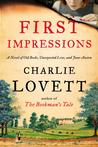
First Impressions: A Novel of Old Books, Unexpected Love, and Jane AustenFirst Impressions: A Novel of Old Books, Unexpected Love, and Jane Austen by Charlie Lovett-- Historical Speculative Fiction/Contemporary Romance/Austenesque

This dual narrative novel tackles Jane Austen's life, the history of printing and publishing, modern romance and intrigue. In 1796 in Hampshire, a clergyman's daughter named Jane Austen happens across a rumpled old man sitting on a stile hunched over reading. Her first impression is that he is a comical figure to be put in a novel she may write one day. His first impression is that she is a rather dull and impetuous young lady. Happily their first impressions are wrong and they soon discover they have a lot in common. They both love to read novels and Mr. Mansfield is also a writer. He has written one book of dull allegorical tales for children but he knows what it takes to be a great writer and he sees it in Miss Austen. The pair soon become close as Mr. Mansfield advises Jane on her writing and provides life advice as they share long walks and cups of tea. Jane trusts him with her darkest secret and Mr. Mansfield comes up with a plan to atone for Jane's feelings of guilt. This plan may alter the course of literary history forever. In present day Oxfordshire, Sophie Collingswood has just completed her Masters' Degree in nineteenth century literature and is wondering what to do next. She's looking forward to some advice from her beloved, bibliophile Uncle Bertram. When she encounters Eric Hall, a brash American who mocked her favorite author (Jane Austen, of course), she's prepared to dismiss him, but as Jane Austen knew well, first impressions may not be entirely correct. Sophie's world is shattered when her uncle dies. She takes comfort in the fact he left her his extensive library, but she is shocked to learn his books were sold to pay his debts. She's determined to get them back one way or another. Her search leads to her a rare book dealer who gives her a job. On the day she's hired, a hunky young man comes in the store to chat her up. He's searching for the second edition of Mansfield's book. When it becomes clear Sophie can't find it right away, he's content to be with her. Then another customer calls looking for the exact same book and he is not so friendly. He threatens Sophie and makes her fear her uncle's death was not as innocent as it seemed. Why are they searching for this particular book? When she finds it, she receives the shock of a lifetime and discovers her favorite author may have plagiarized her most famous novel. Sophie sets out to clear the name of her beloved Jane Austen no matter what; then she can figure out her love life and what she wants to do with the rest of her life.

This is a thrilling book with lots going on. A summary can only scratch the surface. I loved the bookishness of the contemporary plot. Rare books, libraries and history centers are my true love so the setting of the novel appeals to my nerdy heart. The biggest strength of the novel is Jane Austen's plot. I feel the author was true to what we know of her. I truly appreciated the love story. It's a nice change to read a love story that isn't romantic or familial. I hope Jane did have someone like that in her life. We know she was close with Madame LeFroy, but I liked how Mr. Mansfield mentored her and helped shape her writing. The description of life in 18th century Hampshire was excellent. The author didn't try too hard to make Jane's novels inspired by real life. There are some places and incidents that influence her writing but in a natural way. It didn't feel forced the way most novels about Jane's life do. The story almost made me teary eyed towards the end.

Sophie is a great heroine. She's very real. She's not perfect. She's been hurt, she's made mistakes and she's aware of her faults. She's insecure outside of the world of academia and trying to figure out how to be a grown-up. I can really relate to that, being in the same place in my life. She's tenacious, and though I don't approve of some of her methods, I can see me doing many of the same things. I found her relationships interesting. The Mr. Darcy love interest was so swoony - I fell in love with him and the Willoughby suitor was just too obvious to be believable. I found Sophie far more believable and well-written than the contemporary male characters. The men were very two-dimensional and not fleshed out enough. I wanted a bit more character development for one of the two boyfriends. Sophie does shag a man but nothing is really described but how it made her feel. It's mentioned a few times and there's a tiny bit of skin in a second shagging scene, but nothing is described in detail so I rate this as a clean read but not kisses only.

The weak parts of the novel made me bump it down from 4 stars. First, it was obvious which one of Sophie's boyfriends was Mr. Darcy and which was Willoughby. She should know that by now. She chose to ignore what her beloved Jane teaches her readers. The villain was also rather cartoonish. Another thing I didn't like were the obvious inaccuracies about book collecting, rare book shops and libraries. Not only were there inaccuracies, I didn't approve of Sophie's methods of obtaining what she wanted. As a librarian, she should know better. The story also relies too much on coincidences. I also found sections on the history of printing that were from the point-of-view of the printer very boring and unnecessary.

Even with all the faults, I found the mystery so compelling that I had to keep turning the pages to find out how Sophie solved the mystery. It's a real page turner. I also liked the parallel between Sophie's relationship with her Uncle Bertram and Jane's relationship with Rev. Mansfield. I loved reading the (imagined by Lovett) first draft of First Impressions. It was pretty poorly written and if it had remained as such, no one would be reading it today. It really showed what a skilled writer Jane was.

This review is based on my first impression. I need to read it again to see if my opinion changes. I highly recommend it to Janeites, bibliophiles and fans of "chick lit."

What I Read in October Part VIII

What I Read in October Part VIII . . .
Persuasion: An Annotated EditionPersuasion: An Annotated Edition by Jane Austen

A wonderful annotated edition of my favorite Austen novel. This book is filled with notations in the margins gathered from various literary critics. It also contains full-color images showing Austen's world, illustrating scenes from the story, other books/pamphlets and items of note mentioned in the novel. This book is worth looking at for any devoted Janeite.


Penelope's Experiences in ScotlandPenelope's Experiences in Scotland by Kate Douglas Wiggin -- Historical romance


Penelope, Selemina and Francesca are in Scotland, taking Edinborough by storm. There's plenty of scope for their romatic imaginations, new people to meet and new places to explore. Penelope's fiance will follow as soon as he can from Paris to visit with his beloved Penelope. Francesca continues to incur the enmity of a clergyman named Ronald MacDonald. She's so patriotic that his bias against America gets her goat every time.

This story starts off very amusing. Penelope's antics made me cringe a bit. She tries too hard to be a local but it's all in good fun. This section is followed by several chapters on religion which I found boring. I skipped a lot of that part. The story really picks up once they get to the country. There are plenty of quirky characters in Scotland to make the story amusing. I did not like the excessive quoting of Scottish ballads. I also didn't like all the dialect in the story. It made the dialogue hard to follow at times. I would recommend this book to fans of Anne Shirley. It reminded me a lot of one of Maud's books with all the local color and poetry. Not surprising, since PEI was home to many people of Scottish heritage including Maud Montgomery and her husband Ewan McDonald. I think Anne would recognize Penelope as a kindred spirit.

The Firefly Letters: A Suffragette's Journey to CubaThe Firefly Letters: A Suffragette's Journey to Cuba by Margarita Engle--Young Adult Historical Fiction

In this verse novel, Swedish women's rights pioneer Fredrika Bremer travels to Cuba in the 1850s and changes the lives of those around here. There's Cecilia, whose own father sold her into slavery to this distant land. She's expecting her first child, knowing that he or she will never see her homeland because they will belong to someone for the rest of their lives just as she and her husband Beni do. There's also Elena, the daughter of Fredrika's wealthy host. Elena feels like a slave cooped up in her room sewing for her hope chest. She's never allowed outdoors except in the courtyard. She's 12 years old and in a few years her father will arrange her marriage to a business partner or some other acquaintance and she'll move from her father's house to her husband's. Such is the sum total of her life and she finds it very confining but not knowing how to break free, she must put up with it. She envies Cecilia who is allowed to show Fredrika around and who can travel through the streets at night rescuing fireflies.

This novel is short but it packs a punch. Verse is the only way to tell the story. The descriptions of Cuba are so amazing and detailed that it needed the poetry to describe this land. I especially liked the beautiful descriptions of Cuba and how this Eden was juxtaposed with the evils of slavery. I know very little about the history of Cuba and this story was a real eye opener. I kept thinking "how sad" at the end of each chapter and teared up a little at the end. My heart breaks for Cecilia who will likely not live past the birth of her child. She's a wonderful character who showcases the reality of slavery. I also felt bad for Elena, but at least she has a bit of freedom. She may not know how to obtain it yet but she might some day. I have studied this time period and American reformers but never encountered Fredrika before. I really liked her and how she had the courage to leave her father's money behind and do what she felt in her heart was right. I want to know more about her and this novel has inspired me to look her up.


What I Read in October Part VIII

What I Read in October Part VII . . .

Wouldn't It Be Deadly (Eliza Doolittle & Henry Higgins Mystery, #1)Wouldn't It Be Deadly by D.E. Ireland -- Cozy Mystery

This mystery used characters from George Bernard Shaw's play Pygmalion with many tongue-in-cheek references to the musical My Fair Lady. It helps if you're familiar with both before reading this but not necessary. It might be better not to know the characters ahead of time.

In 1913 Eliza Doolittle has left her home in Wimpole street after the Embassy ball in which she passed as a Duchesss. She's now working as an assistant for Henry Higgins' biggest rival, Emil Nepommuck, a Hungarian count. (Or is he merely pretending?) Eliza tries to use the methods Higgins used with her, but finds her male clients want tp flirt and her female clients want to copy her fashion. To make matters worse, someone is lurking about turning off the lights on a stormy day and Eliza might be in danger. When Higgins returns home from Spain with Col. Pickering and discovers Eliza has decamped, he's furious and threatens to ruin Nepommuck. Henry makes the unwise choice to wonder why one of Nepommuck's clients hasn't put a knife in his back yet. Unfortunately for Higgins, someone does and first Eliza and then Henry are the chief suspects. Eliza is certain her friend and mentor did not kill her employer and she's determined to prove it. Henry Higgins is exasperated and annoyed by Eliza at every turn. He knows he's innocent but he can't prove his allibi. It's not something he can ever share. Can Eliza really solve the mystery? Meanwhile Freddie is still courting Eliza and not at all happy about her new activities. He also has a rival for Eliza's affections, a poetry-loving Sanskrit scholar and ex-Army officer has come to London to work with Colonel Pickering. Will one of them win Eliza's heart?

I didn't know whether to cringe in horror or be super excited at the idea of continuing the story of one of my favorite musicals of all time. My Fair Lady was my first professional live musical theater production and I have the movie memorized. I have read the play, but only once a long time ago. I do not think all the characters were true to the originals. I loved Eliza. You can take the girl out of the East End, but you can't take the East End out of the girl. She's a bit naive still but brave and plucky. I know she's supposed to be in love with Higgins ("I only know when he/began to dance with me/I could have danced, danced, danced al night") but she doesn't realize it. Romance is not the focus of her life right now. She thinks she'll settle down with Freddie but she is much more vibrant and intelligent than a Society girl. She's stumbles into situations she shouldn't be in but I found her charming and delightful anyway. I liked the characterization of Henry Higgins for the most part. I did NOT buy his backstory/allibi at all. I also never got the impression he was in love with Eliza. Yet this Henry clearly is and they would actually make a good couple despite the age difference and Henry's misogynistic ways. Col. Pickering is faithful to the original as Eliza's fairy godfather. He doesn't have a large role in the story. Freddie is a bit of an idiot but I think he's spot on for a young man of his situation.

There are many new characters as well and they are too numerous to mention. They're typical of the people who move in and out of London Society in the early 20th century. Any one of them could be the murderer because Emil is a nasty guy.

The plot kept me up waaaayy too late. I wasn't at all surprised by the big reveal but there were enough twists and suspects that I wasn't all sure whodunnit. This is a cozy mystery but a little bit violent in parts. The story moves around London and we get to see Eliza's world past and present. I liked the descriptions of London and the things that were going on. The plot had TOO much going on and too many suspects though. The plot includes topics ripped from today's headlines such as police brutality, class issues, death with dignity and a transgendered person. It was too much for one story. The author's writing style also sounded a little too modern for the period. I liked when Eliza slipped into East End speech. It sounded much more authentic.

I need to go back and reread the play again and see if this novel is true to the original.

Friday, May 1, 2015

Historical Food Fortnightly Challenge #24

Historical Food Fortnightly Challenge #24: 

"Snacks"


The Challenge: Snacks
Who doesn’t love a snack? Make something meant to be consumed in between meals, on the go, or late at night when you’re scrounging for munchies!


The Recipe: 

1955 U.S.
Don't know year -1970s or 80s maybe?


How Did You Make It:
Marshmallow Nutties
 I tried unsuccessfully to score a Graham Cracker in quarters but that proved nearly impossible so I took my fragments, popped half a marshmallow on top, added a few chocolate bits and zapped in the microwave for 20 seconds. I then added a peanut on top of the marshmallow and chocolate and topped with another piece of Graham Cracker.

Kix Mix
I took a more inspired by route for this one. I forgot to buy Kix so I used whatever I had on hand: 1 small bag of Honey Nut Cheerios, 1 small box of Crispix, 1 c. Quaker Oatmeal Squares and 1 c. Kashi Cinnamon Harvest shredded wheat squares. I replaced raisins with Craisins and tossed in about a cup of cut up marshmallows. Then I put honey and the pudding mix in a pan on the stove and proceeded with the directions. I managed to burn the pudding mix a bit so I hastily mixed in some peanut butter and raced to spread it over the cereal mix before it cooled. I put it in the fridge to cool for about an hour and then broke into smaller bits and pieces. 


Time to Complete:  1)20 seconds
                                         2) 30 minutes + cooling time

Total Cost: $10.56 + Graham Crackers, dark chocolate bits and cereal I had at home


How Successful Was It?: 1)Very successful - the sweet and salty combo is a good S'mores flavor. 
2)Because I had larger cereal than Kix, I didn't have enough mix to spread over the entire mixture and the peanut butter was cold and clumped. The flavor is Ok. The sweet and salty mix is an odd taste but surprisingly addicting. My dad said "That's tasty!" My mom said "Tastes OK."


How Accurate Is It?:  1)The recipe was 100% accurate aside from using the microwave
2) Inspired by more than accurate 


Monday, April 20, 2015

Historical Food Fortnightly #23

Historical Food Fortnightly Challenge #23: 

"Sweet Sips and Potent Potables"


The Challenge: Sweet Sips and Potent Potables

Whether it’s hard or soft, we all enjoy a refreshing beverage! Pick a historic beverage to recreate - remember to sip responsibly!


The Recipe: Albumen Beverages
This drink recipe was included in the section with Barley Water and Beef Tea so I assume it's a drink for a sick person. The egg whites provide protein. 

Beat 1 egg white to a froth. Add 1/3 cup orange or lemon juice. Sweeten to taste with a syrup made by boiling 1 cup sugar in 1 cup water 12 minutes. Albumen water is made by mixing beaten egg white with 1/2 cup milk

Lily Haxworth Wallace, The Lily Wallace New American Cookbook, Books Inc., New York, 1947

How Did You Make It: I used pasteurized egg white in a carton, beat that with an electric mixer until foamy and mixed with 1% milk. 

I then squeezed two naval oranges by hand (because of course I can't find the juicer I swear I saw lying around a couple days ago). I only managed about 1/6 c. juice. I strained it and put it in a bowl. I boiled 1/2 c. sugar in 1/2 c. water for 12 minutes. Then I beat another egg white and added it to the orange juice. Finally, I did a stupid thing and poured the entire syrup into the glass. It was way too sweet and I never say that. 


Time to Complete: About a half hour

Total Cost: I had all the ingredients on hand.


How Successful Was It?: Success... yet it was too sweet with all the syrup and the orange taste was overshadowed by the sugar.


How Accurate Is It?:  The recipe was 100% accurate. 

Thursday, April 2, 2015

Historical Food Fornightly #22

Historical Food Fortnightly Challenge #22: 

"Make It Do or Do Without"


The Challenge: Make it Do or Do Without

Working around food availability to gain a desired outcome has been a challenge throughout history. Whether supplementing seasonal produce, dealing with rationed or blockaded food in wartime, or re-imagining a dish without access to crucial ingredients, the cooks of the past had to get creative. Do homage to their ingenuity by interpreting historical substitutions.

This was super easy for me, being well versed in food rationing and food substitutions. For more on that see my online exhibit on food in the World Wars (http://rifoodwars.tumblr.com).
The real challenge was finding a recipe that didn't use the oven since ours is broken!

The Recipe: I chose to make Cornstarch Pudding from Bureau of Home Economics, United States Department of Agriculture and the Consumer Division Office of Price Administration, Recipes to Match Your Sugar Ration, May 1942.


Cornstarch Pudding
1/3 c. cornstarch
1/4 tsp. salt
1 quart milk
1/2 c. sugar, honey, cane or maple sirup
2 tsp. vanilla or 1 square chocolate

Mix the cornstarch and salt with 1 cup of cold milk. 


Scald the remainder of the milk in the top of a double boiler. Add the cornstarch mixture to the milk. 


Let it boil until thick and smooth, stirring constantly. Just before taking from the [heat], add the sirup and vanilla flavoring. If chocolate is used, melt the chocolate and add some of the pudding to it, then mix with the rest of the pudding. pour into molds and allow to cool before unmolding. If vanilla flavoring is used, served with fresh fruit. Serve chocolate pudding with cream or custard sauce.


How Did You Make It: I cut the recipe in half, cooked it on a modern electric stove according to directions. I used maple syrup and vanilla flavoring and made one with a few semi-sweet chocolate chips mixed in. I used ramekins as pudding molds, placed the warm pudding in the refrigerator over night to set the pudding. I didn't have fresh fruit or cream and custard sauce has raw eggs so I ate the pudding as is.


Time to Complete: an hour to cook and cool overnight.

Total Cost: I had all the ingredients on hand.


How Successful Was It?: Success... yet it is really really gross. The texture and taste were OK but the cold pudding is not very appealing so I ended up throwing most of it out since no one else would eat it. It reminded my mom too much of stories about my cousin's mom growing up poor in rural West Virginia and only having cornstarch pudding for dessert.

How Accurate Is It?:  The recipe was 100% accurate.