Saturday, June 11, 2011

What I've Read This Week

What I've Read This Week . ..
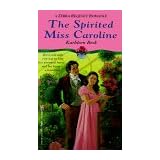
The Spirited Miss Caroline by Kathleen Beck -- Regency Romance
Miss Caroline Garvey is 21 and unmarried and she intends to stay that way. Two years ago she had a whirlwind romance with her former childhood tormentor, Lord Barnabas Cole. The relationship ended with her sending him a scathing letter accusing him of trifling with her affections. She hasn't seen him since nor does she want to. She wants to live at her beloved Monksend Manor forever. However, her home is entailed upon the next male heir, in this case, her cousin Charles, a dandy who prefers the London life to country living. When Caroline learns that cousin Charles has intentions of marrying an American heiress, Miss Faith Morgan and is bringing his bride-to-be, her two sisters Miss Hope and Miss Charity and his future mother-in-law to the manor, Caro thinks the visit will be brief. However, Charles has lost all his money to none other than Barnabas and needs to live at the manor. What's worse, is his vulgar mother-in-law, a former fishmonger's daughter, who has her sights set on an entree into the ton and using Monksend Manor to do it. Then she discovers Barnabas has come along too, determined to renew the relationship with Caroline on his terms. Caroline feels forced to take action. Enlisting the aid of her factotum, Royal, she plans a haunting to scare her unwanted guests away forever. When Barnabas learns of Caroline's deceit, he's determined to humble her and bring her back into his arms. Caroline labels Barnabas "Lord Puppet Master" which is a fitting epithet for him. I did not like him at all. I thought he was a colossal jerk to Caroline and didn't like his manipulating. Caroline has the potential to be an unsympathetic character. She's proud and stubborn and rewrites history to make herself look good. I liked her though and felt sorry for her. The secondary characters are stereotypical. They make Americans and lower class people look stupid and conniving. Miss Hope is a Scarlett O'Hara character. Some parts of the book were amusing but mostly I just couldn't stand all the manipulating and lying. It lacked the charm of a Georgette Heyer or even some of the better writers of mass market paperback Regencies. 


The Seventh Sister by Paula Tanner Girard -- Regency Romance
This is a sequel to The Sister Season which I have not read.

Captain Bixworth Hawksby, on leave in London, is on Cloud 9 because the beautiful actress Miss Divine has just consented to allow him to be her latest protector. Lady Margaret is the seventh daughter of the late Earl of Chantry and his third wife. She, along with her older sisters, have joined their half-brother in London for the Season. Maggie hates London and the social whirl. She would much rather be at home at their estate near the Scottish boarder hunting bugs. Maggie is an etymologist, an interest which does not endear her to London Society. When Maggie's brother Daniel and his wife, Maggie's half-sister Frankie, are called away on business, Daniel decides Maggie needs a chaperon to take her around to the functions she wishes to attend. Hawksby, daydreaming of the lovely charms of Miss Divine, literally runs into his old superior officer Daniel Durham, Earl of Chantry. Daniel decides Hawksby is just the chaperone for Maggie. Hawksby is dismayed. Last Season she led him on a hunt through the bushes for a bug and his regimentals were ruined beyond repair. When Daniel reminds Hawksby of a personal debt, Hawksby has no choice but to agree. Maggie thinks Hawksby is too sober and decides to lead him a merry dance across England. This Season Maggie doesn't lead him on a chase through the mud and bushes but she does lead him on a chase through London museums and lecture halls. He's never been so bored in his life nor more captivated by Maggie's womanly figure.  Hawksby has his job cut out for him chaperoning Maggie and trying to keep Miss Divine out of the arms of a rival.  That's pretty much the whole plot. There's not much chemistry between Hawksby and Maggie. She's little more than a child and he is consumed with thoughts about his mistress for nearly the whole book. I found Maggie interesting because of her intellectual pursuits and though I hate bugs, I can see myself dragging someone through the museums of London. Hawksby is a very bland character. He has little personality until 3/4 of the way through the book. We know little about him until that point. I'm not quite sure if it's totally proper for a house full of young ladies to be left alone and for a stranger to chaperone a young girl. The premise of the book sounded funny but really wasn't. You don't have to read The Sister Season to read this book but the characters refer to events that occurred in that book and I had a hard time figuring out the family relationships which are likely explained in the first. I wouldn't recommend this book to anyone except those who are interested in etymology.

Friday, June 10, 2011

Women in History

Women in History: 
Lucy Kenney


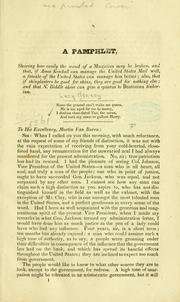
In the 1830s, Lucy Kenney was an aspiring writer living and working in Washington, DC. She first wrote for the Democrats (Martin Van Buren). President Van Buren refused to compensate her for her expenses. He paid her $1 to go away and made her really mad so she turned to writing for the Whig party. The Whigs were the conservative party of the day. They favored the right of each state to make decisions on which laws to uphold and in the South, they supported slavery and the status quo. It seems strange that an independent woman would be attracted to the Whigs. She was originally from Virginia and felt slavery was an important issue and that abolitionist activity threatened the southern way of life. At any rate, the Whigs offered to pay her $100 for her support, an enormous sum of money during a time of economic depression.


She published scathing attacks on Van Buren, claiming that he had gained power through false pretenses. S. She wrote some really nasty stuff about him claiming that he had “poisoned, and laid waste, genius, commerce, enterprise, agriculture, and every thing that was noble, and calculated to improve and elevate this rising nation— you have crushed and withered by your hateful measures and policy, every opening bud of genius, and even shook the firm and unbending oak." he compared him to the serpent in Eden and blamed him for present economic difficulties.

She supported Whig candidates for President in 1836 and 1840. She felt the President should not abuse his power, claiming: “We want a President, distinct from his cabinet, independent in thought, feeling, action ; one who has a great, good mind — a mind capable to exercise, profound, healthy, and honest measures, out of which the interest, prosperity, and advancement of this great nation, will grow and flourish like a green bay tree .” Lucy Kenney felt that the Democrats were corrupt and dishonest and only Whigs were honorable.

Lucy Kenney also attacked abolitionists. She believed abolitionists were dangerous and promoted bloodshed. She said:  “[Abolitionists] boldly aim deadly poisoned arrows at our dearest rights, our domestic peace, our prosperity, our life; who by their fiendish doctrine, would infuse dissatisfaction, rebellion, and death, into the hearts of our domestics, our friends, our children.” In her mind, abolition was a dangerous thing because each state and each voter should be allowed to decide whether they wanted to have slaves or not. 

She also thought abolitionists misinterpreted the Bible. She believed that God orders servants to be obedient to masters in order to earn their "heavenly reward." Abolitionists encouraged disobedience.

She also compared slaves to immigrant workers in northern cities, claiming that slaves had food, shelter and clothing given to them which made them better off than northern wage workers.

 I'm not sure she believed what she wrote or if she did it because she was being paid to. She claimed she was writing out of patriotic duty to her country but I'm sure that money was a good incentive! Lucy Kenney was a woman of strong opinions. I admire the way she was willing to speak out and say such bold things. Not much is known about her but she sounds like someone to admire, even if I disagree with her political beliefs.


Wednesday, June 8, 2011

What I've Read Lately

What I've Read Lately . . .

Robin by Frances Hodgson Burnett -- Historical Romance

This romantic drama by the author of A Little Princess and The Secret Garden takes place during WWI in a rapidly changing England where all the charm and beauty of the world seems to be disappearing. Lost in their own bubble of love, Robin and Donal Muir are elated to find each other again after being parted after their first meeting as children about 15 years earlier. Robin is the lonely only child of an uncaring mother, who upon the death of her husband, accepted financial support from the elderly Head of the House of Coombe. Assuming that Robin's mother is the mistress of the Marquis, other mothers did not allow their children to play with Robin. A chance meeting with a strange boy in the garden while her nanny wasn't paying attention introduced Robin to her one true love. Donal loved Robin instantly and wanted to protect her. He promised to return the next day but his mother cruelly whisked him away. Robin and Donal meet again at a house party given by Robin's employer, the Dowager Duchess of Darte. Donal is instantly smitten with Robin and she never stopped worshiping him. The two find ways to be together and romance blooms as if the pair were lost in a bubble of love. The world is at war however, and the love bubble bursts cruelly when Donal marches off to war and is missing, presumed dead. Robin's world is shattered and she feels as if life can not go on. It must though, for the sake of her unborn child. Robin discovers a beautiful, sacred thing that helps her get through long and dark nights. This book explores the powers of mysticism. Apparently this is a sequel to a book called The Head of the House of Coombe. One does not have to read the first to follow the plot of this book. I really wanted to like this novel because I love her children's books, but I just couldn't like it. It was very slow in the beginning and hard to get in to. I couldn't stand Robin who is far too selfless and innocent for me to relate to or like. I prefer heroines with some backbone. Donal is also quite silly and not a very strong hero. I have a hard time believing the mystic elements. The combination of innocent, doe-eyed heroine plus mysticism was just too much for me. If you like Eva Ibbotson's adult romance novels then you will probably like this one.

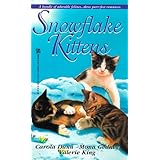
Snowflake Kittens by Carola Dunn, Mona Gedney, Valerie King -- Regency Romance novellas 

In "A Kiss and a Kitten" by Carola Dunn, Miss Mariana Duckworth is enjoying her new home in the country, despite the fact that the locals don't seem very friendly. She loves working in her garden. Her little Golden Retriever provides company and that's all she needs to get by. When Damian Perricourt returns from the wars after the death of his brother, he spies Mariana working in her garden and wonders who the improper female is. Though he finds her attractive, he's convinced she must be hiding something, or why else live alone? He convinces his mother to befriend her and Mariana becomes friendly with Mrs. Perricourt and her two young grandchildren who live with her. Damian, however, remains aloof, until a near-tragedy involving his niece's kitten helps break the ice. This is not Carola Dunn's best story. Her hero and heroine are boring. The romance happens too quickly and unrealistically. Damian acts like a royal jerk for most of the story that when he finally unbends it doesn't seem realistic. This story could have benefited from a few more chapters.

"A Feline Affair" by Mona Gedney is the second novella. Graham Livingstone is on his way to his brother's country home where Robert has lived like a hermit these last two years. Robert had his heart broken when his fiance Marian Piercey jilted him. He believes her to be a jaded fortune hunter. Graham thinks otherwise, which is why he's on his way to visit his brother even though it will put him in close proximity to a Miss Alyce Brightman, a lady who schemes to marry him. Graham hasn't counted on his brother's heart being minded by moldy old Roman ruins just when Graham is about to reunite Robert and Marian! Marian and her mother arrive for a visit and Robert wants nothing to do with them. Meanwhile, Graham has troubles of his own. A raggedy ginger cat has made herself at home on his bed and she insists on bringing him presents of jewels that do not belong to him! Marian pitches in to help solve the mystery and unknowingly, Ginger brings Marian and Graham closer than they had ever dreamed. This is another rushed romance which could benefit from more chapters. I liked the mystery but not the romance. Marian seems nice though we never really get to know her. Graham is a bit boring. He cares more for his clothes and his bachelor status than anything else, including Ginger, at least at first. He does grow throughout the story but it just doesn't seem very much like something that could actually happen.

In "Much Ado About Kittens" Lord Cherriton and Grace Haverstock are competing to see who can marry first. Whoever does will gain full guardianship of their orphaned nieces. The only problem is that Cherriton's fiance Lady Hilary Beaford won't set a date! Grace's fiance, Mr. Mollant, also continually puts off the wedding. Cherriton wonders whether he'll ever be married and gain custody of his beloved nieces. Cherriton takes Lady Hilary to his Aunt and Uncle Plymtree's home where Elizabeth and Emma reside with their Aunt Grace. The girls are to perform a series of plays with their kittens. The subjects of the plays hit a little too close to home for Cherriton and Grace. Once they were passionately in love but Grace blamed Cherriton for the accident that robbed them of their siblings and the previous Lord Cherriton. Lady Hilary and Mr. Mollant don't seem to care for cats or for children. The girls know that their guardians are making the wrong choices but can they, and their adorable kittens, convince the adults of their mistakes? This story sweet and heartwarming. Though it was extremely predictable, the plot seemed realistic. I liked Grace and Cherriton and they had good chemistry. I also adored Aunt and Uncle Plymtree. The children and their cats were a little too cutesy for my taste but not terribly so. I liked this novella the best of the three.

Sunday, June 5, 2011

What I've Read This Week

What I Read This Weekend . . .

Wildwing by Emily Whitman -- Young Adult Historical Fiction

In 1913 England, Adelaide is elated when she's chosen to play the queen in the school play. She's an insignificant nobody; the daughter of a seamstress and nobody knows who. When the other girls from school taunt Addy about her fatherless state, she loses her temper and gets into trouble. Addy's mum is beside herself. She feels Addy should keep her head down and be quiet. Deciding that Addy needs to learn her place, she pulls Addy from school and gets the girl a job as a housemaid in the home of Mr. Greenwood. Mr. Greenwood is an eccentric old man who has been incredibly lonely since the death of his wife and the disappearance of his only son 15 years ago. Slowly, Addy comes to bond with Mr. Greenwood over their love of Shakespeare. He treats her like an equal instead of the servant she really is. When Addy sasses her Mum, her Mum decides that Addy needs a job as a live-in maid instead of working for Mr. Greenwood. Addy is angry. She can't contain her free spirit and she knows she'll be bored as a scullery maid. Her Mum sees the job as a way to a better life. Addy sees it as a prison sentence. When Addy discovers a time-traveling lift in Mr. Greenwood's library, she jumps in and travels back to the 13th century where she hopes she can be free to live her life the way she wants. She's mistaken for Lady Matilda, the ward of the king and the intended bride of Sir Hugh of Berringstoke. Sir Hugh is away and Addy enjoys living in luxury, even if the manners are strange. She finds a way to escape the confines of the castle walls by going out hunting with falcons and the handsome young falconers son Will. Will understands Addy better than anyone. He's a free spirit himself. Soon they've fallen in love, but their love is tested when Addy discovers a secret that could cost Will his life. Unexpected help arrives, but Addy has a difficult decision to make about her future. I liked this book but not as much as I was hoping to. There wasn't enough period details about 1913 and too many about 1240. I found the time travel plot silly and not very logical.  I figured out the mystery in less than 50 pages and it took Addy 250 pages to realize the obvious. I didn't like the ending of the story. I did like Addy and could relate to her desire to be free. I liked her romance though it seemed to happen very quickly. I think this book would appeal to younger teens who are interested in time travel and the Middle Ages. I'm more interested in the Edwardian era and have decided that I really don't like time travel.

Historical Fiction Reading Challenge


Historical Fiction Reading Challenge


Greetings Readers! I have entered the Historical Fiction Reading Challenge sponsored by Historical Tapestry. As you know it's not much of a challenge for me, but it will be fun. I'm aiming for "Severe Bookaholism": 20 books. I've already beaten that but I'd like to see how many I read. I hope some of you will enter the challenge also.

Here's my list of books for June (links lead to my reviews):
  1. Wildwing by Emily Whitman (YA)
  2. Robin by Frances Hodgson Burnett
  3. Snowflake Kittens by Carola Dunn, Mona Gedney, and Valerie King
  4. The Spirited Miss Caroline by Kathleen Beck
  5. The Seventh Sister by Paula Tanner Girard
  6. The Freedom Stone by Jeffrey Kluger (children's)
  7.  Sweet Temptations by Lynn Collum, Wilma Counts, Jo Ann Ferguson
  8. The Scotsman and the Spinster by Carolyn Madison
  9. A Noble Heart by Sara Blayne
  10. The Irresistible Earl by Regina Scott
  11. A Little Folly by Jude Morgan
  12. Picture the Dead by Adele Griffin and Lisa Brown (YA)
  13. The Friendship Doll by Kirby Larson (children's)

    Saturday, June 4, 2011

    Women in History

    Women in History : 
    Mary Chase Barney

    In case you haven't figured it out by now, I'm interested in women's history, especially in ordinary women who did extraordinary things without knowing it. This is the first in a series of posts based on my research for a paper I wrote last semester.


    Mary Chase was born on may 1, 1785 in Baltimore, Maryland. Her father, Samuel Chase, was a signer of the Declaration of Independence and a Supreme Court Judge. In 1808 she married William Barney whose father Joshua was a naval hero of the War of 1812. He was older and had a family from his first marriage. He and Mary had several children together.

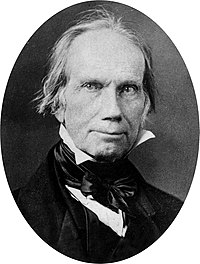
    In 1829, William Barney was removed from his job as a naval customs officer under President Andrew Jackson. Mary Barney was firmly convinced that Jackson fired her husband for voting for John Quincy Adams in the last election. She believed that Jackson replaced honorable men with his political cronies and she was really really mad about it. She was so mad, she published an open letter to the President accusing him of ruining her family. She wrote, “Careless as you are about the effects of your conduct, it would be idle to inform you of the depth and quality of that misery which you have worked in the bosom of my family.” 

    Jackson refused to reinstate her husband and Mary was left to take care of her family during her husband's prolonged illness. She turned to writing a magazine, The National Magazine, or The Ladies' Emporium. She aimed the magazine at women and claimed that it would be "generally literary and occasionally political." It was a lot more than OCCASIONALLY political! She used her magazine to attack the Democrats, especially Andrew Jackson and Martin Van Buren. The country was in a depression at that point and many people blamed the Democrats for not doing enough to get the country out. Andrew Jackson favored a strong Federal Government and high taxes.
    Mary Barney called for the American public to take an interest in politics because the current administration was not behaving honorably and needed to be replaced by more honorable gentlemen who could bring the country back to the simplicity and prosperity of Jefferson's time. She asked, “Will the honest, plain-dealing citizens of the United States continue to be satisfied with an administration, that they must either laugh at or despise?”

    She continued to criticize Jackson claiming, “He could surprise us in no other way than by exhibiting some trait of character which would entitle him to either the esteem which is awarded to virtue and patriotism, or the respect which is sometimes extorted by the union of courage and talent with high-reaching ambition.”

    She also insulted and emasculated Martin VanBuren whom she felt was a  “wily politician” and  “A fearless, highminded, manly openness of conduct, is as much beyond his powers of conception as a melody of sounds is beyond the comprehension of a man born deaf.” 

    It was unusual at this time for women to take such an active role in politics. Usually women played more of a supportive role in politics: waving banners, cooking, attending rallies to make sure men behaved themselves and dressing as patriotic figures. 

    Mrs. Barney claimed she was only doing her duty to care for her family. She often emphasized her role as a mother and apologized for her actions. She played up her femininity as much as possible and used common beliefs about what women were supposed to be like to explain away her actions. She explained that she wouldn't get involved in party politics.  She said, "Female forms are not expected where stout hearts are wanted, because such hearts are rarely lodged in female bosoms.”  Women were not expected to have enough knowledge to be interested in politics, even though she showed that wasn't at all true.

    She was a bit hypocritical though. Even though she tried to work within the framework of what was expected for women at that time, she held strong opinions. Her magazine contained articles on women’s education and the lack of sentimental fiction in her magazine showed that she favored strong-minded, intelligent women and thought that women were capable of intelligence equal to that of men.

    Friday, June 3, 2011

    Women in History

     Women in History: 
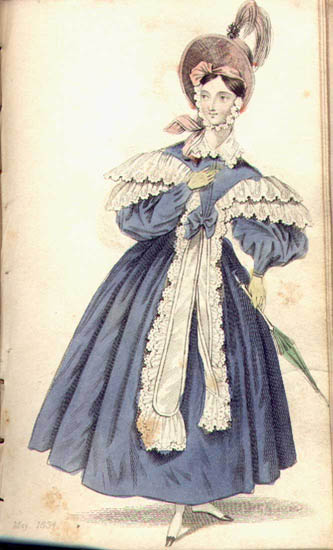
    Behavior for Women in Nineteenth Century America


    I came across some interesting descriptions of feminine behavior in nineteenth century newspapers and magazines. There seemed to be a specific set of qualities associated with women that created an ideal that many people felt women should live up to. 

    On Female character: from The National Magazine, or, The Ladies' Emporium 1831:  Women should behave with “. . . a propriety of deportment, tempered with a sweetness of disposition” 

    In 1834, a "Valedictory to the Pupils of a Female School" was published in The Southern Literary Messenger, a literary magazine published in Virginia. The address outlined how women were supposed to behave. 

    Qualities women were supposed to have included: Self-control, gentleness and benevolence of disposition, purity, rectitude of conduct, courtesy and politeness of manner. "Self-control allows us to command respect and gain esteem" Self-control was seen as the mark of a well-regulated mind. "Other qualities combined with a well-cultivated mind constitute the great charm of domestic and social life." The ladies were advised that any bad qualities must be restrained in public and not to cause annoyance or unhappiness at home or do anything to destroy the peace of the home. [Volume 1, Issue 4]
    An article titled "The Behavior of Females in Company" from the Georgia Journal in 1836 claims southern women were supposed to have “modest reserve”, “retiring delicacy” and “avoid the public eye.” The article claims that “When a girl ceases to blush, she has lost a most powerful charm of beauty.” The article describes proper feminine behavior as modest and silent in company. It advises women to “have a sacred regard to truth” (don’t lie) and a “gentleness of spirit and manners.” Then it says:  “We wish them to possess dignity without pride; affability without meanness; and simple elegance without affectation.”   


    Another newspaper article from The Huntress published in Washington, DC claimed:
    “ . . . woman is a blessing. Her influence over our rough hewn sex is as mild as the moon upon the tide, and twice as powerful. The moral fragrance that surrounds her is as sweet as the odors that arise from a field of white clover; and her beauty makes her one of the most interesting living ornaments that wears either legs or wings; I don’t care whether you mention a bird of Paradise, a butterfly or a straddlebug.” – Dow Jr.  [11/08/1845]

    Another article appearing in The Huntress on the same day titled "A good toast given at the Horticulture Festival in Boston" described the ladies: “The love of plants of earth’s garden, who twice their affectionate tendrils round man’s nature, shielding him from noxious blasts, rejoicing with him in the full leafed summer of prosperity, and aligning to him with unaltered love through the dreary winter of ruin and decay.” 
    [11/08/1845]

    A few weeks later, another article on women appeared in The Huntress. "Woman – The sympathy of woman is one of the crowning excellence of her nature. . . . How brilliantly does this amiable quality shine in the hour of sorrow and death! Then indeed does woman seem like a guardian angel sent from a higher and loftier sphere, to cheer our moments of despondence and distress – to smooth our otherwise rugged passage to the tomb, and prepare the departing spirit for a happy exit from this world of woe. Who, then, will endeavor with impious hands to withdraw her from the position she was destined to occupy – mar the symmetry of her character, and to plunge her into the turbid waters of defamatory scandal!” [11/22/1845]


    In 1847, an article called "The Female Heart" was printed in The Huntress.
    “The female heart may be compared to a garden, which, when cultivated, [illegible] continued succession of fruits and flowers, to regale the soul and delight the eye; but when neglected, produces a crop of weeds, large and flourishing, because their growth is in proportion to the warmth and richness of the soul from which they spring. Then let this ground be faithfully cultivated: let the mind of the young female be stored with useful knowledge, and the influence of woman though undiminished in power, will be like the diamond of the desert sparking and pure, whether surrounded by the sands of desolation, forgotten and unknown, or pouring its refreshing stream through every avenue of the social and moral fabric.” [1/16/1847]

    So basically women were supposed to be sweet and kind and good all the time and not let their tempers show. They were supposed to be moral and religious in order to help make their homes happy and peaceful. Of course not all women could or did behave according to the ideal. I thought you would enjoy reading about some of those who did not and how they claimed that they were upholding the ideal code of behavior. Look for future posts on specific women coming soon.