Thursday, November 10, 2016

A Trip to JASNA AGM 2016 : Pre-Conference Part III

JASNA AGM 2016


A Trip to JASNA AGM 2016 : Pre-Conference Part III


Wednesday night I had the pleasure of attending two wonderful talks. The first was by playwright Ken Ludwig on Jane Austen's comic genius. Ken is a lively, funny guy himself and of course a big fan of Jane Austen. He traced her comic origins back through the literature she read. Novels at that time tended towards the gothic or melodramatic but plays provided the grounding for young Jane Austen to discover humor. The Austens performed amateur theatricals at home. Jane's particular favorite author was Samuel Richardson. She read and reread his play The History of Sir Charles Grandison (1753-4) and the play influenced her early writing. Ken Ludwig noted that all great comic plots come from Shakespeare and Jane Austen's books were no exception. Pride and Prejudice is very similar to Much Ado About Nothing

Following Ken Ludwig's talk was a curator's talk on the Will & Jane exhibit at the Folger Shakespeare. Working at a museum and in archives, I was very interested to hear how this exhibit was put together. The curators, Janine Barchas (Professor of English at the University of Texas) and Kristina Straub (Professor of Literary and Cultural Studies at Carnegie Mellon University) are a dynamic duo themselves. It's quite obvious how much they adore Jane Austen and have a sense of humor about all the memorabilia her works have inspired. They found some really odd things browsing ebay and Etsy but also some really nice homages to a most beloved author and her time period. 

The crowning jewel of their collection is of course the shirt Colin Firth wore as Mr. Darcy. The ladies were extremely excited to get their hands on THE SHIRT! They pondered the possibility of keeping it wet but sadly realized that would be a bad curatorial decision. They talked about the emotions the shirt inspires in people- both women and men. Where women like to pose for "selfies" with the shirt and attempt to kiss the glass, men like to pose for "shirties" behind the shirt, if they're tall enough. Sir Derek Jacobi came to view the exhibit and when the curators told him of the trend for "shirties," he and his husband had to take their own "shirties." The shirt is part of a section on repetition. The curators found many many ceramic figurines of Shakespearean actors (the bobbleheads of the 19th century) in the Folger's vault. There were two poses of Richard III repeated over and over - with only the facial features of the actors changing. The image Mr. Darcy in his wet shirt has also been repeated numerous times.


Benedict Cumberbatch for a Vanity Fair photoshoot
All images for illustrative purposes only. No copyright infringement intended.
The curators undoubtedly had much more to say, but alas, I did not take notes. They were fabulous speakers and the exhibit was wonderful!

Wednesday, November 9, 2016

A Trip to JASNA AGM 2016 : Pre-Conference Part II

JASNA AGM 2016


Satisfy Your Sweet Tooth: A History of Sugar and Dessert


I was lucky enough to get a spot in this talk by food historian and historic foodways consultant Joyce White. Sugar and sweet desserts evolved over time from Medieval England to the Victorian era when desserts became closer to the modern sweets we enjoy today. In Medieval times, sweets were incorporated into the meal. Sugar came from sugar cane and was expensive so honey was more widely used. In the 14th and 15th century sugar-coated seeds and flowers, known as dragĂ©es or comfits, were common eaten. We had the opportunity to try candied violets, which taste very floral. Too much for me. 

Sugar was also used for medicinal purposes. It balanced the humors, especially when combined with vinegar. Sugar and spices were blended with sugar and eaten at the end of a meal to aid digestion. Crystallized ginger was also eaten as a digestive aid. I tried a nibble and it wasn't bad. A larger bite packed a real punch. Eater beware! Sugar coated fennel seeds were eaten 
We also tried sugar coated fennel seeds. Those were actually good. They taste just like crunchy Good and Plenty candies. They must be the forerunners of that type of candy.

Gingerbread was another popular sweet beginning in the medieval period. It was literally ginger bread-made with boiled honey, breadcrumbs and sometimes ground sandalwood chips added for color. This is not the rich molasses gingerbread we know today and it doesn't taste like it. Joyce White's recipe is a transliteration of a medieval recipe. By the 16th century, the honey was replaced by molasses and breadcrumbs with flour. In the 18th century, chemical leavening agents were used in baking.

Before marmalade became common in the 19th century, quince paste was the equivalent in the 16th century. Read more on A Taste of History. I did not like this at all. It smelled strange and tasted as bad as it smelled. It wiggles like Jell-O. I don't eat wiggly foods so after a tiny bite, I passed this one on to my relatives.

Starting in the medieval period, no banquet or dinner party was complete without a fashionable sugar sculpture, known as sotiltees (or subtleties).. Like ice sculptures today, but significantly more ornate, these served as centerpieces on the table. They were 3D objects or scenes made to be admired while food was served around them. Food historian Ivan Day has some magnificent photos of his creations on his blog. These remained popular into the Victorian period.

In Jane Austen's time, small cookies made with currents and flavored with wine, rosewater and/or orange water were popular. Joyce White chose to make Barnet cakes

Ices and creams of all kinds were popular with Georgian and Victorian diners. Ice cream was a rare and expensive treat until the Georgian era. 

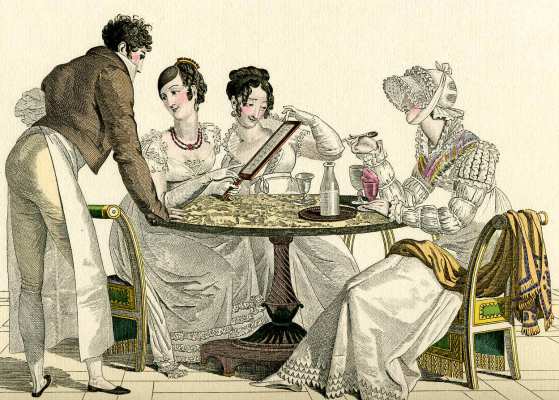
Regency era people enjoyed eating ice at a confectionery shop. 

You wouldn't find ice cream like in a modern ice cream parlor but something more like Italian ice or gelato in flavors that seem unusual and exotic to us, like parmasean cheese, alongside normal flavors like lemon. Ice could be molded into fancy shapes for a dinner or ball. The ice cream making device, known as a sabotiere, differed from a Victorian ice cream maker in that it lacked a crank. The sabotiere was placed in a bucket surrounded by ice and salt and then the cream was hand-turned. 


The ice cream was flavored with natural flavors like berries, spices and rosewater.
Creams could be fancy molded confections or flavored whipped creams.
As technology advanced and sugar refining become easier, desserts evolved into the modern sweets we know today.

This was a great presentation with some unusual historic sweets to try. 

Tuesday, November 8, 2016

A Trip to JASNA AGM 2016 : Pre-Conference

JASNA AGM 2016


I finally made it to an annual general meeting of the Jane Austen Society of North America. This year's meeting was in Washington, DC, my favorite city in the world! I had a free place to stay so I could only just barely afford to go. I went away even though it meant taking a week off work without pay. I had a fabulous time among the Janeites (all 850 of them)!

I arrived on Tuesday. On Wednesday I visited the Folger Shakespeare Library with my traveling companion, mini Jane Austen (my own version of Jane Austen kitsch).

Mini Jane Austen accompanied me to the Jane Austen Society of North America's Annual General Meeting in Washington, DC. She visited the Folger Shakespeare Library where she discovered that in our time, it's the 400th anniversary of Shakespeare's death and approaching the 200th anniversary of the human Jane Austen's death. 


The Folger has put together an incredible exhibit chronicling 400 years of Will and 200 years of Jane's enduring legacies. 


Read about Will & Jane
Shakespeare, Austen, and the Cult of Celebrity


Mini Jane's tour of the exhibit https://goo.gl/photos/kiWrXSCvE6ZPzM1Q6


Sunday, October 9, 2016

Historical Food Forntnightly 2016 #20

Historical Food Fortnightly 2016  Challenge 20

Foods Mentioned in Songs


The Challenge: Foods Mentioned in Songs (September 23 - October 6) Find a historic song that mentions a food - and then cook a historic recipe around that food and the time of the song. Whether it’s Yankee Doodle’s macaroni, mussels a la Molly Malone, or the Muffin Man’s muffins, make sure it’s documented!

The song: "Don't Sit Under the Apple Tree (With anyone else but me)" made famous by Glenn Miller

This song was popular during World War II with young couples like my grandparents. The song originally debuted on Broadway in 1939 in the musical Yokel Boy. The lyrics were changed when the U.S. entered World War II in 1941. It was a top hit from October 1942-January 1943. Glenn Miller recorded the song in 1942. The song was featured in the film Private Buckaroo as a performance by the Andrews Sisters with the Harry James orchestra and featuring a tap dancing routine by The Jivin' Jacks and Jills. The Andrews Sisters then released the song on Decca Records. It remained a popular song in movies through the 40s and even appears in films today. (Wikipedia)

The Recipe: Baked Apple Dumpling

Kitchen-Clatter Magazine October 1949

Dumplings, dough filled with grain, meat, vegetables or fruit date back to ancient times. They were first described in print in the early 17th century. Dumplings can be steamed, fried or baked. Apple orchards were first planted in Jamestown, Virginia by the early English colonists. It took several years before the trees were mature enough to bear fruit and the apples were too tart to eat. These apples were used for cider. By the end of the 18th century, America boasted a wide variety of apples for various uses.

Cookbooks featured recipes for apple dumplings as early as 1765Susannah Carter’s The Frugal Housewife includes a recipe for peeled, cored apples wrapped in thick butter pastry, boiled in a cloth until soft, and served with melted butter, white wine, and grated sugar. American cookbook author Eliza Leslie featured a boiled apple dumpling recipe in her 1840  Directions for Cookery, in Its Various Branches. Baked apple dumplings started to appear in cookbooks by the mid-19th century.

Baked apple dumpling recipes appear frequently in cookbooks of the 1930s, 1940s and 50s.


Date and Region: 1949 Iowa, midwestern United States

How did you make it: The directions were a little vague but I gathered from the ingredients the dough appeared to be a biscuit dough. I measured and sifted the dry ingredients and then lightly stirred in the milk. I rolled the dough and cut into circles.


 After paring and halving the apples, I realized they apples I had were way too big for my dough. I solved the problem by chopping the apples into chunks. I added a teaspoon of sugar, a teaspoon of Ceylon cinnamon and a tiny pat of butter. Then I wet my finger and ran it around the edge of the circle of dough, added another circle on top and pinched together. 


The sauce recipe was vague as to cooking time. I boiled it on the stove until it boiled over and my mom yelled at me. I just poured it over the apple dumplings which were in a buttered casserole dish. 


I baked for 40 minutes until brown and smelling delicious instead of the hour the recipe called for. 

A few days later I baked the leftovers for 35 minutes until the sauce caramelized. 

How Successful Was It?:  Very successful, aside from the sauce. The sauce in the first batch was kind of weird- like applesauce texture. In the second batch the sauce caramelized. Either way they tasted delicious! My brother-in-law said I could open a restaurant with these dumplings. My sister-in-law said they were sooo good. The rest of the family liked them but were not quite as enthusiastic. I enjoyed them with whipped cream. 

Time to Complete: an hour total

Total Cost: My mom bought the apples at a local orchard. I don't know how much she paid. I had everything else on hand. The Ceylon cinnamon was probably the most expensive item but I only used a little bit.

How Accurate Is It?: I don't think late 40s housewives used Ceylon cinnamon but other than that, it's 100% accurate except for using an electric stove and oven. 


Sunday, October 2, 2016

Historical Food Fortnightly 2016 #18


Historical Food Fortnightly 2016  Challenge 11:

Let's Get Saucy!


The Challenge: 
Let’s Get Saucy! (August 26 - September 8) They can be the perfect addition to a delicious dish, the crowning glory, or stand on their own. Make your best sauce and show us how to use it!

The Recipe: 
Hot Chocolate Sauce 

The sauce must be made just before serving time as the ice cream is served the hot sauce is poured over which forms a sort of icing. Put four ounces of chocolate with a cup of sugar and a half cupful of milk in a sauce pan. Cook slowly until the chocolate and sugar are melted and then boil until it slightly hardens when dropped in cold water. Turn at once in a sauce boat and send to the table.

Macon Cook Book: A Collection of Recipes Tested Principally by  Benson-Cobb Chapter, Wesleyan College Alumnae, Macon, Georgia, Wesleyan College (Macon, Ga.). Alumnae, 1909.


Date and Region: 1909 southern U.S.

How did you make it: I melted a mini Hershey bar with sugar and milk in a saucepan. 

How Successful Was It?: Semi-successful. My sauce never really turned hard but it did become a fudge-like consistency. I was afraid to cook it longer for fear it would burn, so I removed it from the stove and poured hot over my ice cream. It still didn't get hard but it tasted good!

Time to Complete: 15 minutes or so?

Total Cost: I bought a bag of mini Hershey bars at Walgreens but I don't remember how much it cost.

How Accurate Is It?: Well, Hershey bars were around in 1909 but that wasn't the kind of chocolate the recipe called for, apparently. You can decide how accurate that makes it!

Historical Food Fortnightly Challenge #17 Part 2

Historical Food Fortnightly Challenge #17

Myths and Legends


The ChallengeMyths and Legends (August 12 - August 25) It’s time to make some legendary food! Pick a story from folklore (a myth, fantasy, legend, or fairy tale) that features food, and use a historical recipe to recreate it. 

As a bonus challenge, I used the fairy tale "Seven Hills of Sweet" by Jane Yolen as my inspiration. An excerpt of the story is as follows: 

"Once in a lovely kingdom called Sweet, which was nestled among seven hills, there lived a noddy old king who loved chocolates. . . . This king loved chocolate above all else.

He had chocolate flakes for breakfast and chocolate sandwiches for lunch. He had chocolate burgers for dinner, which caused seventeen cooks and one dessert chef to quit over the years. He had his castle painted brown so the bricks would look like  chocolate bars and poured hot chocolate into the moat.  . . ."

Jane Yolen, "The Seven Hills of Sweet" in Fairy Tale Feasts : A Literary Cookbook for Young Readers & Eaters", Northampton, Mass: Crocodile Books, USA, 2006.


The Recipe: Chocolate Sandwiches

CHOCOLATE SANDWICH 
Cut thin slices of bread and butter as for other sandwiches have a cake of sweetened chocolate in a warm spot over night or long enough to become soft like cheese Scrape it and spread thickly over the bread and butter then make into sandwiches This sandwich when the appetite is jaded and craves variety will be agreeable to chocolate lovers A cake of chocolate between two crackers is another form of it

 Mrs. John A. Logan, William Mathews, Catherine Owen, Will Carleton, The Home Manual: Everybody's Guide in Social, Domestic, and Business Life , A.M. Thayer & Company, 1889


Chocolate Sandwich No1 
Melt two ounces Lowney's Premium Chocolate. Add two tablespoons hot cream or hot milk two tablespoons wine or one teaspoon vanilla and enough confectioner's sugar to make of the consistency to spread. Use for a filling between crackers or thin slices of bread or cake. Finely chopped nuts slightly salted may be added to the chocolate mixture. 

Maria Willett Howard, Lowney's Cook Book: Illustrated in Colors : a New Guide for the Housekeeper, W. M. Lowney, 1921 –


How did you make it? : I let a mini Hershey bar melt on the counter in the hot sun. I spread some not butter, not margarine spread on some white bread, cut off the crusts and spread on the chocolate.

I melted a mini Hershey Bar and the last of my Taza chocolate on the stove with some milk vanilla and confectioner's sugar. 

Time to Complete: 20 minutes including letting the chocolate melt

How Successful Was It?: Technically it was successful but tastewise, it wasn't as good as I had expected. As much as I love chocolate, this one didn't appeal to me.

I tried to mix a Hershey Bar, Taza Chocolate and some powdered sugar on the stove. It didn't get thick enough to spread before it got too sweet. It made really good hot chocolate though.

How Accurate Is It?: Mostly... Hershey bars were not available in 1889!


Play Review: Arcadia

Arcadia

by Tom Stoppard


all images c. Sandra Feinstein Gamm Theatre

I recently had the pleasure of seeing a local theater company's production of "Arcadia" by Tom Stoppard. This tragi-comedy set at Sidley Park in Derbyshire, England, has a dual narrative. In 1809, thirteen-and-ten-month old Thomasina Coverly questions her tutor about "carnal embrace." It seems the servants have been gossipping about Thomasina's tutor, Septimus Hodge, and his relations with a guest in the home, Mrs. Chater. Septimus distracts Thomasina by setting her complicated mathematics problems I can't even begin to understand or explain. This leads the precocious young scholar to ask even more complicated questions I can't explain, but you can read the play or look it up. Suffice to say, she understands advanced math and science and works on a theory that wasn't proven for almost 200 years after her time. Meanwhile, Septimus must dodge the wrath of Mr. Chater, a poet and guest in the home and somehow Lord Byron is also involved. Lady Croom is engrossed in redesigning the estate in the picturesque style in the manner of Capability Brown (my comments on this follow).

In the late 20th century at Sidley Park, scholar Hannah Jarvis, who wrote a bestselling but critically panned book on Lady Caroline Lamb, is currently studying the elusive hermit of Sidley Park. Byron scholar Bernard Nightingale gate-crashes to investigate a little-known gap in Lord Byron's life and discover the reasons Byron left England in 1809. What they think happened and what actually happened are slowly revealed as the scenes shift back and forth through time. Lord Croom's heir, Valentine Coverly is a mathematical genius, on the verge of an important breakthrough while not-so-secretly pining for Hannah, who is too dedicated to scholarship to have time for romance.

The play is cute and funny in parts. My companion, mini Jane Austen, found it quite witty.
                                                     

She especially enjoyed the references to gothic novels (Maria Radcliffe, Horace Walpole), the picturesque, Capability Brown and the ha-ha. She is certain the author of this play must have read her novels, especially the one she titled Susan but is known as Northanger Abbey. She also liked some of the Byron references but thought no one really cared about the scandalous relationship between Byron and Lady Caroline Lamb. I think I was the only one who actually understood what the characters were talking about! This is a play for Janeites and Regency devotees.

My human companion and I thought the play went on a little too long and some of the references were way too obscure. I thought the landscape design planning went on too long and was too obscure for most people. It was played for laughs and people found it funny because of the characters' actions and words but I'm not sure they really knew who Capability Brown was or what the picturesque was. 


The mathematical theories and whatever it was were way way way too complicated and it went on too long. I understand Valentine's study of grouse. That makes perfect sense. Thomasina's questions about jam stirred into rice pudding and heat make some sense and it all came together in the end, but went on too long. It could have been trimmed a bit.

The characters are quirky and fun. Young Thomasina Coverly is cute and charming. She has a brilliant mind but like every teenager, is curious about love and relationships.


She is loosely based on Ada Lovelace, the only legitimate daughter of Lord Byron, who is considered the first computer programmer. I can imagine Ada heard gossip about her Papa and had a lot of questions, like Thomasina. She is closer to her tutor, Septimus, than her own family. Her parents are taken up with shooting, landscape design, love triangles, and of course, how long until they can marry Thomasina off. They are worried she will be an unmarriageable bluestocking. Septimus tutors Thomasina with patience (most of the time) and humor. He answers her questions and understands her brilliant mind needs to be exercised. In the end, she outdistanced even his own brilliance. Thomasina is quite the main character in this show. At first I didn't think Septimus was going to be a likable character because he seemed to be a rake, constantly being caught in "carnal embrace" with one lady or another. He, like his pupil, has a brilliant mind and as the story goes on and Thomasina gets older, I grew to like him a lot. He may be schoolmates and friendly with Lord Byron and have learned a thing or two about "carnal embrace" but he is not Lord Byron.

The secondary characters in 1809 are not very likeable and hard to keep track of. Mr. Chater is a (bad) poet and apparently as good a husband as he is a poet. He seems a bit pompous and a toned down version of the type of character Jane Austen liked to skewer (Mr. Elton, Mr. Collins). His wife is always unseen but her other paramor, Captain Brice, RN, appears once in awhile to cause trouble. He is the villain of the piece in a sense.

The modern day characters are not all that likable either. I did relate to Hannah Jarvis, a scholar who deals in facts and has no time for frivolity and no patience for the pompous Bernard Nightingale. Something about him reminded me a bit of Mr. Wickham, as played by Aidan Lucas in the 1995 adaptation. He was also the type of character Jane Austen would enjoy writing.


The Coverly family consists of Valentine, the mathematical genius; Chloe, a young lady, older than Thomasina, but also interested in romance and "carnal embrace." Finally, there's Gus, the silent younger son, who appears to have autism. The young actor seemed to have the mannerisms of a child with autism anyway. I also think Valentine also had autism. He is a mathematical genius singularly focused on his study of grouse. He is socially awkward and jokes about Hannah being his "fiance."

The acting was excellent. There were some veteran actors in the show, but I felt that the younger actors did a better job. The stand out was Grace Viverios as Thomasina. A senior in high school and veteran of youth theater, she portrayed all the innocence and sweetness of the younger girl on the cusp of womanhood. She made Thomasina funny and charming. Though Thomasina's brother only appears in the end, the two interacted like siblings and played off each other well. The weak link was Deb Martin as Lady Croom. She overacted the character. Her gestures and movements were too over the top, especially for a Regency lady, and I was in the last row of the small theater. That style probably works best in a larger theater but in a tiny, almost black box, it was too much- almost like she was acting the part of a Regency era actress. Their faux English accents were pretty decent but they spoke much faster than BBC actors.

Now for my critique of the history... Being a Janeite and a Regency history amateur scholar, I nitpicked the history behind the story. I don't understand what on earth Thomasina was studying but I can critique the rest of it; aide from the anachronism of a young lady studying with a tutor, I'll let that pass since she is loosely based on Ada Lovelace.

The story revolved partly around the "Picturesque" movement, giving the play the name "Arcadia."


However, the story takes place in 1809 and Lady Croom wanted her park done in the manner of Capability Brown but also in the style of a gothic novel. It's my understanding that Capability Brown was the anti-gothic novel designer. The "beautiful grounds at Pemberley" that so attracted Elizabeth Bennet were done in a more natural style, probably by Capability Brown. I think the playwright confused Humphrey Repton and Capability Brown's styles. Also, the story, taking place in 1809, relied on styles popularized in the previous century. I thought by 1809 the fad for hermits and grottos and follies was over. I think I was the only one who was confused by the contradiction!


I was also the only one who laughed at the references to the popular Gothic novels of the 18th century. I LOLd at the Maria Radcliffe reference-I think I was the only one who understood exactly who the authors were and what the novels were about, though I've never made it all the way through. (I did try Mysteries of Udolpho but couldn't get into it). The play is about the end of the Enlightenment vs. the Romantic period. I didn't quite get the connection to the gothic novels and the romantic period. That's nitpicking.

The 19th century costumes were gorgeous! Lady Croom especially had an amazing wardrobe. Thomasina's dresses were beautiful and simple - just right for a young lady. My only quibble is that she wore her hair up the whole time. It would have made it easier to tell the passage of time if her hair was down and then later up. The gentlemen looked pretty good. The costume designer must make allowances for the theater and the ease of dressing so ignore the zippers down the backs of the boots and the looser fit than was fashionable. They weren't dressed in the finest fashions but Lord Croom is not seen and prefers country life to town anyway. 

It was a good play despite being too long in parts and not fully comprehensible. I will have to read the play so I can go slowly and digest it.