Showing posts with label Historical Food Fortnightly. Show all posts

Sunday, October 9, 2016

Historical Food Forntnightly 2016 #20

Historical Food Fortnightly 2016  Challenge 20

Foods Mentioned in Songs


The Challenge: Foods Mentioned in Songs (September 23 - October 6) Find a historic song that mentions a food - and then cook a historic recipe around that food and the time of the song. Whether it’s Yankee Doodle’s macaroni, mussels a la Molly Malone, or the Muffin Man’s muffins, make sure it’s documented!

The song: "Don't Sit Under the Apple Tree (With anyone else but me)" made famous by Glenn Miller

This song was popular during World War II with young couples like my grandparents. The song originally debuted on Broadway in 1939 in the musical Yokel Boy. The lyrics were changed when the U.S. entered World War II in 1941. It was a top hit from October 1942-January 1943. Glenn Miller recorded the song in 1942. The song was featured in the film Private Buckaroo as a performance by the Andrews Sisters with the Harry James orchestra and featuring a tap dancing routine by The Jivin' Jacks and Jills. The Andrews Sisters then released the song on Decca Records. It remained a popular song in movies through the 40s and even appears in films today. (Wikipedia)

The Recipe: Baked Apple Dumpling

Kitchen-Clatter Magazine October 1949

Dumplings, dough filled with grain, meat, vegetables or fruit date back to ancient times. They were first described in print in the early 17th century. Dumplings can be steamed, fried or baked. Apple orchards were first planted in Jamestown, Virginia by the early English colonists. It took several years before the trees were mature enough to bear fruit and the apples were too tart to eat. These apples were used for cider. By the end of the 18th century, America boasted a wide variety of apples for various uses.

Cookbooks featured recipes for apple dumplings as early as 1765Susannah Carter’s The Frugal Housewife includes a recipe for peeled, cored apples wrapped in thick butter pastry, boiled in a cloth until soft, and served with melted butter, white wine, and grated sugar. American cookbook author Eliza Leslie featured a boiled apple dumpling recipe in her 1840  Directions for Cookery, in Its Various Branches. Baked apple dumplings started to appear in cookbooks by the mid-19th century.

Baked apple dumpling recipes appear frequently in cookbooks of the 1930s, 1940s and 50s.


Date and Region: 1949 Iowa, midwestern United States

How did you make it: The directions were a little vague but I gathered from the ingredients the dough appeared to be a biscuit dough. I measured and sifted the dry ingredients and then lightly stirred in the milk. I rolled the dough and cut into circles.


 After paring and halving the apples, I realized they apples I had were way too big for my dough. I solved the problem by chopping the apples into chunks. I added a teaspoon of sugar, a teaspoon of Ceylon cinnamon and a tiny pat of butter. Then I wet my finger and ran it around the edge of the circle of dough, added another circle on top and pinched together. 


The sauce recipe was vague as to cooking time. I boiled it on the stove until it boiled over and my mom yelled at me. I just poured it over the apple dumplings which were in a buttered casserole dish. 


I baked for 40 minutes until brown and smelling delicious instead of the hour the recipe called for. 

A few days later I baked the leftovers for 35 minutes until the sauce caramelized. 

How Successful Was It?:  Very successful, aside from the sauce. The sauce in the first batch was kind of weird- like applesauce texture. In the second batch the sauce caramelized. Either way they tasted delicious! My brother-in-law said I could open a restaurant with these dumplings. My sister-in-law said they were sooo good. The rest of the family liked them but were not quite as enthusiastic. I enjoyed them with whipped cream. 

Time to Complete: an hour total

Total Cost: My mom bought the apples at a local orchard. I don't know how much she paid. I had everything else on hand. The Ceylon cinnamon was probably the most expensive item but I only used a little bit.

How Accurate Is It?: I don't think late 40s housewives used Ceylon cinnamon but other than that, it's 100% accurate except for using an electric stove and oven. 


Saturday, August 13, 2016

Historical Food Fortnightly 2016 #17

Historical Food Fortnightly Challenge #17

Myths and Legends


The ChallengeMyths and Legends (August 12 - August 25) It’s time to make some legendary food! Pick a story from folklore (a myth, fantasy, legend, or fairy tale) that features food, and use a historical recipe to recreate it. 

Many myths and fairy tales feature pancakes of some sort. From King Midas, who eats hot cakes for breakfast, to Hansel & Gretl, whose witch makes pancakes for the children. There's also the "Runaway Pancake," the forerunner of the "Runaway Gingerbread Man". 


Pancakes seem to have originated in Ancient Greece, thus making them  historically accurate for King Midas. Greek pancakes, known as “Tiganites" were shaped like small medallions. They are thin pancakes,  slightly thicker than crêpes and can be sweet or savoury. Their main ingredients, then were wheat flour, olive oil, honey and curdled milk. Today they can be made with butter, milk and eggs. They are usually drizzled with honey and cinnamon and served for breakfast or dessert. These ancient Greek pancakes were made with wheat flour, olive oil, honey, and curdled milk, and were usually served for breakfast just as they are today. 


Historical documentation comes from  William Martin Leake, Travels in Northern Greecep. 254

"They received a farther annual gift from Venice of ...  pancakes made of oil eggs flour and honey ... It was at these two feasts [Christmas and Epiphany]  that the distribution was made of the tiganites."

I took my inspiration from the Norwegian folk tale the Pancake

"Once upon a time there was a good housewife, who had seven hungry children. One day she was busy frying pancakes for them, and this time she had used new milk in the making of them. One was lying in the pan, frizzling away -- ah! so beautiful and thick -- it was a pleasure to look at it. The children were standing round the fire, and the husband sat in the corner and looked on.

"Oh, give me a bit of pancake, mother, I am so hungry!" said one child.
"Ah, do! dear mother," said the second (through 6th children)
"Ah, do! dear, good, kind, nice, sweet, darling mother," said the seventh. And thus they were all begging for pancakes, the one more prettily than the other, because they were so hungry, and such good little children.

"Yes, children dear, wait a bit until it turns itself," she answered -- she ought to have said "until I turn it" -- "and then you shall all have pancakes, beautiful pancakes, made of new milk -- only look how thick and happy it lies there."

When the pancake heard this, it got frightened, and all of a sudden, it turned itself and wanted to get out of the pan, but it fell down in it again on the other side, and when it had been fried a little on that side too, it felt a little stronger in the back, jumped out on the floor, and rolled away, like a wheel, right through the door and down the road.

"Halloo!" cried the good wife, and away she ran after it, with the frying pan in one hand and the ladle in the other, as fast as she could, and the children behind her, while the husband came limping after, last of all.

"Halloo, won't you stop? Catch it, stop it. Halloo there!" they all screamed, the one louder than the other, trying to catch it on the run, but the pancake rolled and rolled, and before long, it was so far ahead, that they could not see it, for the pancake was much smarter on its legs than any of them.
Click the above link to read the rest of the story.

The Recipe: 

Pancakes.
(Another way.)

Put in an earthen pan four whole eggs, a pinch of salt, one of sugar,three spoons of flour; beat with one quart of milk. The preparation must be very light. Bake the pancakes in a frying pan, very thickly spread with butter, turn them upside down on the table, put some currant or other jelly on one side; roll them; put them on a plate; powder them with sugar.

Fullständigaste Svensk-Amerikansk kokbok: Swedish-English cookbook. Chicago: Engberg-Holmberg; 1897. p. 23.


How did you make it? I tried and I tried to follow the recipe. I added extra flour to compensate for using 1% (lowfat) milk. I melted butter in a frying pan and poured the batter in and fried until brown on both sides.


 I spread blueberry preserves on one pancake and rolled it and sprinkled on some powdered (confectioners) sugar.


 I also drizzled some cinnamon honey on one, in honor of the ancient Greeks. 


Time to Complete:  Maybe an hour

Total Cost:  I had everything on hand. The most expensive part the cinnamon honey I drizzled on top for $12 a pound at the farmer's market.

How Successful Was It?: Not very! I had a tough time incorporating the flour into the milk and egg mixture. No matter how much I whisked  and stirred, I was still left with an eggy mixture that made something akin to an omelet. I found all the flour at the bottom of the bowl. The taste is OK but pretty bland. They do need some jam or honey to make them taste better. I usually use a modern recipe and add a lot of cinnamon.

How Accurate Is It?: 100% as possible using modern ingredients and not farm fresh.


Historical Food Fortnightly 2016 #14 and #16

Historical Food Fortnightly Challenge #14 and #16

Waste Not, Want Not 

and 

Foods Named After People


I've been too busy with real life to keep up with HFF. I'm using the same recipe for two different challenges. I hope I can catch up and fill in the others later.


The Challenge: Waste Not, Want Not/Foods Named After People
14. Waste Not, Want Not (July 1 - July 14) Good housekeeping in any historic era included making the most of your food items. Pick a recipe that involves avoiding waste (maybe reusing leftovers, or utilizing things commonly thrown out) and show us how historically-green you can be!

16. Foods Named After People (July 29 - August 11) Beef Wellington? Charlotte Russe? Choose a dish named after a person (either fictional or real) to create. Bonus points if you tell us about the link between the person and the dish!

The Recipe: 

Blueberry Charlotte


found on forgottencookbooks.com and of course I have forgotten which cookbook!

This recipe fulfils both challenges because it uses up stale bread and leftover fruit from the summer harvest. It is also named after a person. According to foodtimeline.org, cooked Charlottes are related to bread pudding. Charlotte is said to be named after Queen Charlotte of Great Britain, wife of King George III, at the end of the 18thc entury. I'm not sure what the connection is or whether it was named to honor the Queen. This baked pudding usually contains apple baked surrounded by bread inside a round, deep mold. It can be made with any fresh fruit and variations appear in many cookbooks of the 18th and 19th centuries.


How did you make it?

I hate hate hate crusts of bread. I always cut them off and throw them out. The same with heels of bread. I used up my last remaining slices of white bread WITH the crusts still on and the two ends of the loaf for this recipe.


Stale bread


I substituted blueberries for raspberries. Raspberry season has just ended and raspberries are very expensive for only a tiny little container. Blueberries are fresh and plentiful still. I won a raffle for a gift certificate to the local farmer's market and promptly spent it on blueberries. 

I followed the recipe which is pretty vague. I don't have pudding molds so I greased two ramekins with butter. Then I broke up my stale bread into crumbs and sprinkled a layer on the bottom of each ramekin. 
Bread crumbs
Breadcumbs and butter

Then I added a bit of butter, some blueberries and a few teaspoons of sugar. 
Blueberry layer
I baked in the oven covered with foil for about 20 minutes and then uncovered for 10. 


The Charlottes were not quite sweet enough for my taste so I drizzled with some cinnamon honey I picked up at the farmer's market. I didn't have any cream but a smidge of leftover ice cream both moistened and sweetened this dessert. 


Time to Complete:  About 40 minutes plus cooling time.


Total Cost:  I had everything on hand. The most expensive part was blueberries $5.00 for two small containers at the farmer's market. Cinnamon honey was also expensive -$8 for a pound at the farmer's market.

How Successful Was It?: I burned the bread crumbs on the top and the berries were not sweet enough for me. Once I drizzled with cinnamon honey, however, the taste was much improved. This was an easy recipe and a good way to use up old bread.

How Accurate Is It?: The bread I used was not accurate for the period and I substituted blueberries and added honey. Blueberries and honey were of course available at the time. I believe my recipe is close to 100% accurate.


Sunday, June 26, 2016

Historical Food Fortnightly 2016 13

Historical Food Fortnightly Challenge #13

Pies


The Challenge: Pies

Make a pie! Meat, fruit, sweet or savory; traditional pies, hand pies, standing pies, or galottes - get creative, but make sure it’s documented!

This challenge fell at exactly the right time. I had some rare days off work AND it's Father's Day. I didn't even have to ask my dad what kind of pie he wanted- I already knew- his mother's famous blueberry pie with crumb topping.  My grandmother always used fresh blueberries, stocking up during a sale. She would make the topping and freeze it and used prepared pie crusts. In in the interest of making this a true challenge, I made my own pie crust. This type of pie, a crumble or a crisp, goes back to early America but I think this particular recipe comes from the 1960s. I found a similar recipe clipping at this vintage recipe blog.

I also added a bonus challenge to use my extra pie crust.

The Recipe: 


Nonnie's Best Blueberry Pie

Pie crust recipe from my Nonnie (paternal grandmother) with help from The Lily Wallace New American Cookbook c. 1947:
3 heaping cups full of flour
1 handful equal to one stick shortening
1 pinch salt
3/4 c. ice water


Mix flour, salt and shortening by hand. Slowly add ice water and combine by hand. Press into a ball and divide into two parts.


 Chill and roll out until 1/8" thick. Flour rolling pin and roll dough back onto rolling pin and into pie tin.


 Gently press dough into pie tin and prick all around with a fork. 


Topping:
2 c. flour
1 stick butter, softened
1 pinch salt 
3/4 c. sugar (mix white and brown or use dark brown)
dash cinnamon
1 pinch nutmeg
Mix with fingers and knead until crumbly


Filling:
1 1/2 qt. blueberries
3/4 sugar
1 T. butter 
1 drop lemon juice
flour (opt.)

Wash and dry blueberries and place in a large bowl. If very dry you can add 6 T. flour. Add sugar, cinnamon and nutmeg. Mix. Double tinfoil in pan so pie doesn't leak. Squeeze a drop of lemon juice on the blueberries. Put a pat of butter on top and add crumb topping. Bake at 350 degrees. Check after 15 minutes. Give it another 15 if not done. Bake until crumbs are golden brown. (You will smell it when it's done!) 

Bonus:
Pennsylvania Dutch Funny Cake
I had extra pie crust AND I have Pennsylvania Dutch mini pie pans. This recipe came from  a Swans Down recipe and advertisement from September 21, 1953. I found it on Pinterest from the blog Dying for Chocolate. See the full ad on the blog.


The Date/Year and Region: 1960s New England
Crumbles, crisps, slumps and grunts that date back to pioneer times, according to foodtimeline.org. This particular recipe, which is very similar, dates to the 1960s

Funny Cake recipe is from 1953 but it supposedly dates back a lot farther.

How Did You Make It: 
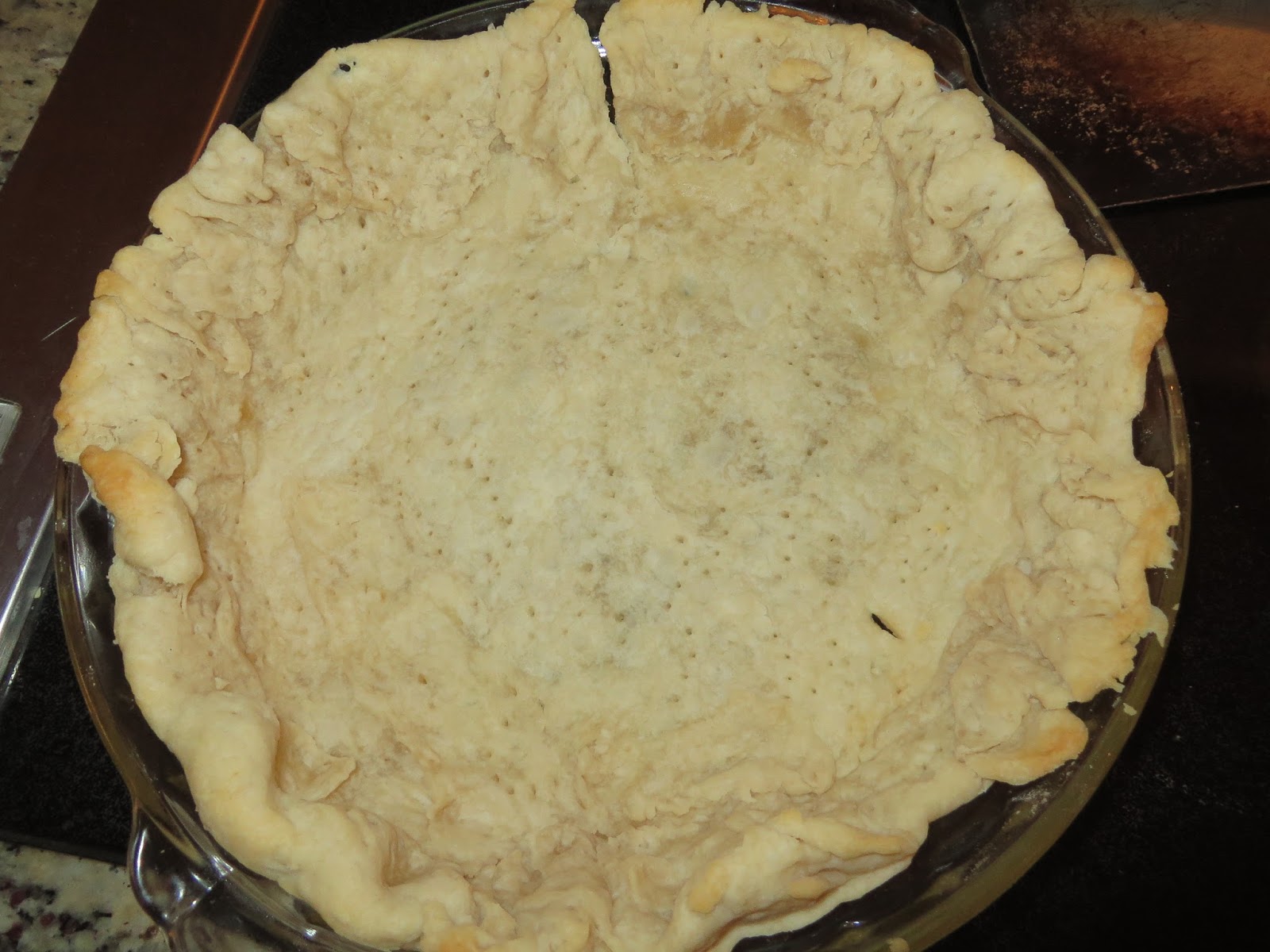
Nonnie was one of those old world grandmas who never measured. She had all her recipes in her head. Several years ago I watched my Nonnie make the pie and copied down actual measurements. She used a handful of shortening, a pinch of cinnamon, etc. I followed my own written directions.  I added more fat and more water to the crust and more fat and brown sugar to the crumbs. I let the pie crust dough chill for an hour in the fridge before rolling and then blind baked it for 15 minutes. 

(I poked holes in the crust, filled it with rice and baked). 


Put foil over the crust and filled with rice.
After blind baking my crust is lightly browned.


Smaller crush blind baked

For the Funny Cake, I made a chocolate sauce melting dark chocolate chips instead of unsweetened chocolate, which I didn't have. I made the cake flour by removing 2 T of flour and adding 2 T of cornstarch per cup of flour. I sifted that together. I creamed the shortening in an electric mixer and then sifted the dry ingredients together and then poured slowly into the shortening and mixed again. I followed the rest of the directions to make cake batter. Then I poured it into my two small PA Dutch pie tins.


I topped the pie with chocolate sauce and crushed unsalted peanuts.


 I poured more chocolate sauce on the cake before baking. My pie tins were close to overflowing!


and then more when I cut it and ate it. Oops we ate it too fast for a picture! Here's one of the cut pie/cake.


Time to Complete:  About 2 hours for the pie crust and an hour for the pie including baking time. 


The Funny Cake took about an hour.

Total Cost: Blueberries were on sale and I had to buy brown sugar but I had everything else on hand.

How Successful Was It?: 
Very. I normally don't like pie crust. It's too thick and tasteless but my homemade crust was really good. It's light and flaky. Everyone, including my uncle who stopped by, said it tasted like Nonnie's and it was delicious. I think I added too much sugar and too much nutmeg but it's still so good.

The Funny Cake was a pleasant surprise. My chocolate sauce was runny and not very chocolately. I ended up with more sauce than I needed so I poured some over the hot cake. The cake is very light and buttery. My dad thinks it could be eaten for breakfast. 

How Accurate Is It?: 100% for both.


Historical Food Fortnightly 2016 13

Historical Food Fortnightly Challenge #13

Pies


The Challenge: Pies

Make a pie! Meat, fruit, sweet or savory; traditional pies, hand pies, standing pies, or galottes - get creative, but make sure it’s documented!

This challenge fell at exactly the right time. I had some rare days off work AND it's Father's Day. I didn't even have to ask my dad what kind of pie he wanted- I already knew- his mother's famous blueberry pie with crumb topping.  My grandmother always used fresh blueberries, stocking up during a sale. She would make the topping and freeze it and used prepared pie crusts. In in the interest of making this a true challenge, I made my own pie crust. This type of pie, a crumble or a crisp, goes back to early America but I think this particular recipe comes from the 1960s. I found a similar recipe clipping at this vintage recipe blog.

I also added a bonus challenge to use my extra pie crust.

The Recipe: 


Nonnie's Best Blueberry Pie

Pie crust recipe from my Nonnie (paternal grandmother) with help from The Lily Wallace New American Cookbook c. 1947:
3 heaping cups full of flour
1 handful equal to one stick shortening
1 pinch salt
3/4 c. ice water


Mix flour, salt and shortening by hand. Slowly add ice water and combine by hand. Press into a ball and divide into two parts.


 Chill and roll out until 1/8" thick. Flour rolling pin and roll dough back onto rolling pin and into pie tin.


 Gently press dough into pie tin and prick all around with a fork. 


Topping:
2 c. flour
1 stick butter, softened
1 pinch salt 
3/4 c. sugar (mix white and brown or use dark brown)
dash cinnamon
1 pinch nutmeg
Mix with fingers and knead until crumbly


Filling:
1 1/2 qt. blueberries
3/4 sugar
1 T. butter 
1 drop lemon juice
flour (opt.)

Wash and dry blueberries and place in a large bowl. If very dry you can add 6 T. flour. Add sugar, cinnamon and nutmeg. Mix. Double tinfoil in pan so pie doesn't leak. Squeeze a drop of lemon juice on the blueberries. Put a pat of butter on top and add crumb topping. Bake at 350 degrees. Check after 15 minutes. Give it another 15 if not done. Bake until crumbs are golden brown. (You will smell it when it's done!) 

Bonus:
Pennsylvania Dutch Funny Cake
I had extra pie crust AND I have Pennsylvania Dutch mini pie pans. This recipe came from  a Swans Down recipe and advertisement from September 21, 1953. I found it on Pinterest from the blog Dying for Chocolate. See the full ad on the blog.


The Date/Year and Region: 1960s New England
Crumbles, crisps, slumps and grunts that date back to pioneer times, according to foodtimeline.org. This particular recipe, which is very similar, dates to the 1960s

Funny Cake recipe is from 1953 but it supposedly dates back a lot farther.

How Did You Make It: 
Nonnie was one of those old world grandmas who never measured. She had all her recipes in her head. Several years ago I watched my Nonnie make the pie and copied down actual measurements. She used a handful of shortening, a pinch of cinnamon, etc. I followed my own written directions.  I added more fat and more water to the crust and more fat and brown sugar to the crumbs. I let the pie crust dough chill for an hour in the fridge before rolling and then blind baked it for 15 minutes. 

(I poked holes in the crust, filled it with rice and baked). 


Put foil over the crust and filled with rice.
After blind baking my crust is lightly browned.


Smaller crush blind baked

For the Funny Cake, I made a chocolate sauce melting dark chocolate chips instead of unsweetened chocolate, which I didn't have. I made the cake flour by removing 2 T of flour and adding 2 T of cornstarch per cup of flour. I sifted that together. I creamed the shortening in an electric mixer and then sifted the dry ingredients together and then poured slowly into the shortening and mixed again. I followed the rest of the directions to make cake batter. Then I poured it into my two small PA Dutch pie tins.


I topped the pie with chocolate sauce and crushed unsalted peanuts.


 I poured more chocolate sauce on the cake before baking. My pie tins were close to overflowing!


and then more when I cut it and ate it. Oops we ate it too fast for a picture! Here's one of the cut pie/cake.


Time to Complete:  About 2 hours for the pie crust and an hour for the pie including baking time. 


The Funny Cake took about an hour.

Total Cost: Blueberries were on sale and I had to buy brown sugar but I had everything else on hand.

How Successful Was It?: 
Very. I normally don't like pie crust. It's too thick and tasteless but my homemade crust was really good. It's light and flaky. Everyone, including my uncle who stopped by, said it tasted like Nonnie's and it was delicious. I think I added too much sugar and too much nutmeg but it's still so good.

The Funny Cake was a pleasant surprise. My chocolate sauce was runny and not very chocolately. I ended up with more sauce than I needed so I poured some over the hot cake. The cake is very light and buttery. My dad thinks it could be eaten for breakfast. 

How Accurate Is It?: 100% for both.