Showing posts with label early 1900s. Show all posts

Saturday, March 25, 2017

What I Read in December 2016 Part VII . . .

What I Read in December 2016 Part VII . . .


A Most Extraordinary Pursuit (Emmaline Truelove, #1)A Most Extraordinary Pursuit by Juliana Gray--Historical Mystery

The Duke of Olympia has passed away and with him, the old century seems to have died. Miss Emmeline Rose Truelove is uncertain about what the rest of the 20th century will bring now her beloved employer has passed on. Worried about her future, Emmeline is visited by an apparition of the late Queen (Victoria), who advises Emmeline to refuse the request of the Dowager Duchess. Emmeline is quite stubborn, much like the queen, and though she knows not what the request may be, she knows she has to accept. Emmeline is shocked to learn the Dowager Duchess wants her to go after the long lost heir, Maximilian Haywood, in Crete- in the winter. She is to be accompanied by notorious rake, Lord Silverton. The voyage to find Max will bring Emmeline in close proximity with Silverton, a man who makes his intentions very clear. The Queen is not amused and neither is Emmeline. When they arrived in Greece, they discover a mystery much greater and worrisome than they ever expected. Something sinister is afoot, but what is it and why is someone evil after them?

The story is sort of a parallel of the Greek myths of the Minotaur and Theseus. It involves time traveling bandits, mythology come to life and a huge suspension of disbelief. All this colors my opinion of the book. If I had known about the supernatural elements in advance, I probably wouldn't have read this book - maybe... I REALLY can't stand time travel and I'm not a fan of supernatural stories. The intrusion of the villains into the well-ordered Edwardian lives really jarred me out of the story. The language is a real problem. Is there another way to convey modern unsavory characters without resorting to the F- word? It's not fully written out but it's vulgar just the same. As a certain Dowager Duchess said "Vulgarity is no substitute for wit." Another thing that really annoyed me was little wink winks about Titanic and Downton Abbey.

The plot was very engaging once Emmeline and Freddie, Lord Silverton, got to Greece. I had a hard time putting it down but I was able to do it. I wasn't crazy about the romance element but the main character had sizzling chemistry shown, rather than told, through banter and I did like that. The secondary romance was completely bizarre and unexpected. It eventually dawned on me that the story was going to parallel the myth but the plot did not make any sense at all. I am sure Emmeline would never believe it if she hadn't seen it with her own eyes. The villains also left more questions than answers. There are even more questions created by Max's field of study, his uniqueness and the Institute itself. I assume these questions will continue and be revealed gradually.

The romance plots themselves are clean but this book would be rated TV-14 for dialogue, language, sex and violence. Lord Silverton is a rake and women fall at his feet. He has no problems taking a woman to bed and anything he does with them is behind clothes doors except for one brief mention of nudity and a whole lot of discussion that makes Emmeline blush. Then there's the Greek myth which also tells a tale of violence and passion.

I really liked Emmeline. I could relate to her very well. Mostly no-nonsense and practical, Emmeline has had a sheltered life living among Society but is not OF Society. She's aware of her position in life and how she needs to work for a living. She isn't pretentious or social climbing. She's also a hopeless romantic. I can relate to that too. She isn't very worldly but she knows enough to not fall for a man like Silverton. However, Silverton is not quite your typical rake. He reveals his innermost feelings and wishes to Emmeline and no one else, which made me quite like him. I was sort of rooting for him to succeed in wooing her but his actions throughout the story are opposite of his words. Emmeline values what she can see and what she sees is an unrepentant rake.

The secondary characters are numerous and none of them really play a large role in most of the story except for Queen Victoria and Emmeline's father. Her father is kind and loving and wants what's best for his daughter. The main secondary characters are Mr. Higganbothom, a scholar, who has a deep interest in some mysterious photos in Emmeline's possession. He may or may not be what he seems. Then there's Max. Max is introduced very late in the story. He seems like a nice fellow, a bit absent-minded maybe, with a very big heart. I don't really understand what he does or what happens to him because this story is clearly not a stand-alone. The third main secondary character is the mysterious woman. I don't get why every man falls in love with her. I understand the rescue complex. She is not very nice and I found her insufferable.

I may have to keep reading this series so I get answers to the questions but it's not really my favorite kind of read.

Read this if you love Tasha Alexander, Deanna Raybourn and Lauren Willig

Saturday, June 4, 2016

Historical Food Fortnightly 2016 11

Historical Food Fortnightly 2016  Challenge 11:

Picnic Foods


The Challenge: Picnic Foods

 Some foods are just meant to be eaten in the outdoors! Concoct a dish that is documented for al fresco dining, or foods that might particularly lend themselves to eating at a picnic. Bonus points for putting it to the test!

Work/real life is keeping me busy.  I didn't have the time to bake anything AND it suddenly got very hot here so I didn't even feel like turning the oven on. Naturally, I turned to sandwiches! What is more iconic for a picnic than a sandwich? I made several different types from the early 1900s and though I did put them to the test, I kept forgetting to snap pictures. 

The Recipes: 

Sweet Sandwiches
Any conserve or marmalade may be used with minced nuts and spread between slices of buttered bread. Both white and entire wheat or graham bread may be used. Jellies may be mixed with cream or cottage cheese and spread between buttered crackers. Raisins and nuts moistened with grape juice white bread. Shaved maple sugar and cream entire wheat bread. The butter for spreading should always be creamed. Wrap in wax paper.

from 
Linda Hull Larned, One Hundred Picnic Suggestions, Charles Scribner's Sons, 1915 . 116

Peanut Paste for Sandwiches

from 

The Settlement Cook Book: The Way to a Man's Heart, The Settlement, Milwaukee, 1903


Strawberry Sandwiches

 Marion Harris Neil, Salads, Sandwiches and Chafing Dish Recipes, D. McKay, 1916 p.127


Date and Region: 1903-1916 United States

How did you make it: 

It was too hot and time consuming to make bread so I used commercially baked country white bread and spread it with the toppings. I also used round saltine crackers. I was too lazy to really cream the butter much but I let it sit until softened and beat it with an electric mixer until spreading consistency. 

I crushed unsalted peanuts in a ziplock bag with a rolling pin. 


Creamed butter with a pinch of salt in an electric handmixer until soft and spreadable.


 I combined the butter and peanuts into a paste, spread it on white bread, trimmed the crusts and cut into triangles. 
Peanut paste sandwich
Wrapped in wax paper for traveling.

I mixed Philadelphia light cream cheese with maple sugar and spread on white bread.
Cream cheese and maple sugar sandwich


I mixed Philadelphia light cream cheese with Bon Mamamn blackberry preserves and spread on round saltine crackers spread with butter.

Cream Cheese and Jam sandwich on saltines

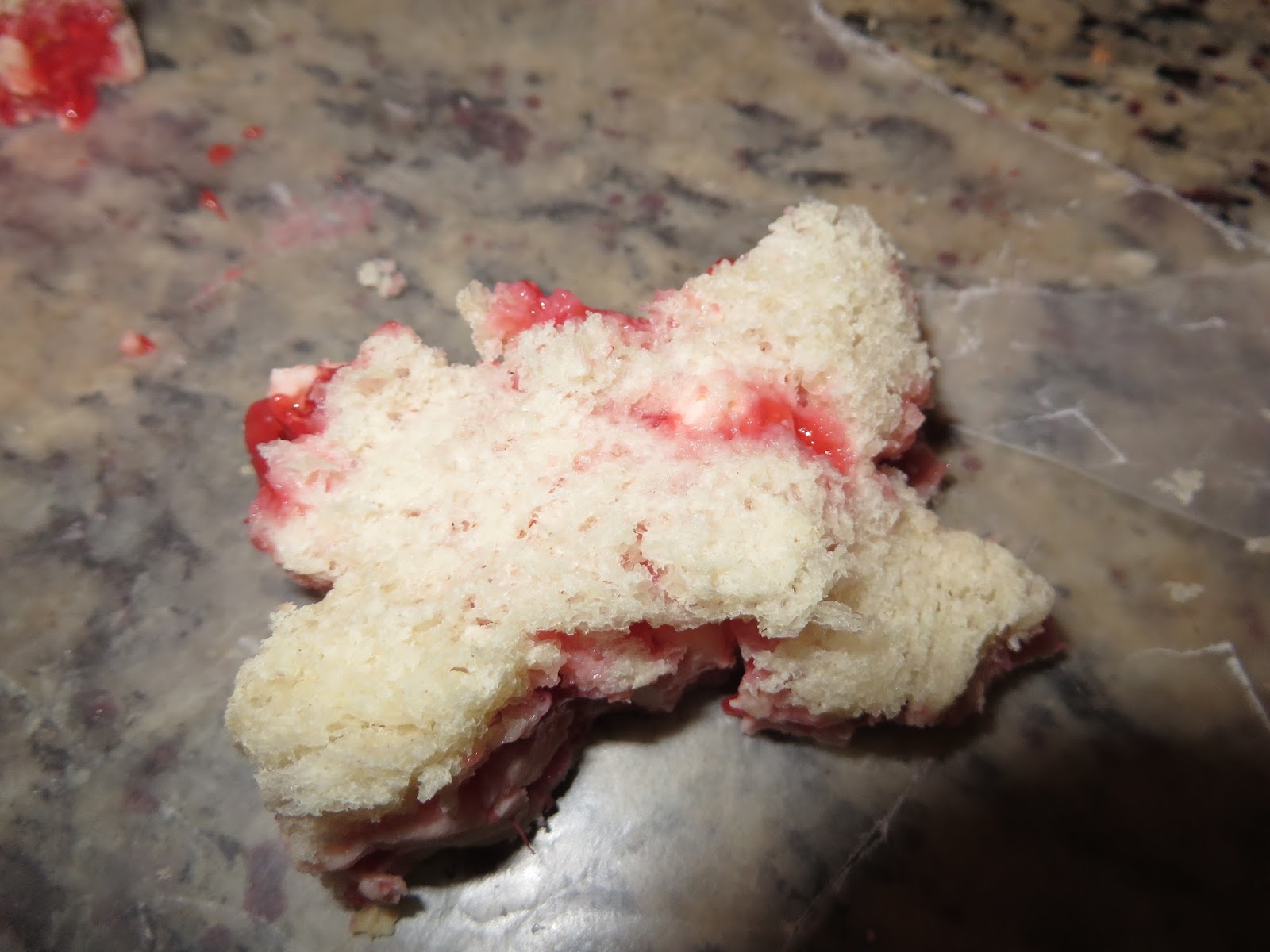
I mooshed strawberries with a potato masher and mixed with butter then chilled in the fridge. I spread on white bread and cut with a butterfly cutter.
mashed strawberries

Strawberries and butter mixture
strawberries and butter butterfly shaped sandwich

I mixed Jif peanut butter with unprocessed honey from Corsica and spread on white bread. I sprinkled on a bit of maple sugar for extra sweetness.

How Successful Was It?: The jam sandwiches are very messy and soggy. The strawberry/butter mixture was odd. It didn't spread very well and the chunks of strawberries made the sandwich thick and messy to eat.

Adding salt to the peanut paste was not a good idea. It made my sandwich a bit too salty for my preference.

The most successful was the PB and honey. I make PB and honey all the time but I never thought to mix the honey in the peanut butter. This made the sandwich extra delicious and cut down on the stuck in your mouth feeling from too much PB.


Time to Complete:  Each one takes about 15 minutes or less, not counting the time to soften butter. I made these over the course of a week and a half for lunches at work. 

Total Cost:  I had all the ingredients on hand.

How Accurate Is It?: Mostly accurate. I didn't use fresh baked bread or any homemade ingredients. I put together commercial Philadelphia cream cheese or grocery store butter with store-bought jams, jellys and peanut butter. I substituted cream cheese for cream in the maple sugar sandwich and left out the confectioner's sugar in the strawberry sandwich. I did however, use special wild honey my parents purchased in Europe to mix with the commercial peanut butter. 

Wednesday, February 3, 2016

What I Read in December 2015 Part VI

What I Read in December 2015 Part VI ...

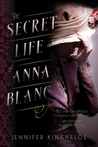
The Secret Life of Anna Blanc by Jennifer Kincheloe -- Historical Mystery/Romance 


The Secret Life of Anna Blanc Wealthy socialite Anna Blanc is tired of living under the tyrannical thumb of her father. It's 1907 in Los Angeles not Europe in the Middle Ages. She's read unsuitable books and asked her father for things to make her happy but without success. Her only recourse is to run away. Enter Louis Taylor, her soon-to-be husband, if they can make it to Las Vegas without her father finding out. The elopement is semi-successful - Anna manages a wedding but unfortunately the marriage is annulled faster than she can discover the secrets of married life. Anna resolves to try again to do all she can to escape, but under strict chaperonage, it's difficult to do. She finally manages to take a job as a police matron. The job is difficult - Anna is hardly qualified- and the men are mostly rude and crude. When she discovers a vital clue in the deaths of a number of prostitutes and urges the police to take her seriously. It seems no one cares what happens to prostitutes. The police are focused on catching the Boyle Heights Rape Fiend with Anna's assistance. Anna is put on duty under cover with her antagonist, Joe Singer, the police chief's son. In the name of police duty, Anna pretends to be his sweetheart and kisses Joe. The kiss sends her body tingling in the nether regions and makes her head spin. She never knew kissing could be so delightful. If only her new fiance would kiss her now and again. She's certain she'll learn to love him once they're married and she'll even give up police work, but she does like Joe immensely. What's the difference between liking someone immensely and loving someone? Will she have the chance to find out? If her father and fiance find out about her job and Joe, they'll lock her up and throw away the key. There's also a murderer and a rape fiend on the loose. Can she solve the crimes before her wedding?

I had mixed feelings about this book. The plot was compelling and I never guessed who the rape field or murderer was. I suspected the same thing as Anna did towards the end but the author threw in a delightful twist that turned what I/Anna thought on it's head. I thought the rape fiend plot was too much of an aside and the novel could have been trimmed a bit. There's a bit too much of dead bodies, visiting brothels and passionate kissing scenes that pad the novel. I also really wanted to know what happened to one of the villains and what the law actually was for that sort of thing. Yes it's a terrible terrible thing to do but I wonder whether that person would be hanged or get off with a jail sentence. I'm not marking this book as clean or kisses only though technically it is. There's a lot of racy dialogue, passionate kissing scenes, a rape fiend, a frank sentence describing treatment for hysteria, visits to brothels, and violence. I can nitpick a few things that weren't around yet in 1907 but the author does acknowledge this in the beginning of her book so she's forgiven. The author did an amazing job researching 1907 Los Angeles and wove the details seamlessly into the story. However, I have no frame of reference for Los Angeles and would have liked to see a map or have the story set in New York, Boston or London but that's because I've been to those cities and am familiar with the geography.

My main beef with this story is Anna! She is TSTL (too stupid to live). I cringed as I turned the pages anticipating her next madcap scheme. She's a sheltered innocent longing to break free from her gilded cage. She acts very immature for her age. Her innocence and longing for adventure don't make her a very appealing heroine. I felt like locking her up myself. I find it a bit hard to believe she could connect the dots to solve the mystery of the murdered prostitutes. I couldn't have put the clues together. I did admire her pluck and determination to solve her problems on her on. I didn't like her relationship with Joe. She strung him along and played with his emotions. He was the only central character I remotely liked but I wish more of the story had been from his point-of-view so the reader got to know him better and know what he was thinking, especially in the beginning. The rest of the male characters were so stereotypical. I find it shocking that men would be so rude and crude to women in the West as late as 1907. The West was more liberal than the East Coast in attitudes towards women. I especially hated Wolf and Snow. The only male who isn't crude is Edgar and I wondered if his refusal to kiss Anna meant something about his sexuality but that never came up. Anna longs for a Heathcliff type lover and I don't think Edgar fits the bill. He's way more like Edgar Linton.

There's a lot going on in this book and it's worth reading if you like gaslight mysteries and crime novels. Marquise and anyone who despises ditzy young heroines, you will NOT like Anna so unless you really love crime novels, skip this one.

Tuesday, February 2, 2016

What I Read in December 2015 Part V

What I Read in December 2015 Part V ...

Rachel's Secret (Rachel Trilogy #1) by Shelly Sanders --Young Adult Historical fiction


Rachel's Secret (The Rachel Trilogy #1) For Rachel, the village of Kishinev in Russia is not big enough to hold her dreams. While her friends are thinking of romance and marriage, she's more interested in reading and writing. Now Rachel's friend Mikhail is also thinking of romance - with her! She likes Mikhail as a friend but not as a lover and besides, Jews and gentiles can't be together. When Rachel witnesses Mikhail's murder, she believes it was all her fault because someone saw him kiss her. She keeps her secret to herself. Mikhail's friend Sergei wants to get to know Rachel better but he always acts like an idiot whenever she's around. As Mikhail's murder kicks off a wave of anti-Semitic fights, Sergei takes a stand to fight injustice. When something terrible happens, he feels powerless, a feeling Rachel also feels trapped in the middle of it all. After an unspeakable tragedy, Rachel knows the time for telling her secret has finally come. Will anyone believe her, a girl and a Jew? Sergei does and he will fight for her and for justice all he can.

I started this ages ago and put it down. I felt the writing style was too juvenile for the subject matter, the motive for murder was completely stupid and the author let the reader see the murder so who did it and why is never a mystery. After reading the final volume in the trilogy, I was curious enough to return to this book. I found myself interested in Sergei. There's not a lot of plot involving Rachel until the middle of the book. I was surprised the big event happened in the middle and not at the end. The rest was resolution. I found the tragic event absolutely terrible. I have heard about pogroms but I had never actually read one as it happened before. It was completely awful. The writing style is young enough for middle grades but the violence bumps it to young adult level. I especially liked the aftermath and learning how everyone coped and what happened to the various characters.

I didn't really connect with Rachel in this story. She's just beginning to dream of her future but I can identify with the longing to leave her small town and explore the wider world. I also identified with Sergei and his hot temper and fight for justice. I didn't buy the budding romance at all though. Sergei is wrong for Rachel, religion not withstanding. He's too hot tempered and quick to shoot his mouth off. She's a writer and knows to choose her words carefully. There's no real romance in this story, just a quick kiss.


Rachel's Hope (Rachel Trilogy #3) by Shelly Sanders --Young Adult Historical fiction

Rachel's Hope Rachel and her family have finally made it to San Francisco after escaping Russia and staying in Shanghai. Rachel is excited to be in America where she can pursue her dream of becoming a writer. She discovers that life in America is easier for Jews in some ways but more difficult in others. They must work hard and barely seem to get ahead but things begin to look up when Rachel meets Anna, a modern, feminist Jewish-American writer who helps Rachel learn to read and write better in English in exchange for Russian lessons. Anna is going to Russia to cover the plight of the people for American papers and she promises to look up Rachel's friend Sergei. Then the San Francisco earthquake and fire threaten everything Rachel and her family have worked towards. Will she ever get to University and become a writer? Sergei meanwhile has become involved with Russian politics and the socialist workers party. He's friends with Maxim Gorky, the great writer and Revolutionary and the Czar promises liberal reforms. Sergei and his friends know that nothing much has changed and if they don't do something about it, nothing will ever change. His life will never be the same again but hope of seeing Rachel again keeps him going.

The plot of this story was very compelling. I stayed up very very late reading the book to see what would happen. I skimmed a lot of Sergei's sections because I know a bit about what happened in Russia at that time and how it led to the 1917 Revolution and frankly, anarchists and communists don't interest me much. I learned a lot about Jews in San Francisco and I especially liked Rachel's article on the pressures of assimilation. I know a lot about Jews in New York but not much about San Franscisco so I enjoyed the different setting. There is way too much going on in this story though. It could have been split into two or three other books. Sergei's story is a book in and of itself. If the author had based Anna on a real person instead of making her an actual real person, she would also deserve her own novel.

I really identified with Rachel very strongly. I'm not Jewish and I never experienced anything like she did but I do understand her desire and focus on education and her dream of becoming a writer. I also identified strongly with her fears and her feelings of failure. She's a very honest and sympathetic heroine. My favorite character was Anna. She sounds like my kind of woman and I have a new hero. All the other characters were very well done and memorable. Rachel's sister is a bit of a stereotype as far as sister character goes and Menaham/Marty was also a bit cookie cutter for a young boy but he had some depth to him that made him a little different from the usual little brother character. Rachel's brother-in-law Jacob and her friend Alexander round out the characters as men who embrace all America has to offer but still keep their faith in their hearts. They're drawn to strong women who know what they want and go after it. I'm not sure how realistic that is for 1907 but I liked them.

If you're looking for a book for a girl in her early-mid teens with strong female characters, this fits the bill.


What I Read in November 2015 Part VI

What I Read in November 2015 Part VI ...

The Hired Girl by Laura Amy Schlitz-- Young Adult Historical Fiction

The Hired Girl Joan Skaggs is tired of being a drudge on her father's farm. She dreams of becoming uplifted and enlightened to become a teacher like her idol, Miss Chandler. It was Miss Chandler who first introduced Joan to books. Joan owns three books: Jane Eyre, Dombey and Son and Ivanhoe. She's read them all many times and longs for more. Her beloved mother understood but her mother is dead, leaving Joan's father and brothers to make a slave of her. When the situation at home becomes intolerable, Joan finally takes a stand. When the stand-off threatens to destroy her dreams, Joan takes off. She finds herself in Baltimore living under a new identity as a hired girl, Janet Lovelace. As a hired girl she can make as much as $6 a week for doing the same or fewer chores she had on the farm. Throughout the course of a year from 1911-1912 Joan writes in her diary of all she experiences and feels, of all her hopes and dreams for her future and how they are and aren't coming true.

This book is for fans of Anne of Green Gables, Daddy-Long-Legs and Jane Eyre. It's very long for a YA historical fiction book - almost 400 pages - but the pace moves quickly enough to be interesting and move the plot along. The first section is a little long before it comes to the exciting part and there's a whole lot about religion, but the religious content is woven into the plot as part of the characters and how they relate to one another and the world around them. There's a message there but it's not heavy handed. A little quibble about Janet's religious instruction. She would have to be baptized before she was confirmed and took her first communion. I'm not sure how that worked in 1911. I did like the details about Mass being in Latin and the priest's back to the congregation. I don't know how many young readers would know that unless their grandparents told them or their teachers tell them. The details about work in 1911 are also very rich and descriptive. Even with modern labor-saving devices, being a hired girl was still a lot of work. The ending of the novel reminded me a lot of Daddy Long-Legs, again probably on purpose.

Joan/Janet is very silly but in a charming, naive way. She writes like Anne Shirley talks- probably on purpose on the part of the author. I didn't see much growth until the last third of the book but it was there earlier, just too subtle to really realize. I found Joan/Janet very likable and could relate to her dream world. I think all teenage girls will be able to relate to her in many respects. Her family is completely horrible and a bit on the stereotypical side but Father acts as a catalyst for the action. I liked how her romance played out. It was very realistic.

The Rosenbachs are very progressive for their day - maybe a little too much to be completely accurate but they're so progressive they appear modern. They do have their prejudices regarding class, religion and ethnicity. They are a loving family and the parents just want their children to be happy. Their faith is important to them and an integral part of their lives but I felt that it was maybe a little too much for German Jews at that time. Mimi is annoying but I liked her for the most part. I agree with Janet's feelings about her and it's too bad Mimi hates reading because she's so much like Amy March! Maybe by the time she finishes Little Women she'll figure that out.

I highly recommend this book to readers 12+, especially those who love Anne of Green Gables and Daddy-Long-Legs.


What I Read in October 2015 Part III

What I Read in October 2015 Part III ...

A Love Affair For LizzieLove Affair for Lizzie by Mona K. Gedney-- RegencyHistorical Romance

Lizzie Lancaster has always had an understanding with her childhood friend Matthew Webster. The two formally pledged their love when Lizzie was 16 and promised to marry. Then Matthew went off to fight Napoleon while Lizzie stayed home. Lizzie has no desire to leave her home or her family and she faithfully waits for Matthew to return to her. When he writes breaking off their engagement in favor of a more worldly lady, Lizzie is heartbroken. She then cooks up a scheme to show him exactly how worldly she can be. She enlists the aid of a neighbor, Lady Thalia, to take Lizzie to Vienna where she can be reunited with Matthew and convince him to marry her. Along the way to Vienna they meet Mr. Daniel Thoreau, an American traveling in Europe and Mr. Mansfield, a well-connected young man headed to Vienna for the social life. Mr. Thoreau helps Lizzie learn to enjoy her adventure and joins her in her plan to make Matthew realize just what he's missing.

This story was OK. I didn't love it, I didn't hate it. It's not what I would call a love story, let alone a romance. Lizzie doesn't even encounter Matthew until almost halfway through the book. Almost the whole story is told from Lizzie's POV with some from Mr. Thoreau and none at all from Matthew. The plot moves along very slowly and comes to a quick resolution. I found the ending a bit too sudden for my enjoyment. The Epilogue didn't really add to the story. I really enjoyed the descriptions of Paris and Vienna and the social life Lizzie experiences. She does things that I haven't read about in any other novel that I found incredibly interesting and charming.

The characters in this novel consist of Lizzie, a strong-minded young lady who is determined to win over the love of her life. I liked her and wanted her to be happy but I wasn't rooting for her to find happiness with Matthew. He was a real idiot and a complete jerk to her. He fell for a flirtatious *itch which made me automatically not like him, then he treated Lizzie abominably. I hated his behavior and though he was correct, he had no right to scold Lizzie about her behavior. That is Lady Thalia's job! I preferred Mr. Thoreau to Matthew. Daniel is kind, considerate, thoughtful and intelligent. Plus, he's American! He helps guide Lizzie and helps her become an adult with a purely unselfish motive. I thought he was a much better catch than Matthew! I wanted to like Lady Thalia for being a man-hating spinster but I found her irritating. I hated how she always talked in italics and selfish she was. She couldn't be bothered to hang out with Lizzie and chaperon the girl when she didn't feel like it. Mr. Mansfield is hardly in the novel and I wondered what his purpose was. He advances the plot on occasion. The final character to note is George Andronikos. Like Lizzie I found him charming and delightful. He isn't husband material but he's a fun escort and I wanted to know a little more about his activities.

I found this book for 50 cents at the library book sale. I wouldn't rush out and try to find it but if you can get it for free, it's not a terrible read.


Chasing SecretsChasing Secrets by Gennifer Choldenko-- Young Adult Historical Fiction

Thirteen-year old Lizzie Kennedy doesn't fit in. It's 1900 and girls are not expected to like science or want to be doctors but medicine is Lizzie's passion and she dreams of being a doctor like her father one day. She loves accompanying her father on house calls and the feeling she gets from helping people. Her Aunt Hortense dismisses Lizzie's passion and everyone expects Lizzie to want to get married. As a result of her unusual interest and her older brother Billy's new interest in fighting, Lizzie is alone. Her only friend, if you can call him that, is Jing, the family's Chinese cook. When Jing goes missing, Lizzie fears the worst. She finds an unexpected friend in Jing's son Noah, who must be kept a secret. Noah fears Jing stuck in quarantine in Chinatown where rumors of the plague abound. "The plague in San Francisco? Don't be absurd!" claim all the doctors but Lizzie isn't so sure. She knows one thing though - she has to get Jing out of there and back home where he belongs. When tensions between white Americans and the Chinese population of San Francisco grow stronger, Lizzie must summon all her courage and knowledge to help keep those she loves from harm.

This book doesn't quite live up to the promise of a "heart-stopping race." The action takes too long to get going and starts and stops too often to be really compelling. The plot fell flat for me and I didn't feel moved by the tragedy. I find Gennifer Choldenko's Al Capone books a little more compelling. The subject is new to me though. I had no idea there was plague in the 20th century United States or that there was a vaccine against it! The history behind the plot was more interesting than the plot. The author's note had some interesting facts and seemed geared towards teachers and parents.

The characters are good but not all that memorable. Lizzie is a likable, spunky teenage girl who thinks and acts in a very modern way. I liked her a lot though. I felt bad for her for being constrained by her gender and because she was so lonely. I thought some of her actions were totally crazy and I would never be that brave. I liked how she tried to make friends but still be herself. That's an important lesson that often gets lost in teenage novels. At first I wasn't crazy about Noah. I thought he was rather rude and a bit too cocky but he grew on me as Lizzie got to know him better. I wished he would have told Lizzie a little more about his life but the facts he revealed are interesting. He's smart, loyal and loving and that makes him a good friend for Lizzie. Gus, Lizzie's potential love interest, also shares the same qualities as Noah and is also brave. He's quiet but an important part of Lizzie's life so far. I really liked him. Gus's sister Gemma is crazy in a fun way. I'm not sure I'd like to be friends with her because trying to keep up with her would be exhausting! Most importantly to Lizzie is Jing. He's father, mother, friend and cook to Lizzie. She loves him and he seems to care for her yet still part of him is closed off to her because he's Chinese and a servant. Like Lizzie, I'd like to know more about him. Orange Tom, the cat, is another major character in the book. Lizzie discovers she can use him as a messenger but he's a working cat and doesn't like to be held. I wished he did for Lizzie's sake for she really needed the unconditional love of a pet.

The minor characters in this novel include Lizzie's Papa, Dr. Kennedy. He seems indulgent towards Lizzie but I am not positive he takes her seriously. He's a great doctor given the limited medical knowledge even in 1900. He's very honorable. Then there's Aunt Hortense, who has hidden depths that are hinted at but not quite revealed. I expect she is much more like Lizzie than Lizzie realizes. There's also Aunt Hortense's husband, Uncle Karl, a newspaper man who strives to tell the truth. I take it Uncle Karl is based on Joseph Pulitzer since his biggest rival is William Randolph Hearst. Uncle Karl comes across as largely two-dimensional and a man of his time but with a bit more honesty and integrity than many other men. Lizzie's big brother Billy plays an important role in her life. She always looked up to him and now he's moved on from being her pal and trying to become his own person. His struggles were tough to read about and I wish he and his father could have had a heart to heart talk. Finally, there's Maggy Doyle, the maid. She is a little bit slow but sweet and a good worker. I liked her very much.

I would recommend this novel to those who like a quick read and like to learn something new while having fun reading.

Friday, January 29, 2016

What I Read in September 2015 Part V

What I Read in September 2015 Part V ...

Celia's House by D.E. Stevenson-- Historical Fiction/Historical Romance/Austenesque 

Celia's House
Celia Dunne has lived 90 years at Dunnian. She was born the day after Waterloo and has lived into the new century. Now she's elderly and dying and knows she has to leave her beloved Dunnian. There have always been Dunnes at Dunnian, even before their house was built. Her nephew, Maurice, and his wife Nina are dying to get their hands on Dunnian to make "improvements," but Celia has other plans. She summons her great-nephew Humphrey, on leave from the Navy and determines he loves Dunnian as much as she does. It will be a good place for his children to grow up, she thinks and she will leave the house to his daughter Celia. The catch - Celia isn't born yet and the house has to stay in the Dunne family. Should Celia marry, her husband must take her name. Humphrey's wife Alice and their three children: Mark, Edith and Joyce, settle into life at Dunnian. Once Mark becomes acquainted with the woods, the streams and the old Peale, he becomes enchanted with Dunnian. When his distant cousin Deb comes to live with them, she shares his quiet enthusiasm for their beloved old home. Years come and go, two more children are born at Dunnian and Mark learns the truth about the inheritance. He promises to work hard and make a living for himself if he can be near Dunnian. One by one the siblings begin to leave the nest and old neighbors are now grown. This includes the beautiful, lively Tessa and her charming brother Oliver, who come to visit their grandmother in the summer. Summer casts it's spell and soon the plot turns into Mansfield Park. If you haven't read the original - go do that now before you read this book.

The story has too much exposition at the beginning and very little plot. About halfway through the story turns into Mansfield Park - light. It's close enough to be a pale imitator rather than an homage. The plot pretty much follows Mansfield Park from the scheme of getting up the play to the end - leaving out all the extraneous bits that don't fit the 1920s plotline and leaving out nasty Mrs. Norris. There's a lot at the end - a few chapters of epilogue. The writing is decent but there's a lot of telling. The very best writing is reserved for the last chapter. I was very interested in that final chapter and it ends so abruptly! I can imagine what happens though. This book isn't what I would call a romance. It's more about the house than the people and the romance is only a third of the story. It follows Mansfield Park pretty closely but there are some changes which I really liked. This story lacks the satire and humor of Miss Buncle's Book but it's not that kind of story. The first half and the end reminded me a lot of a Lucy Maud Montgomery story. It's a story of place more than people.

The characters aren't all that memorable. I wasn't crazy about Humphrey and his feelings that Dunnian should be entailed on Mark. He was away a lot and I kept having to remind myself that the story begins in 1905 and he is a man of his time. I'm not sure what was up with Alice but she's better than Lady Bertram. She's kind and loving but a little vague and physically weak at times. She wants Deb to stay with her because she truly loves Deb and requires Deb's help, unlike Lady Bertram and Mrs. Norris who treat Fanny as an unpaid servant. Deb is very much a member of the family. Mark frequently refers to her as "my favorite sister." She's sweet and kind but not as insipid as Fanny. She has good heart, she nurses her secret love for years but she also has a lively, loving grandmother who gives her good advice. I liked the way Deb handled her situation very much. I liked Mark a lot too, for the most part. He's smart, works hard, loves his family and the old home. I can relate. He, like most men, like Edmund Bertram, is dazzled by a pretty face and sparkling personality. I liked Tessa too, at first, until she grew into a spoiled minx who would stop at nothing to achieve her ends. Then I loathed her. Her brother Oliver is too slick for my tastes. He's not as bad as Henry Crawford but he is indulged and used to getting his own way.

The minor characters include the other children. Edith and Joyce are Maria and Julia Bertram without the influence of Mrs. Norris. Edith is a spoiled beauty and I didn't care for her much. I didn't feel bad for her at all. Joyce is hardly in the book but her character transformation is told rather than shown and I was happy to read it. The younger children are charming. I like their adventures very much and thought they should have been in the story more. I also really liked the servants who are as devoted to Dunnian as the family. They're more like family than hired help. I wished they appeared more often.


Listening ValleyListening Valley by D.E. Stevenson-- Historical Fiction/Historical Romance

Lou and Antonia Melville live in an ordinary house in the city. They spend their days in the nursery with Nannie except for a daily walk. During those walks the girls spy a walled garden they long to see inside. One day while Nannie is out, the two sisters take off on an adventure that will change their lives. Lou, always bold and daring, marches right up to the mysterious house and rings the bell. A kind lady answers and brings them in for tea. They have the most marvelous time eating eclairs and listening to the lady's son Jack teasing. All too soon it's time to return home and the adventure ends - or so they think. Years later, the girls are grown and Lou dares to make her boldest move yet. Poor Tonia is left alone without her sister, without Nannie or anyone to love her or help her. Her hands are clumsy; she can never do anything right; her parents bicker and Tonia is miserable. All she has is her listening place where she can go in her head and dream and listen to the music there. Enter Mr. Robert Norman who is willing to take Tonia under his wing to teach her about life and give her a sense of self-worth, if only she'll let him. Set against the backdrop of the years between the wars and World War II, this novel is a companion to Celia's House. Part I only mentions the Dunnes in passing, but part 2 takes place in the Scottish countryside near Dunnian and serves as a prequel and sequel to Celia's House.

This book is a light, easy read. It reminded me a lot of Lucy Maud Montgomery's later stories and novels, especially The Blue Castle. The writing is more sophisticated than today's "chick lit" but very accessible. The plot is a little slow at first. There's a lot of exposition and a lot of telling what happened. Then in Part II the action picks up a bit and becomes more interesting. I especially liked/but didn't like the bits about flying. They were boring but yet interesting because my grandfather was in the U.S. Army Air Corps during the war stationed in England and flying liberators over Europe. I can't see him participating in the easy camaraderie the characters in this novel do. My library copy is missing the final page. The ending seems very abrupt and unsatisfactory. Thanks to some Good Reads friends for sharing the beautiful ending. This author has a way with words and her descriptions are really lovely. I fell in love with the country more than I did in Celia's House. I loved the connection to the Dunnes and learning more about both Celia's, my favorite characters who didn't get enough page time in Celia's House. The romances rely a little too much on coincidence to be realistic but I enjoyed them anyway. I found a certain mystery element to be entirely obvious and can't believe the characters wouldn't have figured it out.

The characters in this book are great. I liked and identified with both Lou and Tonia. Like Lou, I'm the big sister and I tend to take charge. I am also like Tonia - shy and going away to a place in my head where I can dream of more pleasant things. This is Tonia's story - her coming of age and coming into her own. I loved her character development. Her sweetness and sympathetic nature appealed to me and annoyed me at times. I wish she wasn't such a push over sometimes. Lou probably wouldn't have let people walk all over her and would have figured out what was what quickly.

Daisy is lovely. She's so warm-hearted and the type of person anyone except the stuffy Victorian-minded Melvilles would want t be friends with. Her son Jack likes to tease and I don't really care for that. He's not in the story long enough to be developed well. I especially liked the Smilies. As their name implies, they're very happy, caring people who open their hearts to Tonia and serve as the parents she didn't have. The young officers are pretty much all alike. I can't remember which was which except for Bay. Bay's character development is interesting. If I say more, I risk spoiling the plot.

I highly recommend this novel to those who enjoy quiet, kind sorts of novels. It's the perfect bedtime read or should be read with a cup of tea on a rainy day.

Thursday, January 28, 2016

What I Read in August 2015 Part VI

What I Read in August 2015 Part VI ...


Al Capone Does My Homework
Al Capone Does My Homework by Gennifer Choldenko-- Middle Grades Historical Fiction

January 1936: Moose's dad has been promoted to Associate Warden - ahead of Darby Trixel. Darby was sure he'd get that promotion and he is super mad. Moose knows he has to look out for his dad and protect him against Trixel and the cons, but how can he do that and be a normal kid? He also has to look after Natalie, who is home on vacation. Natalie is supposed to be working on eye contact and she stubbornly refuses to do it. Moose is frustrated by his sister's "funny business" but he's quick to defend her when their apartment burns and fingers point to Natalie as the arsonist. Moose knows his sister didn't do it but a niggling thought in the back of his mind fears she DID do it and they'll all get kicked off the island and Natalie won't be allowed back at school. On top of all this, there's a mysterious note in Al Capone's handwriting on Moose's essay and Annie is turning from "one of the boys gal pal" into a beautiful young woman. He's sort of Piper's boyfriend, or is he? What's she up to anyway acting so unusual? Moose has a lot on his shoulders!

The plot of this story was a little less compelling than the previous two. I figured out the mystery pretty much right away. I thought it was mentioned in the beginning and I connected the dots. There are some surprises in the plot though.I was a little surprised by the final reveal. I was frustrated by the attempts to force Natalie to make eye contact and act out of her comfort zone. I know this is hard work. The Mrs. Kelly reveals the reason why and it made sense. This story focuses less on Natalie and more on Moose, Annie, Jimmy and Piper. Theresa appears for comic relief and Natalie does play a larger role as the story goes on.

I liked Moose a little better in this book now he's stopped mooning over Piper. His worries are valid this time though I still wish he would confide in an adult. He always feels better once he does! The Al Capone business is very minor in this one compared to the previous two books. It doesn't really make a lot of sense until Moose suddenly figures it out. His growing feelings for Annie develop very slowly and the romance is very sweet and almost non-existent.

Piper is less annoying but she does something stupid she should have known not to do. I didn't really feel that bad for her. Jimmy's new scientific study is on cockroaches. It's pretty gross but funny and ingenious.

The Trixels are the most awful people. Their actions go from bad to worse in this novel. I just hate them. The villain I didn't like them from the first and suspected that everything was connected. Moose had a niggling suspicion too but wanted to like this person and with everything else he was going through, just didn't figure it out. This character is the only new character central to the story. Annie's dad and Theresa and Jimmy's dad make cameo appearances and there are some new cons but we don't get to know them too well.

I like the reader for this book. He doesn't sound 13 but he pitches his voice differently for each character and makes me believe he's a woman, a girl and a 13 year old boy.


The Curious World of Calpurnia Tate (Calpurnia Tate, #2)The Curious World of Calpurnia Tate by Jacqueline Kelly-- Middle Grades Historical Fiction

Callie Vee, the endearing heroine from The Evolution of Calpurnia Tate is back. It's spring 1900 and Callie Vee has high hopes for the new year and new century. She continues her scientific studies but it isn't always easy with her younger brother Travis tagging along. Travis loves nature too, but his love comes in the form of obsession with animals. He's searching for the perfect pet and Callie knows that Travis's idea of a perfect pet may get him in trouble and she can't let that happen. After a devastating tragedy, Callie's cousin Aggie comes to stay and Callie has high hopes Aggie will be the older sister she never had. Along with Aggie, the tragedy introduces Callie Vee to someone new who will influence her future life plans. Her parents of course, have other ideas.

I didn't quite enjoy this story as much as the first. The primary reason being Callie's scientific studies have progressed to dissection. Being more like Travis, I'm a real animal lover and squeamish about blood and guts. I did enjoy the science project ideas and if this book had been around when I was a kid, I may have been a bit more enthusiastic about science. I also enjoyed the history of scientific study and how the processes we take for granted were quite new in 1900. There's also a great description of the largest natural disaster in U.S. history. Young readers may make the connection to a certain natural disaster that occurred 10 years ago. The story features less of Grandpa and Callie and Grandpa's relationship, which is what made the first book so special.

Callie is as spunky as ever. Her vocabulary is growing bigger and she narrates her story in a scientific manner. She does occasionally act like a normal 12 year old girl which is funny and makes her sympathetic. She faces challenges as a girl and as a girl who wants to be a scientist. I think girls interested in STEM will relate but at least no one expects a girl today to limit her expectations to marriage. I really felt for Callie. It was tough to be her in this story and I would love to see her succeed some day.

The story is largely about Travis. Travis is a sweet, warm-hearted boy whose heart is bigger than his common sense. I both loved and cringed at his numerous adopted pets. As an adult I know better. As a child I probably wouldn't have crossed my parents but it wouldn't have stopped me from wanting to try. His adventures are sweet and funny.

Aggie is one of two new characters introduced in this story. I was hoping she would be an unexpected ally for Callie. Callie learns a few things from her cousin but largely I found Aggie predictable and stereotypical. Callie is a more interesting character. Dr. Pritzker, a veterinarian, is the second new character in the novel. At first he isn't any different from any other man of his day but as he comes to know Callie and her grandfather, he becomes more interesting. I found the scenes with his actually practicing veterinary medicine a bit too graphic.

Fans of the first book will enjoy this one too and if you haven't read the first one, this works OK as a stand-alone.

Tuesday, January 26, 2016

What I Read in June 2015 Part IX

What I Read in June 2015 Part IX ...

Audacity by Melanie Crowder  --Young adult historical Fiction
Audacity
A novel in verse about Clara Lemlich, a young female labor leader who organized the female garment workers' union and helped coordinate the history strike of 1909. The story begins with her childhood in Russia and her undying thirst for knowledge. Clara dreams of being a doctor but only boys study books in the shetl and her father protests against antisemitism by not allowing Russian language in the home. Clara protests by teaching songs and trading small favors with friends from the village to get access to books. Following a devastating pogrom in a nearby village, the family immigrates to New York where young Clara finds work in the garment factories, learns English and moves ever closer to her dream of becoming a doctor. Her family disapproves of her actions but the fire burning inside her won't be stopped and when she's blacklisted for speaking out against unfair working conditions, her fire burns even stronger.

The plot is very slow moving at first, but then gets better once the family gets to New York. I as more interested in how Clara came to be form the union and her work with the strike. The story disappointingly ends before the Triangle Shirtwaist factory fire. It really needed that to show just how important Clara's work was and how the fire changed workplace rules. The blank verse poetry isn't really my thing but some of the unusual forms are nice. The author's note and interview with family members are far more interesting.


A School for Unusual Girls (Stranje House, #1)
A
 School for Unusual Girls (Stranje House #1) by Kathleen Baldwin--Young Adult Historical Fantasy/Paranormal Regency Romance


Georgiana Fitzwilliam's parents are banishing her to Miss Stranje's school for unusual girls all for the little matter of burning her father's stables and half the neighbor's orchard. Georgie resists the banishment, arguing she was only trying to find a formula for invisible ink in hopes of saving the lives of soldiers. It's too late to save her older brother Robbie but if she can prevent more families from experiencing that pain, she will. Unfortunately for Georgie, the fire was the latest in a long list of unusual accomplishments and her parents are only too glad to be rid of her. Georgie is terrified of Miss Stranje and her torture chamber of horrors. Attempting to run away brings her face to face with the bold and teasing Sebastian, Lord Wyatt who makes her blood boil in more ways than one. Soon Georgie discovers all is not what it seems and she must trust in her own abilities and work with Sebastian or the world will be plunged into chaos in Napoleon's wake.

This book is sort of a fantasy/speculative hybrid. It's an alternate world where one split second decision can change the course of world history. It's not so much a gothic fantasy as it sounds but there are fantasy elements. That's really my only big complaint about the novel is that there's not enough explanation. Who is Miss Stranje? What exactly is her school and who are the other girls? There's very little characterization of the secondary characters - they'll get their own books, but there should have been more. What are Tess' nightmares and why are they taken for fact? What is her unusual affinity for animals? Why does Maya blend in and what is so special about her voice? Is it paranormal or just something natural? That isn't explained. The exposition goes on a bit too long. I knew there had to be a villain working for Napoleon because there always is. That person appears a little late in the story and the showdown comes much later than it should have. Too much time is spend on Georgie's experiments. I don't have a scientific brain so maybe it was just that all that was lost on me. The romantic plot/s were typical of the YA genre. I believe the author must love Anne of Green Gables because Georgie has red hair and a bit of a temper and Sebastian likes to tease and flirt much like Gilbert. Yes the romance is rather unbelievable but it's common for YA stories and I liked it though I was MORE interested in the adult romance - what's the story there?!

Georgie is a prickly character, a lot like Triss in Tamora Pierce's Circle of Magic series. Red hair + hot temper + brains = prickly heroine. I don't mind because I can relate to that sort of heroine better than one like Lady Jane or Myra who are very nice. Georgie has a lot of weight carried on her shoulders and she likes to wallow in self pity but I see a young woman in a time of great change coming into her own and learning how to value her own abilities and how to trust others to help her make decisions. She's certainly very intelligent, which I value highly. Sebastian is brooding one minute and teasing the next. He's a typical selfless YA hero who wants to fall on his sword instead of falling in love. He's a curious character with a tough backstory that's shaped him. He wants to be noble but he's only human and can't help his feelings. I love that he is not the hero of the story.

My favorite secondary character is Tess. She's also prickly like Georgie but tough. She's used to being rejected and it hurts but she's comfortable in her own skin. She has some mysterious stuff going on and a seriously intense love/hate relationship. Her sparring partner is also a favorite character but he's not a likeable one. He's actually a jerk to Tess and awkward around women. I'm sure he will get more backstory in the next book because I found him intriguing for his faults. Miss Stranje is strange indeed and if I knew more about her, I would really like her. I like what I know about her anyway and commend her for what she does. The villain is a little cardboard. The villain has a backstory but I wanted a bit more to add more depth to their plot. This isn't a book where you guess who the villain is going to be. The characters know from the outset but there's not much to go on except a few facts.

This is a fun book for YA fans and Georgie's exposition plot shows newcomers to the Regency era what a young lady should and should not be like. There's a sneak peak of the next book and I want to read it NOW!

Monday, February 9, 2015

Historical Food Fortnightly #18

Historical Food Fortnightly Challenge #18: 

"Descriptive Foods"


The Challenge: Descriptive Foods


The Recipe: Snippy Doodle Cake
SNIPPY DOODLE CAKE 
One cup granulated sugar, one cup flour, one half cup milk, two eggs beaten light, one tablespoonful butter, one tablespoonful cinnamon, one and one half teaspoonfuls baking powder. Cream butter and sugar add eggs beaten all together and light then the flour and milk stirring briskly. Mix cinnamon and baking powder together with the flour. Bake in a sheet and sprinkle granulated sugar on top when nearly done 
Elizabeth Lohman Gibraltar Island Ohio 


The Book of Priceless Recipes, George F. Lasher, printer, 1907  p. 125

I think this is a misprint or a corruption of Snickerdoodle. I found the recipe in the same cookbook as the Moravian Sugar Cake and it also contains a recipe for German Sand Tarts (Christmas cookies) which my Pennsylvania grandmother always made for Christmastime. I infer from all those German recipes and the fact that the book was published in Philadelphia, that Snickerdoodle might be a Pennsylvania Dutch cookie. The Food Timeline has various theories ranging from ancient European to Dutch to colonial New England and my personal theory, German/Pennsylvania Dutch. According to Wikipedia: The Joy of Cooking claims that snickerdoodles are probably German in origin, and that the name is a corruption of the German word Schneckennudel ("snail noodles"), a kind of pastry.[1] It is also possible that the name is simply a nonsense word with no particular meaning, originating from a New England tradition of whimsical cookie names.[2][3] "Snicker" may be a word of German origin and derived from the word "schnecken", i.e. sticky buns."
---Craig Claiborne's The New York Times Food Encyclopedia, Craig Claiborne [Times Books:New York] 1985 (p. 412) 

Snickerdoodle cookies first appeared in American cookbooks in the early 20th century. The modern type of Snickerdoodle does not contain nuts or fruit and this recipe apparently dates to 1958. Where Snippy came from, I don't know but it could be a typo. I just liked the name. 

How Did You Make It:

I followed the recipe. It didn't make enough to cover a baking sheet so I whipped up a double batch and baked it in muffin/cupcake tins. That made 2 1/2 dozen large cupcake/muffins.


Time to Complete: The key it to let the butter warm up so it creams with the sugar. That took awhile the first time as the house was cold. The second time I made sure to warm the butter first. The total time would probably be about 40 minutes or so.

Total Cost:
I don't know. We had all the ingredients on hand. There are very few ingredients. I imagine the cinnamon would be expensive if one used real cinnamon. I used grocery store brand.


How Successful Was It?:
100%. It felt like cheating this was so easy and soooo delicious! My dad and I almost ate the whole pan all at once. (Picture us going yuuummm soooo goood... break off another piece and repeat)

How Accurate Is It?: 
100% except I used store brand cheap cinnamon and not real Ceylon cinnamon.